<?xml version="1.0" encoding="utf-8"?><?xml-stylesheet type="text/xsl" href="atom.xsl"?>
<feed xmlns="http://www.w3.org/2005/Atom">
    <id>https://blog.base14.io/</id>
    <title>base14 Blog Blog</title>
    <updated>2026-01-28T00:00:00.000Z</updated>
    <generator>https://github.com/jpmonette/feed</generator>
    <link rel="alternate" href="https://blog.base14.io/"/>
    <subtitle>base14 Blog Blog</subtitle>
    <icon>https://blog.base14.io/img/favicon.ico</icon>
    <entry>
        <title type="html"><![CDATA[The Multi-Cloud Design: Engineering your code for Portability]]></title>
        <id>https://blog.base14.io/multi-cloud-design</id>
        <link href="https://blog.base14.io/multi-cloud-design"/>
        <updated>2026-01-28T00:00:00.000Z</updated>
        <summary type="html"><![CDATA[Avoid cloud vendor lock-in by decoupling business logic from proprietary SDKs. Learn how the adapter pattern (hexagonal architecture) and GitOps enable architectural portability across AWS, GCP, and Azure.]]></summary>
        <content type="html"><![CDATA[<p>In our <a class="" href="https://blog.base14.io/cloud-native-foundation-layer">previous post on Cloud-Native foundations</a>,
we explored why running on one cloud isn't lock-in—but designing for one cloud
is. Now let's look at how to implement that portability.</p>
<p>Portability is not defined by the ability to run everywhere simultaneously, as
that is often a path toward over-engineering. It is, more accurately, a
function of reversibility. It provides the technical confidence that if a
migration becomes necessary, the system can support it. This quality is not
derived from a specific cloud provider, but rather from the deliberate layering
of code and environment. While many teams focus on the destination of their
deployment, true portability is found in the methodology of the build.</p>
<h2 class="anchor anchorTargetStickyNavbar_Vzrq" id="the-two-fronts-application-layer-vs-environment-layer">The Two Fronts: Application Layer vs Environment Layer<a href="https://blog.base14.io/multi-cloud-design#the-two-fronts-application-layer-vs-environment-layer" class="hash-link" aria-label="Direct link to The Two Fronts: Application Layer vs Environment Layer" title="Direct link to The Two Fronts: Application Layer vs Environment Layer" translate="no">​</a></h2>
<p>To keep your options open, you have to work on two fronts.</p>
<p>First, the <strong>Application Layer.</strong> This is your domain logic. It should be
blissfully unaware of whether it's talking to a proprietary cloud queue or a
local database. Second, the <strong>Environment Layer.</strong> This is your config, the
"container" your code lives in. It needs to be reproducible and declarative.
If an environment cannot be recreated with a single command, the system relies
on luck rather than automation.</p>
<p>Most systems don't fail at the deployment stage. They fail in the code. When
your business logic starts calling proprietary SDKs directly, you've stopped
building a product and started building a feature for your cloud provider. You
might be "on Kubernetes," but if your code is married to a specific vendor's
identity service or database quirks, you're stuck.</p>
<h2 class="anchor anchorTargetStickyNavbar_Vzrq" id="designing-for-a-cloud-is-the-trap-the-cost-of-vendor-lock-in">Designing for a Cloud is the Trap: The Cost of Vendor Lock-In<a href="https://blog.base14.io/multi-cloud-design#designing-for-a-cloud-is-the-trap-the-cost-of-vendor-lock-in" class="hash-link" aria-label="Direct link to Designing for a Cloud is the Trap: The Cost of Vendor Lock-In" title="Direct link to Designing for a Cloud is the Trap: The Cost of Vendor Lock-In" translate="no">​</a></h2>
<p>There is no harm in running on one cloud. The risk is making <strong>irreversible
design decisions.</strong> If you build on open interfaces, you can happily stay on
one provider for years while still keeping the power to:</p>
<ul>
<li class="">Spin up a secondary site during a regional meltdown.</li>
<li class="">Shift workloads when the "committed spend" math stops adding up.</li>
<li class="">Actually negotiate your contract because you have a credible exit.</li>
</ul>
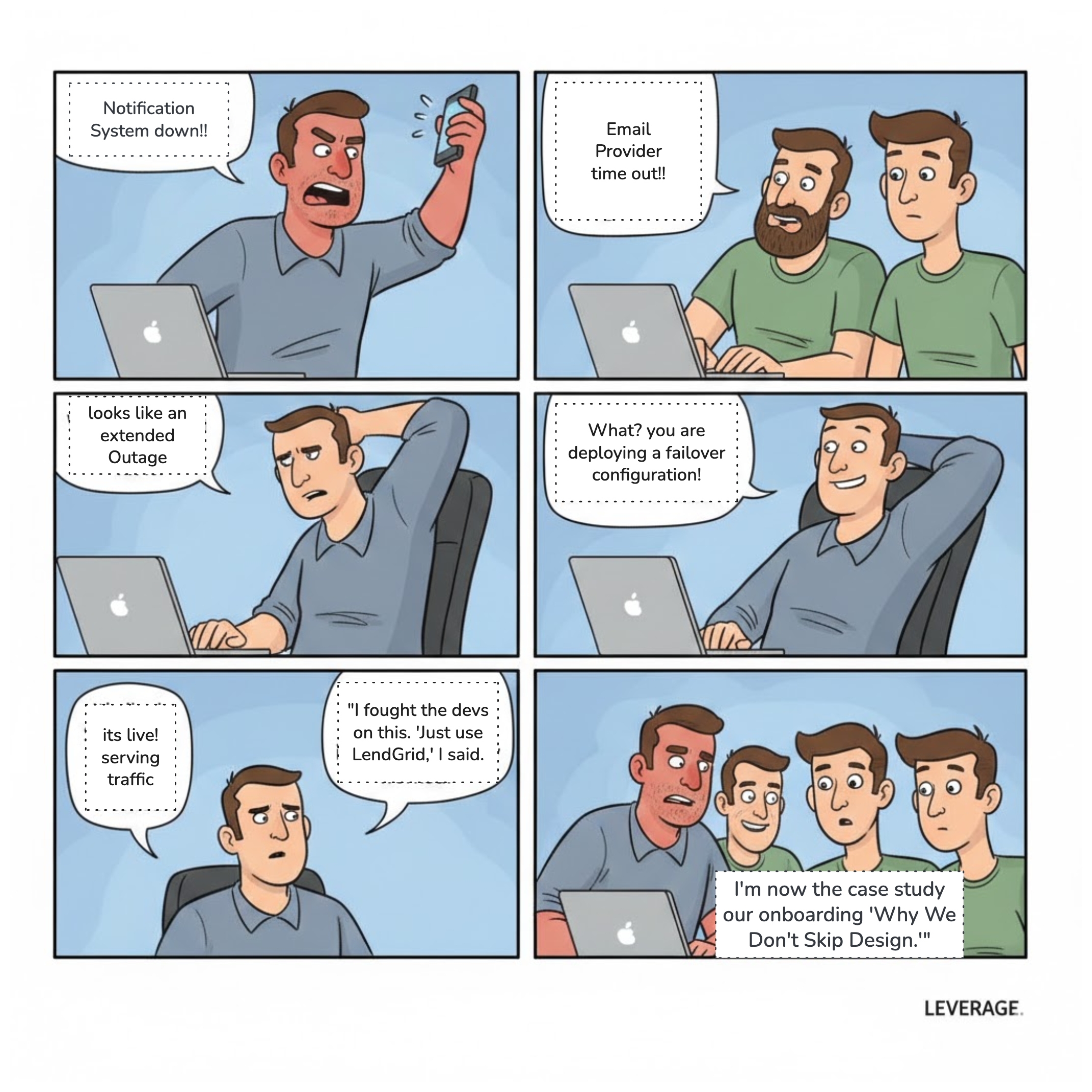
<p>Portability provides strategic <strong>leverage</strong></p>
<p><img decoding="async" loading="lazy" alt="Diagram showing how architectural portability provides strategic leverage in cloud vendor negotiations" src="https://blog.base14.io/assets/images/leverage-70eacf4a64a7f61adb51c5e71ad31470.png" width="2143" height="2143" class="img_ev3q"></p>
<h2 class="anchor anchorTargetStickyNavbar_Vzrq" id="kafka-as-a-library-the-interface-first-mindset">Kafka as a Library: The Interface-First Mindset<a href="https://blog.base14.io/multi-cloud-design#kafka-as-a-library-the-interface-first-mindset" class="hash-link" aria-label="Direct link to Kafka as a Library: The Interface-First Mindset" title="Direct link to Kafka as a Library: The Interface-First Mindset" translate="no">​</a></h2>
<p>Take Kafka. It's a great example because it has evolved from a tool into a
protocol. If your app depends on the Kafka <strong>API</strong> rather than a specific
vendor's implementation, Kafka effectively becomes a library. Whether you're
using self-hosted Apache Kafka, a managed service, or something like Redpanda,
your producers and consumers don't care. Only the plumbing changes.</p>
<p>This pattern is everywhere if you look for it:</p>
<ul>
<li class="">
<p><strong>Databases:</strong> Postgres and MySQL protocols.</p>
</li>
<li class="">
<p><strong>Identity:</strong> OAuth and OIDC.</p>
</li>
<li class="">
<p><strong>Observability:</strong> OpenTelemetry.</p>
</li>
<li class="">
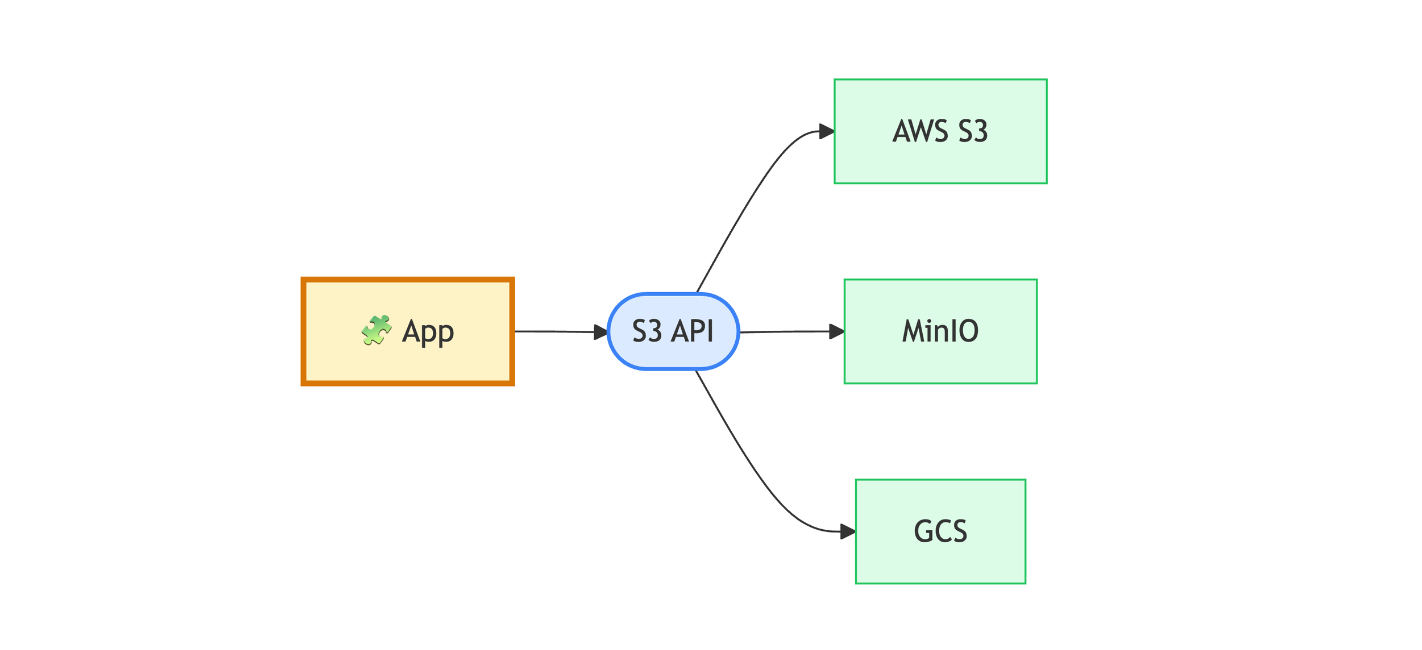
<p><strong>Storage:</strong> The S3 API.</p>
</li>
</ul>
<p><img decoding="async" loading="lazy" alt="S3 as a protocol API working across AWS S3, MinIO, and other S3-compatible storage providers" src="https://blog.base14.io/assets/images/s3-as-api-05d57a1a790344c4118910e85a255ace.png" width="1422" height="650" class="img_ev3q"></p>
<p>The CNCF landscape is more than a list of tools; it's a map of the interfaces
that won. When you see multiple mature implementations for the same protocol,
that's your green light to build. It sets the pace for the entire ecosystem,
signaling to vendors the language the ecosystem now speaks.</p>
<h2 class="anchor anchorTargetStickyNavbar_Vzrq" id="business-logic-should-be-ignorant-the-adapter-pattern">Business Logic Should Be Ignorant: The Adapter Pattern<a href="https://blog.base14.io/multi-cloud-design#business-logic-should-be-ignorant-the-adapter-pattern" class="hash-link" aria-label="Direct link to Business Logic Should Be Ignorant: The Adapter Pattern" title="Direct link to Business Logic Should Be Ignorant: The Adapter Pattern" translate="no">​</a></h2>
<p>Portability fails when your code knows too much. The rule is simple: <strong>Your
business logic should not care where it runs.</strong></p>
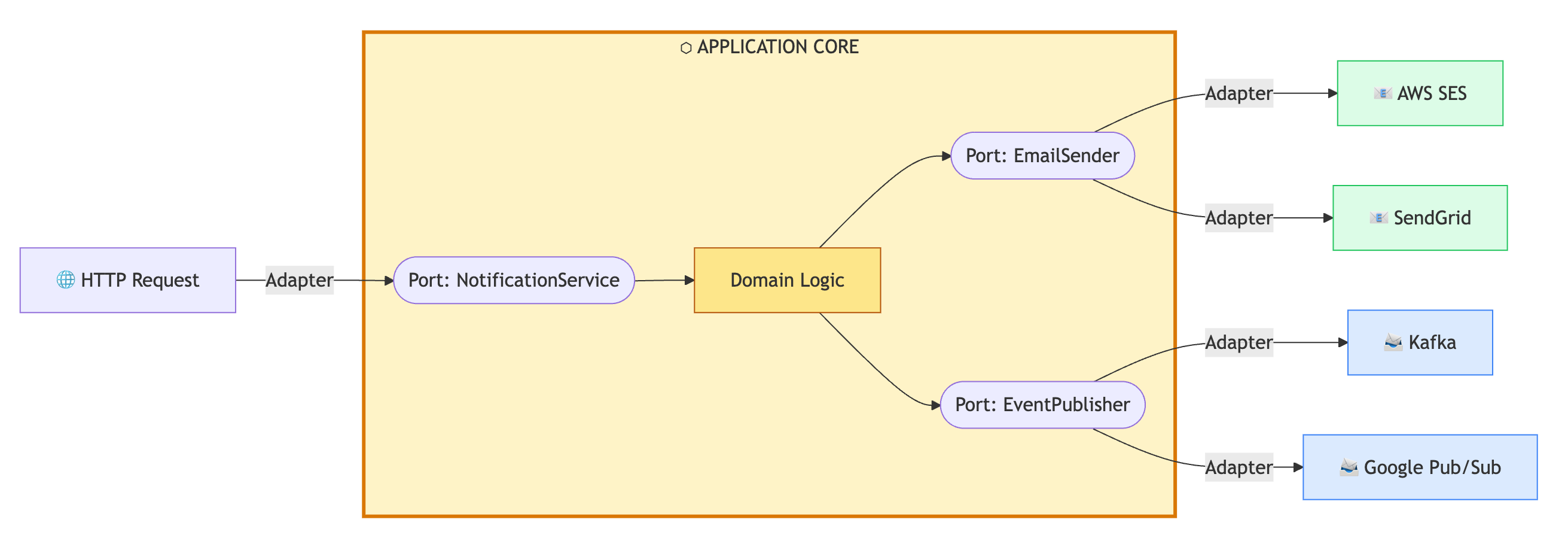
<p>This is where "ports and adapters" (hexagonal architecture) moves from theory
to practical survival. Your domain talks to an interface; your infrastructure
lives behind an adapter.</p>
<p>Yes, this costs something. You pay in abstraction. But 'abstract' shouldn't
mean 'complex.' You aren't introducing a heavy new component or a fragile
moving part; you're just building a wrapper. This is the <strong>adapter pattern</strong> in
its most practical form. The 'adapter' in a <strong>ports and adapters</strong> architecture.
It's the difference between hard-wiring your logic into a vendor's proprietary
API and simply translating their contract into your own domain schema. This
minor friction today prevents a total collision during a high-cost migration
later.</p>
<p><strong>While portability requires consistent daily investment, it mitigates the significant, sudden costs associated with vendor lock-in..</strong>
<img decoding="async" loading="lazy" alt="Hexagonal architecture diagram showing adapter pattern with ports connecting business logic to cloud services" src="https://blog.base14.io/assets/images/hexagonal-65c2fa90c6c2347298548974d86aac82.png" width="2622" height="934" class="img_ev3q"></p>
<h2 class="anchor anchorTargetStickyNavbar_Vzrq" id="intent-vs-instructions-gitops-for-reproducibility">Intent vs. Instructions: GitOps for Reproducibility<a href="https://blog.base14.io/multi-cloud-design#intent-vs-instructions-gitops-for-reproducibility" class="hash-link" aria-label="Direct link to Intent vs. Instructions: GitOps for Reproducibility" title="Direct link to Intent vs. Instructions: GitOps for Reproducibility" translate="no">​</a></h2>
<p>Layered code is insufficient if standing up in a new environment requires
tribal knowledge. Infrastructure must be reproducible, which is the core of
GitOps. Storing intent is superior to storing instructions, because describing
"what" must exist is more durable than the "how" of a dashboard. Mapping this
intent to specific cloud APIs is a one-time configuration task that moves
cloud-specific friction out of the architecture and into a manageable layer.</p>
<p><img decoding="async" loading="lazy" alt="GitOps workflow showing infrastructure intent stored in Git and synced to cloud environments" src="https://blog.base14.io/assets/images/gitops-0f9c2750db7522df40e71eb7dc3483b9.png" width="2616" height="444" class="img_ev3q"></p>
<p>GitOps makes this real by storing your <strong>intent</strong> in Git. Now, let's be clear:
this isn't magic. You still have to do the one-time work of mapping that intent
to a specific cloud's APIs whether that's configuring a Crossplane provider, a
Terraform module, or a specific Ingress controller. Think of it as installing a
driver. You do the plumbing once so that your application logic doesn't have to
care about it. Once those mappings are in place, the workflow is identical:
commit, push, sync. You've successfully moved the cloud-specific friction out
of your architecture and into a manageable configuration layer. This is what
makes true multi-cloud and hybrid deployments practical.</p>
<h2 class="anchor anchorTargetStickyNavbar_Vzrq" id="you-dont-need-to-move-you-just-need-to-know-you-can">You Don't Need to Move, You Just Need to Know You Can<a href="https://blog.base14.io/multi-cloud-design#you-dont-need-to-move-you-just-need-to-know-you-can" class="hash-link" aria-label="Direct link to You Don't Need to Move, You Just Need to Know You Can" title="Direct link to You Don't Need to Move, You Just Need to Know You Can" translate="no">​</a></h2>
<p>At the end of the day, some decisions are hard to undo. Choosing open
interfaces and declarative configs makes them easier.</p>
<p>It gives you the room to respond to outages, control your costs, and meet new
compliance hurdles without breaking the company.</p>
<p>You don't need to move often or move at all. You just need to know that the
door isn't locked from the outside. That's the real value of avoiding vendor lock-in.</p>
<hr>
<h2 class="anchor anchorTargetStickyNavbar_Vzrq" id="whats-next">What's Next?<a href="https://blog.base14.io/multi-cloud-design#whats-next" class="hash-link" aria-label="Direct link to What's Next?" title="Direct link to What's Next?" translate="no">​</a></h2>
<p>In the next post, we'll dig into the stack itself: which protocols actually
preserve your freedom, and which ones are "open" in name only.</p>
<h2 class="anchor anchorTargetStickyNavbar_Vzrq" id="related-reading">Related Reading<a href="https://blog.base14.io/multi-cloud-design#related-reading" class="hash-link" aria-label="Direct link to Related Reading" title="Direct link to Related Reading" translate="no">​</a></h2>
<ul>
<li class=""><a class="" href="https://blog.base14.io/cloud-native-foundation-layer">The Cloud-Native Foundation Layer</a> —
Part 1: why running on one cloud isn't lock-in, but designing for one is</li>
<li class=""><a class="" href="https://blog.base14.io/unified-observability">Why Unified Observability Matters</a> —
Applying vendor-neutral principles to your monitoring stack</li>
<li class=""><a class="" href="https://blog.base14.io/observability-theatre">Observability Theatre</a> —
The cost of fragmented tooling and how to escape it</li>
</ul>
<h2 class="anchor anchorTargetStickyNavbar_Vzrq" id="references">References<a href="https://blog.base14.io/multi-cloud-design#references" class="hash-link" aria-label="Direct link to References" title="Direct link to References" translate="no">​</a></h2>
<ul>
<li class=""><a href="https://medium.com/the-software-architecture-chronicles/ports-adapters-architecture-d19f2d476eca" target="_blank" rel="noopener noreferrer" class="">Ports and Adapters Architecture</a></li>
<li class=""><a href="https://dzone.com/articles/hexagonal-architecture-is-powerful" target="_blank" rel="noopener noreferrer" class="">Hexagonal Architecture</a></li>
<li class=""><a href="https://developer.hashicorp.com/terraform/tutorials/networking/multicloud-kubernetes" target="_blank" rel="noopener noreferrer" class="">Multi-Cloud K8s</a></li>
</ul>]]></content>
        <author>
            <name>Irfan Shah</name>
            <uri>https://base14.io/about</uri>
        </author>
        <category label="cloud-native" term="cloud-native"/>
        <category label="portability" term="portability"/>
        <category label="vendor-neutral" term="vendor-neutral"/>
        <category label="architecture" term="architecture"/>
        <category label="multi-cloud" term="multi-cloud"/>
        <category label="kubernetes" term="kubernetes"/>
    </entry>
    <entry>
        <title type="html"><![CDATA[Live Metric Registry: find and understand observability metrics across your stack]]></title>
        <id>https://blog.base14.io/metric-registry</id>
        <link href="https://blog.base14.io/metric-registry"/>
        <updated>2026-01-19T00:00:00.000Z</updated>
        <summary type="html"><![CDATA[Search 3,700+ observability metrics from OpenTelemetry, Prometheus, and Kubernetes. Live registry extracted from source code, updated nightly.]]></summary>
        <content type="html"><![CDATA[<p>Introducing <a href="https://metric-registry.base14.io/" target="_blank" rel="noopener noreferrer" class="">Metric Registry</a>: a live,
searchable catalog of 3,700+ observability (and rapidly growing) metrics
extracted directly from source repositories across the OpenTelemetry,
Prometheus, and Kubernetes ecosystems, including cloud provider metrics.
Metric Registry is open source and built to stay current automatically as
projects evolve.</p>
<h2 class="anchor anchorTargetStickyNavbar_Vzrq" id="what-you-can-do-today-with-metric-registry">What you can do today with Metric Registry<a href="https://blog.base14.io/metric-registry#what-you-can-do-today-with-metric-registry" class="hash-link" aria-label="Direct link to What you can do today with Metric Registry" title="Direct link to What you can do today with Metric Registry" translate="no">​</a></h2>
<p><strong>Search across your entire observability stack.</strong> Find metrics by name,
description, or component, whether you're looking for HTTP-related histograms
or database connection metrics.</p>
<p><strong>Understand what metrics actually exist.</strong> The registry covers 15 sources
including OpenTelemetry Collector receivers, Prometheus exporters (PostgreSQL,
Redis, MySQL, MongoDB, Kafka), Kubernetes metrics (kube-state-metrics,
cAdvisor), and LLM observability libraries.</p>
<p><strong>See which metrics follow standards.</strong> Each metric shows whether it complies
with OpenTelemetry Semantic Conventions, helping you understand what's
standardized versus custom.</p>
<p><strong>Trace back to the source.</strong> Every metric links to its origin: the repository,
file path, and commit hash. When you need to understand a metric's exact
definition, you can go straight to the source.</p>
<p><strong>Trust the data.</strong> Metrics are extracted automatically from source code and
official metadata files, and the registry refreshes nightly to stay current as
projects evolve.</p>
<p><strong>Can't find what you're looking for?</strong> Open an issue or better yet, submit a
PR to add new sources or improve existing extractors.</p>
<h3 class="anchor anchorTargetStickyNavbar_Vzrq" id="sources-already-indexed">Sources already indexed<a href="https://blog.base14.io/metric-registry#sources-already-indexed" class="hash-link" aria-label="Direct link to Sources already indexed" title="Direct link to Sources already indexed" translate="no">​</a></h3>
<table><thead><tr><th>Category</th><th>Sources</th></tr></thead><tbody><tr><td>OpenTelemetry</td><td>Collector Contrib, Semantic Conventions, Python, Java, JavaScript</td></tr><tr><td>Prometheus</td><td>node_exporter, postgres_exporter, redis_exporter, mysql_exporter, mongodb_exporter, kafka_exporter</td></tr><tr><td>Kubernetes</td><td>kube-state-metrics, cAdvisor</td></tr><tr><td>LLM Observability</td><td>OpenLLMetry, OpenLIT</td></tr><tr><td>CloudWatch</td><td>RDS, ALB, DynamoDB, Lambda, EC2, S3, SQS, API Gateway</td></tr></tbody></table>
<iframe width="100%" height="400" src="https://www.youtube.com/embed/A7GNbDjTL2s?rel=0" title="YouTube video player" frameborder="0" allow="accelerometer; autoplay; clipboard-write; encrypted-media;
gyroscope; picture-in-picture; web-share; fullscreen"></iframe>
<p><em>Watch: Introduction to the Live Metric Registry.</em></p>
<h2 class="anchor anchorTargetStickyNavbar_Vzrq" id="whats-the-need-for-a-metric-registry">What's the need for a Metric Registry?<a href="https://blog.base14.io/metric-registry#whats-the-need-for-a-metric-registry" class="hash-link" aria-label="Direct link to What's the need for a Metric Registry?" title="Direct link to What's the need for a Metric Registry?" translate="no">​</a></h2>
<p>If you've ever tried to answer "what metrics does my stack actually emit?", you
know the pain. Observability metrics are scattered across hundreds of
repositories, exporters, and instrumentation libraries. The OpenTelemetry
Collector Contrib repo alone has over 100 receivers, each emitting dozens of
metrics. Add Prometheus exporters for PostgreSQL, Redis, MySQL, Kafka. Then
Kubernetes metrics from kube-state-metrics and cAdvisor. Then your application
instrumentation across Go, Java, Python, and JavaScript.</p>
<p>Each source uses different formats:</p>
<ul>
<li class="">OpenTelemetry Collector uses <code>metadata.yaml</code> files</li>
<li class="">Prometheus exporters define metrics in Go code via <code>prometheus.NewDesc()</code></li>
<li class="">Python instrumentation uses decorators and meter APIs</li>
<li class="">Some sources just have documentation (if you're lucky)</li>
</ul>
<p>Different naming conventions compound the problem. Is it
<code>http_server_request_duration</code> or <code>http.server.request.duration</code>? Underscores
or dots? <code>_total</code> suffix or not?</p>
<p>There's no central registry, no single place to search "show me all histogram
metrics related to HTTP requests across my entire observability stack."</p>
<h2 class="anchor anchorTargetStickyNavbar_Vzrq" id="why-not-just-a-static-list-">Why not just a static list ?<a href="https://blog.base14.io/metric-registry#why-not-just-a-static-list-" class="hash-link" aria-label="Direct link to Why not just a static list ?" title="Direct link to Why not just a static list ?" translate="no">​</a></h2>
<p>The obvious solution is to create a curated list. Document all the metrics, put
them in a spreadsheet or wiki, and call it a day.</p>
<p>This fails for several reasons:</p>
<p><strong>Metrics change constantly.</strong> Every release of every exporter can add, modify,
or deprecate metrics. The OpenTelemetry Collector Contrib repo has hundreds of
commits per month, and a static list becomes outdated quickly.</p>
<p><strong>Manual curation doesn't scale.</strong> The registry indexes over 3,400 metrics from
just 15 sources. The full observability ecosystem has thousands of exporters
and instrumentation libraries. No team can manually track all of this.</p>
<p><strong>No provenance.</strong> A static list tells you a metric exists, but not where it's
defined, what version introduced it, or whether the definition you're looking
at is current. When debugging why a metric isn't appearing as expected, you
need to trace back to the source.</p>
<p><strong>No trust levels.</strong> Some metric definitions come from official metadata files
maintained by the project. Others are inferred from code analysis. A static
list treats them the same, but they're not equally reliable.</p>
<h2 class="anchor anchorTargetStickyNavbar_Vzrq" id="its-not-trivial-to-build-a-live-metric-registry---why-is-that">Its not trivial to build a live Metric Registry - why is that?<a href="https://blog.base14.io/metric-registry#its-not-trivial-to-build-a-live-metric-registry---why-is-that" class="hash-link" aria-label="Direct link to Its not trivial to build a live Metric Registry - why is that?" title="Direct link to Its not trivial to build a live Metric Registry - why is that?" translate="no">​</a></h2>
<p>Building a system that automatically extracts and catalogs metrics from source
repositories sounds straightforward. Clone the repos, parse the files, store
the results. In practice, it's surprisingly complicated.</p>
<h3 class="anchor anchorTargetStickyNavbar_Vzrq" id="multi-language-extraction">Multi-Language Extraction<a href="https://blog.base14.io/metric-registry#multi-language-extraction" class="hash-link" aria-label="Direct link to Multi-Language Extraction" title="Direct link to Multi-Language Extraction" translate="no">​</a></h3>
<p>Metrics are defined in Go, Python, Java, TypeScript, YAML, and more. Each
requires different parsing strategies:</p>
<ul>
<li class=""><strong>Go</strong>: AST parsing to find <code>prometheus.NewDesc()</code> calls,
<code>prometheus.NewGauge()</code>, and similar patterns</li>
<li class=""><strong>Python</strong>: AST walking to find <code>meter.create_counter()</code> and instrument
decorators</li>
<li class=""><strong>TypeScript</strong>: Parsing to extract metric definitions from OpenTelemetry JS
instrumentation</li>
<li class=""><strong>YAML</strong>: Structured parsing for OpenTelemetry metadata files</li>
<li class=""><strong>Regex</strong>: Sometimes the cleanest option for semi-structured definitions</li>
</ul>
<p>A single "parser" doesn't work, since each language and each project has its
own patterns.</p>
<h3 class="anchor anchorTargetStickyNavbar_Vzrq" id="multiple-definition-patterns">Multiple Definition Patterns<a href="https://blog.base14.io/metric-registry#multiple-definition-patterns" class="hash-link" aria-label="Direct link to Multiple Definition Patterns" title="Direct link to Multiple Definition Patterns" translate="no">​</a></h3>
<p>Even within a single language, metrics are defined differently across projects.</p>
<p>In Go alone, the patterns include:</p>
<ul>
<li class=""><code>prometheus.NewDesc()</code> with <code>BuildFQName()</code> for namespaced metrics</li>
<li class="">Direct string literals for metric names</li>
<li class="">Map-based definitions where metric metadata is stored in data structures</li>
<li class="">Constants defined separately from the metric registration</li>
</ul>
<p>The redis_exporter defines metrics in maps. The postgres_exporter uses the
standard <code>NewDesc</code> pattern. kube-state-metrics generates metrics dynamically
based on Kubernetes resource types. Each required a different extraction
approach.</p>
<h3 class="anchor anchorTargetStickyNavbar_Vzrq" id="normalization-challenge">Normalization Challenge<a href="https://blog.base14.io/metric-registry#normalization-challenge" class="hash-link" aria-label="Direct link to Normalization Challenge" title="Direct link to Normalization Challenge" translate="no">​</a></h3>
<p>Once extracted, metrics need normalization into a canonical schema. This means:</p>
<ul>
<li class="">Consistent naming: converting between <code>http_server_duration</code> and
<code>http.server.duration</code></li>
<li class="">Unified types: mapping Prometheus's counter/gauge/histogram/summary to
OpenTelemetry's instrument types</li>
<li class="">Attribute standardization: labels, dimensions, and tags are all the same
concept with different names</li>
</ul>
<p>Without normalization, searching across sources becomes difficult.</p>
<h3 class="anchor anchorTargetStickyNavbar_Vzrq" id="provenance-tracking">Provenance Tracking<a href="https://blog.base14.io/metric-registry#provenance-tracking" class="hash-link" aria-label="Direct link to Provenance Tracking" title="Direct link to Provenance Tracking" translate="no">​</a></h3>
<p>Every metric in the registry must link back to:</p>
<ul>
<li class="">The source repository</li>
<li class="">The exact file path</li>
<li class="">The git commit hash</li>
<li class="">The extraction timestamp</li>
</ul>
<p>This information is essential for debugging and trust. When a user questions
why a metric has a certain description, they need to see the source.</p>
<h3 class="anchor anchorTargetStickyNavbar_Vzrq" id="trust-levels">Trust Levels<a href="https://blog.base14.io/metric-registry#trust-levels" class="hash-link" aria-label="Direct link to Trust Levels" title="Direct link to Trust Levels" translate="no">​</a></h3>
<p>Not all metric definitions are equally reliable:</p>
<ul>
<li class=""><strong>Authoritative</strong>: From official metadata files maintained by the project
(like OTel Collector's <code>metadata.yaml</code>)</li>
<li class=""><strong>Derived</strong>: Extracted from source code via AST analysis</li>
<li class=""><strong>Documented</strong>: Scraped from documentation</li>
<li class=""><strong>Vendor-claimed</strong>: From vendor docs without source verification</li>
</ul>
<p>A registry that doesn't distinguish between these levels can mislead users
about the reliability of metric definitions.</p>
<h3 class="anchor anchorTargetStickyNavbar_Vzrq" id="semantic-convention-compliance">Semantic Convention Compliance<a href="https://blog.base14.io/metric-registry#semantic-convention-compliance" class="hash-link" aria-label="Direct link to Semantic Convention Compliance" title="Direct link to Semantic Convention Compliance" translate="no">​</a></h3>
<p>OpenTelemetry defines semantic conventions, which are standardized metric names
and attributes. A useful registry should indicate which metrics comply with
these conventions:</p>
<ul>
<li class=""><strong>Exact match</strong>: <code>http.server.request.duration</code> matches the semantic
convention exactly</li>
<li class=""><strong>Prefix match</strong>: <code>http.server.request.duration.bucket</code> starts with a
convention metric</li>
<li class=""><strong>No match</strong>: Custom metric not covered by conventions</li>
</ul>
<p>This helps teams understand which metrics are "standard" versus custom.</p>
<h2 class="anchor anchorTargetStickyNavbar_Vzrq" id="and-so---source-first-metric-extraction">And so - source-first metric extraction<a href="https://blog.base14.io/metric-registry#and-so---source-first-metric-extraction" class="hash-link" aria-label="Direct link to And so - source-first metric extraction" title="Direct link to And so - source-first metric extraction" translate="no">​</a></h2>
<p>The Metric Registry extracts metrics directly from source repositories,
normalizes them into a canonical schema, and exposes them via search.</p>
<h3 class="anchor anchorTargetStickyNavbar_Vzrq" id="design-principles">Design Principles<a href="https://blog.base14.io/metric-registry#design-principles" class="hash-link" aria-label="Direct link to Design Principles" title="Direct link to Design Principles" translate="no">​</a></h3>
<p><strong>Source-first</strong>: Derive metrics from repos. The source code is the ground
truth.</p>
<p><strong>Pluggable adapters</strong>: Each source gets its own adapter that knows how to
fetch and extract. Adding a new source doesn't require changing core logic.</p>
<p><strong>Provenance-aware</strong>: Every metric links to its origin. Always know where a
metric came from and how trustworthy it is.</p>
<p><strong>Search-oriented</strong>: Optimize for discovery. Full-text search, faceted
filtering, semantic convention badges.</p>
<h2 class="anchor anchorTargetStickyNavbar_Vzrq" id="architecture-deep-dive">Architecture Deep Dive<a href="https://blog.base14.io/metric-registry#architecture-deep-dive" class="hash-link" aria-label="Direct link to Architecture Deep Dive" title="Direct link to Architecture Deep Dive" translate="no">​</a></h2>
<div class="language-text codeBlockContainer_Ckt0 theme-code-block" style="--prism-background-color:hsl(230, 1%, 98%);--prism-color:hsl(230, 8%, 24%)"><div class="codeBlockContent_QJqH"><pre tabindex="0" class="prism-code language-text codeBlock_bY9V thin-scrollbar" style="background-color:hsl(230, 1%, 98%);color:hsl(230, 8%, 24%)"><code class="codeBlockLines_e6Vv"><span class="token-line" style="color:hsl(230, 8%, 24%)"><span class="token plain">┌──────────────────────────────────────────────────────────────────────┐</span><br></span><span class="token-line" style="color:hsl(230, 8%, 24%)"><span class="token plain">│                            Sources                                   │</span><br></span><span class="token-line" style="color:hsl(230, 8%, 24%)"><span class="token plain">│  otel-contrib │ postgres │ redis │ ksm │ cadvisor │ otel-python │ ...│</span><br></span><span class="token-line" style="color:hsl(230, 8%, 24%)"><span class="token plain">└───────┬───────────┬─────────┬───────┬───────┬───────────┬────────────┘</span><br></span><span class="token-line" style="color:hsl(230, 8%, 24%)"><span class="token plain">        │           │         │       │       │           │</span><br></span><span class="token-line" style="color:hsl(230, 8%, 24%)"><span class="token plain">        ▼           ▼         ▼       ▼       ▼           ▼</span><br></span><span class="token-line" style="color:hsl(230, 8%, 24%)"><span class="token plain">┌──────────────────────────────────────────────────────────────────────┐</span><br></span><span class="token-line" style="color:hsl(230, 8%, 24%)"><span class="token plain">│                           Adapters                                   │</span><br></span><span class="token-line" style="color:hsl(230, 8%, 24%)"><span class="token plain">│     Each adapter: Fetch (git clone) → Extract (parse) → RawMetric    │</span><br></span><span class="token-line" style="color:hsl(230, 8%, 24%)"><span class="token plain">└─────────────────────────────────┬────────────────────────────────────┘</span><br></span><span class="token-line" style="color:hsl(230, 8%, 24%)"><span class="token plain">                                  │</span><br></span><span class="token-line" style="color:hsl(230, 8%, 24%)"><span class="token plain">                                  ▼</span><br></span><span class="token-line" style="color:hsl(230, 8%, 24%)"><span class="token plain">┌──────────────────────────────────────────────────────────────────────┐</span><br></span><span class="token-line" style="color:hsl(230, 8%, 24%)"><span class="token plain">│                          Orchestrator                                │</span><br></span><span class="token-line" style="color:hsl(230, 8%, 24%)"><span class="token plain">│         RawMetric → CanonicalMetric → Store (SQLite + FTS5)          │</span><br></span><span class="token-line" style="color:hsl(230, 8%, 24%)"><span class="token plain">└─────────────────────────────────┬────────────────────────────────────┘</span><br></span><span class="token-line" style="color:hsl(230, 8%, 24%)"><span class="token plain">                                  │</span><br></span><span class="token-line" style="color:hsl(230, 8%, 24%)"><span class="token plain">                                  ▼</span><br></span><span class="token-line" style="color:hsl(230, 8%, 24%)"><span class="token plain">┌─────────────────────────────────────────────────────────────────────┐</span><br></span><span class="token-line" style="color:hsl(230, 8%, 24%)"><span class="token plain">│                           Enricher                                  │</span><br></span><span class="token-line" style="color:hsl(230, 8%, 24%)"><span class="token plain">│      Cross-reference with OTel Semantic Conventions                 │</span><br></span><span class="token-line" style="color:hsl(230, 8%, 24%)"><span class="token plain">│      Match types: exact, prefix, none                               │</span><br></span><span class="token-line" style="color:hsl(230, 8%, 24%)"><span class="token plain">└─────────────────────────────────┬───────────────────────────────────┘</span><br></span><span class="token-line" style="color:hsl(230, 8%, 24%)"><span class="token plain">                                  │</span><br></span><span class="token-line" style="color:hsl(230, 8%, 24%)"><span class="token plain">                                  ▼</span><br></span><span class="token-line" style="color:hsl(230, 8%, 24%)"><span class="token plain">┌───────────────────────────────────────────────────────────────────────┐</span><br></span><span class="token-line" style="color:hsl(230, 8%, 24%)"><span class="token plain">│                       REST API + Next.js UI                           │</span><br></span><span class="token-line" style="color:hsl(230, 8%, 24%)"><span class="token plain">│   Search, filter by type/source/component, semantic convention badges │</span><br></span><span class="token-line" style="color:hsl(230, 8%, 24%)"><span class="token plain">└───────────────────────────────────────────────────────────────────────┘</span><br></span></code></pre></div></div>
<h3 class="anchor anchorTargetStickyNavbar_Vzrq" id="adapters">Adapters<a href="https://blog.base14.io/metric-registry#adapters" class="hash-link" aria-label="Direct link to Adapters" title="Direct link to Adapters" translate="no">​</a></h3>
<p>Each adapter implements a common interface:</p>
<div class="language-go codeBlockContainer_Ckt0 theme-code-block" style="--prism-background-color:hsl(230, 1%, 98%);--prism-color:hsl(230, 8%, 24%)"><div class="codeBlockContent_QJqH"><pre tabindex="0" class="prism-code language-go codeBlock_bY9V thin-scrollbar" style="background-color:hsl(230, 1%, 98%);color:hsl(230, 8%, 24%)"><code class="codeBlockLines_e6Vv"><span class="token-line" style="color:hsl(230, 8%, 24%)"><span class="token keyword" style="color:hsl(301, 63%, 40%)">type</span><span class="token plain"> Adapter </span><span class="token keyword" style="color:hsl(301, 63%, 40%)">interface</span><span class="token plain"> </span><span class="token punctuation" style="color:hsl(119, 34%, 47%)">{</span><span class="token plain"></span><br></span><span class="token-line" style="color:hsl(230, 8%, 24%)"><span class="token plain">    </span><span class="token function" style="color:hsl(221, 87%, 60%)">Name</span><span class="token punctuation" style="color:hsl(119, 34%, 47%)">(</span><span class="token punctuation" style="color:hsl(119, 34%, 47%)">)</span><span class="token plain"> </span><span class="token builtin" style="color:hsl(119, 34%, 47%)">string</span><span class="token plain"></span><br></span><span class="token-line" style="color:hsl(230, 8%, 24%)"><span class="token plain">    </span><span class="token function" style="color:hsl(221, 87%, 60%)">SourceCategory</span><span class="token punctuation" style="color:hsl(119, 34%, 47%)">(</span><span class="token punctuation" style="color:hsl(119, 34%, 47%)">)</span><span class="token plain"> domain</span><span class="token punctuation" style="color:hsl(119, 34%, 47%)">.</span><span class="token plain">SourceCategory</span><br></span><span class="token-line" style="color:hsl(230, 8%, 24%)"><span class="token plain">    </span><span class="token function" style="color:hsl(221, 87%, 60%)">Confidence</span><span class="token punctuation" style="color:hsl(119, 34%, 47%)">(</span><span class="token punctuation" style="color:hsl(119, 34%, 47%)">)</span><span class="token plain"> domain</span><span class="token punctuation" style="color:hsl(119, 34%, 47%)">.</span><span class="token plain">ConfidenceLevel</span><br></span><span class="token-line" style="color:hsl(230, 8%, 24%)"><span class="token plain">    </span><span class="token function" style="color:hsl(221, 87%, 60%)">ExtractionMethod</span><span class="token punctuation" style="color:hsl(119, 34%, 47%)">(</span><span class="token punctuation" style="color:hsl(119, 34%, 47%)">)</span><span class="token plain"> domain</span><span class="token punctuation" style="color:hsl(119, 34%, 47%)">.</span><span class="token plain">ExtractionMethod</span><br></span><span class="token-line" style="color:hsl(230, 8%, 24%)"><span class="token plain">    </span><span class="token function" style="color:hsl(221, 87%, 60%)">RepoURL</span><span class="token punctuation" style="color:hsl(119, 34%, 47%)">(</span><span class="token punctuation" style="color:hsl(119, 34%, 47%)">)</span><span class="token plain"> </span><span class="token builtin" style="color:hsl(119, 34%, 47%)">string</span><span class="token plain"></span><br></span><span class="token-line" style="color:hsl(230, 8%, 24%)"><span class="token plain">    </span><span class="token function" style="color:hsl(221, 87%, 60%)">Fetch</span><span class="token punctuation" style="color:hsl(119, 34%, 47%)">(</span><span class="token plain">ctx context</span><span class="token punctuation" style="color:hsl(119, 34%, 47%)">.</span><span class="token plain">Context</span><span class="token punctuation" style="color:hsl(119, 34%, 47%)">,</span><span class="token plain"> opts FetchOptions</span><span class="token punctuation" style="color:hsl(119, 34%, 47%)">)</span><span class="token plain"> </span><span class="token punctuation" style="color:hsl(119, 34%, 47%)">(</span><span class="token operator" style="color:hsl(221, 87%, 60%)">*</span><span class="token plain">FetchResult</span><span class="token punctuation" style="color:hsl(119, 34%, 47%)">,</span><span class="token plain"> </span><span class="token builtin" style="color:hsl(119, 34%, 47%)">error</span><span class="token punctuation" style="color:hsl(119, 34%, 47%)">)</span><span class="token plain"></span><br></span><span class="token-line" style="color:hsl(230, 8%, 24%)"><span class="token plain">    </span><span class="token function" style="color:hsl(221, 87%, 60%)">Extract</span><span class="token punctuation" style="color:hsl(119, 34%, 47%)">(</span><span class="token plain">ctx context</span><span class="token punctuation" style="color:hsl(119, 34%, 47%)">.</span><span class="token plain">Context</span><span class="token punctuation" style="color:hsl(119, 34%, 47%)">,</span><span class="token plain"> result </span><span class="token operator" style="color:hsl(221, 87%, 60%)">*</span><span class="token plain">FetchResult</span><span class="token punctuation" style="color:hsl(119, 34%, 47%)">)</span><span class="token plain"> </span><span class="token punctuation" style="color:hsl(119, 34%, 47%)">(</span><span class="token punctuation" style="color:hsl(119, 34%, 47%)">[</span><span class="token punctuation" style="color:hsl(119, 34%, 47%)">]</span><span class="token operator" style="color:hsl(221, 87%, 60%)">*</span><span class="token plain">RawMetric</span><span class="token punctuation" style="color:hsl(119, 34%, 47%)">,</span><span class="token plain"> </span><span class="token builtin" style="color:hsl(119, 34%, 47%)">error</span><span class="token punctuation" style="color:hsl(119, 34%, 47%)">)</span><span class="token plain"></span><br></span><span class="token-line" style="color:hsl(230, 8%, 24%)"><span class="token plain"></span><span class="token punctuation" style="color:hsl(119, 34%, 47%)">}</span><br></span></code></pre></div></div>
<p>The adapter handles everything source-specific: cloning the repo, finding
metric definitions, parsing them. The orchestrator doesn't need to know whether
it's parsing YAML or walking a Go AST.</p>
<h3 class="anchor anchorTargetStickyNavbar_Vzrq" id="extraction-methods">Extraction Methods<a href="https://blog.base14.io/metric-registry#extraction-methods" class="hash-link" aria-label="Direct link to Extraction Methods" title="Direct link to Extraction Methods" translate="no">​</a></h3>
<p><strong>YAML Parsing</strong> (OpenTelemetry Collector Contrib)</p>
<p>The cleanest case. OTel Collector receivers include <code>metadata.yaml</code> files with
structured metric definitions:</p>
<div class="language-yaml codeBlockContainer_Ckt0 theme-code-block" style="--prism-background-color:hsl(230, 1%, 98%);--prism-color:hsl(230, 8%, 24%)"><div class="codeBlockContent_QJqH"><pre tabindex="0" class="prism-code language-yaml codeBlock_bY9V thin-scrollbar" style="background-color:hsl(230, 1%, 98%);color:hsl(230, 8%, 24%)"><code class="codeBlockLines_e6Vv"><span class="token-line" style="color:hsl(230, 8%, 24%)"><span class="token key atrule" style="color:hsl(35, 99%, 36%)">metrics</span><span class="token punctuation" style="color:hsl(119, 34%, 47%)">:</span><span class="token plain"></span><br></span><span class="token-line" style="color:hsl(230, 8%, 24%)"><span class="token plain">  </span><span class="token key atrule" style="color:hsl(35, 99%, 36%)">redis.clients.connected</span><span class="token punctuation" style="color:hsl(119, 34%, 47%)">:</span><span class="token plain"></span><br></span><span class="token-line" style="color:hsl(230, 8%, 24%)"><span class="token plain">    </span><span class="token key atrule" style="color:hsl(35, 99%, 36%)">description</span><span class="token punctuation" style="color:hsl(119, 34%, 47%)">:</span><span class="token plain"> Number of client connections</span><br></span><span class="token-line" style="color:hsl(230, 8%, 24%)"><span class="token plain">    </span><span class="token key atrule" style="color:hsl(35, 99%, 36%)">unit</span><span class="token punctuation" style="color:hsl(119, 34%, 47%)">:</span><span class="token plain"> </span><span class="token string" style="color:hsl(119, 34%, 47%)">"{connection}"</span><span class="token plain"></span><br></span><span class="token-line" style="color:hsl(230, 8%, 24%)"><span class="token plain">    </span><span class="token key atrule" style="color:hsl(35, 99%, 36%)">gauge</span><span class="token punctuation" style="color:hsl(119, 34%, 47%)">:</span><span class="token plain"></span><br></span><span class="token-line" style="color:hsl(230, 8%, 24%)"><span class="token plain">      </span><span class="token key atrule" style="color:hsl(35, 99%, 36%)">value_type</span><span class="token punctuation" style="color:hsl(119, 34%, 47%)">:</span><span class="token plain"> int</span><br></span></code></pre></div></div>
<p><strong>Go AST Parsing</strong> (Prometheus Exporters)</p>
<p>Most Prometheus exporters define metrics using <code>prometheus.NewDesc()</code>:</p>
<div class="language-go codeBlockContainer_Ckt0 theme-code-block" style="--prism-background-color:hsl(230, 1%, 98%);--prism-color:hsl(230, 8%, 24%)"><div class="codeBlockContent_QJqH"><pre tabindex="0" class="prism-code language-go codeBlock_bY9V thin-scrollbar" style="background-color:hsl(230, 1%, 98%);color:hsl(230, 8%, 24%)"><code class="codeBlockLines_e6Vv"><span class="token-line" style="color:hsl(230, 8%, 24%)"><span class="token plain">prometheus</span><span class="token punctuation" style="color:hsl(119, 34%, 47%)">.</span><span class="token function" style="color:hsl(221, 87%, 60%)">NewDesc</span><span class="token punctuation" style="color:hsl(119, 34%, 47%)">(</span><span class="token plain"></span><br></span><span class="token-line" style="color:hsl(230, 8%, 24%)"><span class="token plain">    prometheus</span><span class="token punctuation" style="color:hsl(119, 34%, 47%)">.</span><span class="token function" style="color:hsl(221, 87%, 60%)">BuildFQName</span><span class="token punctuation" style="color:hsl(119, 34%, 47%)">(</span><span class="token plain">namespace</span><span class="token punctuation" style="color:hsl(119, 34%, 47%)">,</span><span class="token plain"> subsystem</span><span class="token punctuation" style="color:hsl(119, 34%, 47%)">,</span><span class="token plain"> </span><span class="token string" style="color:hsl(119, 34%, 47%)">"connections"</span><span class="token punctuation" style="color:hsl(119, 34%, 47%)">)</span><span class="token punctuation" style="color:hsl(119, 34%, 47%)">,</span><span class="token plain"></span><br></span><span class="token-line" style="color:hsl(230, 8%, 24%)"><span class="token plain">    </span><span class="token string" style="color:hsl(119, 34%, 47%)">"Number of active connections"</span><span class="token punctuation" style="color:hsl(119, 34%, 47%)">,</span><span class="token plain"></span><br></span><span class="token-line" style="color:hsl(230, 8%, 24%)"><span class="token plain">    </span><span class="token punctuation" style="color:hsl(119, 34%, 47%)">[</span><span class="token punctuation" style="color:hsl(119, 34%, 47%)">]</span><span class="token builtin" style="color:hsl(119, 34%, 47%)">string</span><span class="token punctuation" style="color:hsl(119, 34%, 47%)">{</span><span class="token string" style="color:hsl(119, 34%, 47%)">"database"</span><span class="token punctuation" style="color:hsl(119, 34%, 47%)">}</span><span class="token punctuation" style="color:hsl(119, 34%, 47%)">,</span><span class="token plain"></span><br></span><span class="token-line" style="color:hsl(230, 8%, 24%)"><span class="token plain">    </span><span class="token boolean" style="color:hsl(35, 99%, 36%)">nil</span><span class="token punctuation" style="color:hsl(119, 34%, 47%)">,</span><span class="token plain"></span><br></span><span class="token-line" style="color:hsl(230, 8%, 24%)"><span class="token plain"></span><span class="token punctuation" style="color:hsl(119, 34%, 47%)">)</span><br></span></code></pre></div></div>
<p>The extractor walks the AST to find these calls, resolves the string arguments
(including <code>BuildFQName</code> concatenation), and extracts metric name, description,
and labels.</p>
<p><strong>Python AST</strong> (OpenTelemetry Python, OpenLLMetry)</p>
<p>Python instrumentation uses the meter API:</p>
<div class="language-python codeBlockContainer_Ckt0 theme-code-block" style="--prism-background-color:hsl(230, 1%, 98%);--prism-color:hsl(230, 8%, 24%)"><div class="codeBlockContent_QJqH"><pre tabindex="0" class="prism-code language-python codeBlock_bY9V thin-scrollbar" style="background-color:hsl(230, 1%, 98%);color:hsl(230, 8%, 24%)"><code class="codeBlockLines_e6Vv"><span class="token-line" style="color:hsl(230, 8%, 24%)"><span class="token plain">meter</span><span class="token punctuation" style="color:hsl(119, 34%, 47%)">.</span><span class="token plain">create_histogram</span><span class="token punctuation" style="color:hsl(119, 34%, 47%)">(</span><span class="token plain"></span><br></span><span class="token-line" style="color:hsl(230, 8%, 24%)"><span class="token plain">    name</span><span class="token operator" style="color:hsl(221, 87%, 60%)">=</span><span class="token string" style="color:hsl(119, 34%, 47%)">"http.client.duration"</span><span class="token punctuation" style="color:hsl(119, 34%, 47%)">,</span><span class="token plain"></span><br></span><span class="token-line" style="color:hsl(230, 8%, 24%)"><span class="token plain">    description</span><span class="token operator" style="color:hsl(221, 87%, 60%)">=</span><span class="token string" style="color:hsl(119, 34%, 47%)">"Duration of HTTP client requests"</span><span class="token punctuation" style="color:hsl(119, 34%, 47%)">,</span><span class="token plain"></span><br></span><span class="token-line" style="color:hsl(230, 8%, 24%)"><span class="token plain">    unit</span><span class="token operator" style="color:hsl(221, 87%, 60%)">=</span><span class="token string" style="color:hsl(119, 34%, 47%)">"ms"</span><span class="token plain"></span><br></span><span class="token-line" style="color:hsl(230, 8%, 24%)"><span class="token plain"></span><span class="token punctuation" style="color:hsl(119, 34%, 47%)">)</span><br></span></code></pre></div></div>
<p>AST walking finds these calls and extracts the arguments.</p>
<h3 class="anchor anchorTargetStickyNavbar_Vzrq" id="custom-patterns">Custom Patterns<a href="https://blog.base14.io/metric-registry#custom-patterns" class="hash-link" aria-label="Direct link to Custom Patterns" title="Direct link to Custom Patterns" translate="no">​</a></h3>
<p>Some sources required custom approaches:</p>
<ul>
<li class="">redis_exporter stores metrics in Go maps, so the extractor parses map
literals</li>
<li class="">OpenTelemetry Java uses a mix of constants and method calls, so regex
extraction worked best</li>
<li class="">kube-state-metrics generates metrics dynamically from Kubernetes types</li>
</ul>
<h3 class="anchor anchorTargetStickyNavbar_Vzrq" id="storage-and-search">Storage and Search<a href="https://blog.base14.io/metric-registry#storage-and-search" class="hash-link" aria-label="Direct link to Storage and Search" title="Direct link to Storage and Search" translate="no">​</a></h3>
<p>SQLite with FTS5 (full-text search) provides:</p>
<ul>
<li class="">Fast text search across metric names, descriptions, components</li>
<li class="">Faceted filtering by instrument type, source category, component</li>
<li class="">Efficient pagination for browsing</li>
</ul>
<h3 class="anchor anchorTargetStickyNavbar_Vzrq" id="enrichment">Enrichment<a href="https://blog.base14.io/metric-registry#enrichment" class="hash-link" aria-label="Direct link to Enrichment" title="Direct link to Enrichment" translate="no">​</a></h3>
<p>After extraction, the enricher cross-references each metric against
OpenTelemetry Semantic Conventions:</p>
<ul>
<li class=""><strong>349 semantic convention metrics</strong> parsed from the official repo</li>
<li class="">Name normalization (underscores → dots) before matching</li>
<li class="">Three match types: exact, prefix, none</li>
<li class="">Results stored alongside the metric for filtering and display</li>
</ul>
<h2 class="anchor anchorTargetStickyNavbar_Vzrq" id="whats-next">What's next<a href="https://blog.base14.io/metric-registry#whats-next" class="hash-link" aria-label="Direct link to What's next" title="Direct link to What's next" translate="no">​</a></h2>
<p><strong>More sources</strong>: Cloud provider metrics (AWS CloudWatch, GCP Monitoring), more
language instrumentations (.NET), additional Prometheus exporters.</p>
<p><strong>Deeper enrichment</strong>: Attribute validation against semantic conventions,
stability level tracking, deprecation warnings.</p>
<p><strong>Cross-ecosystem mapping</strong>: Identifying equivalent metrics across OpenTelemetry
and Prometheus ecosystems.</p>
<hr>
<p>The observability ecosystem is vast and fragmented. A live metric registry
makes "what metrics exist?" an answerable question, and it stays current
automatically through nightly extraction from source repositories.</p>
<p>The source code is the truth and this Metric Registry makes it searchable.</p>
<h2 class="anchor anchorTargetStickyNavbar_Vzrq" id="contribute">Contribute<a href="https://blog.base14.io/metric-registry#contribute" class="hash-link" aria-label="Direct link to Contribute" title="Direct link to Contribute" translate="no">​</a></h2>
<p>Metric Registry is open source. We welcome contributions—whether it's adding
new metric sources, improving extraction accuracy, or fixing bugs. Check out
the repo at <a href="https://github.com/base-14/metric-library" target="_blank" rel="noopener noreferrer" class="">github.com/base-14/metric-library</a>
and join us in building a comprehensive catalog of observability metrics.</p>
<hr>
<p><strong>Put these metrics to work.</strong> base14 Scout ingests metrics from all the sources
indexed in Metric Registry—OpenTelemetry, Prometheus exporters, Kubernetes, and
more—into a unified observability platform.
<a href="https://docs.base14.io/guides/quick-start" target="_blank" rel="noopener noreferrer" class="">Get started with Scout →</a></p>
<hr>
<h2 class="anchor anchorTargetStickyNavbar_Vzrq" id="related-reading">Related Reading<a href="https://blog.base14.io/metric-registry#related-reading" class="hash-link" aria-label="Direct link to Related Reading" title="Direct link to Related Reading" translate="no">​</a></h2>
<ul>
<li class=""><a class="" href="https://blog.base14.io/cloud-native-foundation-layer">The Cloud-Native Foundation Layer</a> —
Building observability infrastructure that scales with your stack</li>
<li class=""><a class="" href="https://blog.base14.io/reducing-bus-factor-in-observability">Reducing Bus Factor in Observability Using AI</a> —
Making metric knowledge accessible across your team</li>
<li class=""><a class="" href="https://blog.base14.io/unified-observability">Why Unified Observability Matters for Growing Engineering Teams</a> —
The case for consolidating your monitoring stack</li>
</ul>]]></content>
        <author>
            <name>Ranjan Sakalley</name>
            <uri>https://base14.io/about</uri>
        </author>
        <category label="observability" term="observability"/>
        <category label="metrics" term="metrics"/>
        <category label="opentelemetry" term="opentelemetry"/>
        <category label="prometheus" term="prometheus"/>
        <category label="open-source" term="open-source"/>
        <category label="kubernetes" term="kubernetes"/>
        <category label="metric-discovery" term="metric-discovery"/>
        <category label="otel-collector" term="otel-collector"/>
        <category label="semantic-conventions" term="semantic-conventions"/>
    </entry>
    <entry>
        <title type="html"><![CDATA[Evaluating Database Monitoring Solutions: A Framework for Engineering Leaders]]></title>
        <id>https://blog.base14.io/evaluating-database-monitoring-solutions</id>
        <link href="https://blog.base14.io/evaluating-database-monitoring-solutions"/>
        <updated>2026-01-18T00:00:00.000Z</updated>
        <summary type="html"><![CDATA[Fragmented database monitoring costs more than invoices show. A framework for evaluating PostgreSQL monitoring based on data unification.]]></summary>
        <content type="html"><![CDATA[<p>It was 5:30 AM when Riya (name changed), VP of Engineering at a Series C
e-commerce company, got the page. Morning traffic was climbing into triple
digits and catalog latency had spiked to twelve seconds. Within minutes, Slack
was flooded with alerts from three different monitoring tools, each painting a
partial picture. The APM showed slow API calls. The infrastructure dashboard
showed normal CPU and memory. The dedicated PostgreSQL monitoring tool showed
elevated query times, but offered no correlation to what changed upstream. Riya
watched as her on-call engineers spent the first forty minutes of the incident
jumping between dashboards, arguing over whether this was a database problem or
an application problem. By the time they traced the issue to a query introduced
in the previous night's deployment, the checkout flow had been degraded for
nearly ninety minutes. The postmortem would later reveal that all the data
needed to diagnose the issue existed within five minutes of the alert firing.
It was scattered across three tools, owned by two teams, and required manual
timeline alignment to interpret. Riya realized the problem was not
instrumentation. It was fragmentation.</p>
<h2 class="anchor anchorTargetStickyNavbar_Vzrq" id="the-hidden-cost-model-of-fragmented-observability">The Hidden Cost Model of Fragmented Observability<a href="https://blog.base14.io/evaluating-database-monitoring-solutions#the-hidden-cost-model-of-fragmented-observability" class="hash-link" aria-label="Direct link to The Hidden Cost Model of Fragmented Observability" title="Direct link to The Hidden Cost Model of Fragmented Observability" translate="no">​</a></h2>
<p>Engineering leaders evaluating PostgreSQL monitoring solutions typically focus
on feature checklists: which metrics are collected, how dashboards look, what
alerting options exist. These are reasonable starting points, but they obscure
a more significant cost driver that compounds over time.</p>
<p>Fragmented observability, the practice of monitoring databases separately from
applications and infrastructure, introduces costs that do not appear on any
vendor invoice. These costs manifest as slower incident resolution, reduced
velocity in shipping software, erosion of operational culture, and the gradual
accumulation of knowledge silos.</p>
<h2 class="anchor anchorTargetStickyNavbar_Vzrq" id="impact-on-incident-resolution">Impact on Incident Resolution<a href="https://blog.base14.io/evaluating-database-monitoring-solutions#impact-on-incident-resolution" class="hash-link" aria-label="Direct link to Impact on Incident Resolution" title="Direct link to Impact on Incident Resolution" translate="no">​</a></h2>
<p>The most immediately measurable cost of fragmented observability is extended
mean time to resolution. When database metrics live in one tool, application
traces in another, and infrastructure signals in a third, engineers must
perform manual correlation before diagnosis can begin.</p>
<p>This correlation tax applies to every incident where the root cause is not
immediately obvious. Engineers must align timelines across tools by eyeballing
timestamps. They must mentally map application identifiers to database
identifiers, since different tools use different labeling conventions. They
must context-switch between interfaces, each with its own query language and
navigation model.</p>
<p>For straightforward issues, this overhead might add ten or fifteen minutes. For
complex incidents involving interaction between application behavior and
database state, the overhead can dominate the entire investigation. Riya's team
spent forty minutes establishing that the database was the victim rather than
the cause, before they could begin examining what the previous night's
deployment had changed.</p>
<h2 class="anchor anchorTargetStickyNavbar_Vzrq" id="impact-on-software-delivery-velocity">Impact on Software Delivery Velocity<a href="https://blog.base14.io/evaluating-database-monitoring-solutions#impact-on-software-delivery-velocity" class="hash-link" aria-label="Direct link to Impact on Software Delivery Velocity" title="Direct link to Impact on Software Delivery Velocity" translate="no">​</a></h2>
<p>The effects extend beyond incident response into day-to-day development. Teams
that cannot quickly understand how their changes affect database behavior tend
to ship more conservatively, or worse, ship without understanding the database
implications at all.</p>
<p>Consider a team deploying a new feature that introduces a new query pattern.
With <a class="" href="https://blog.base14.io/unified-observability">unified observability</a>, they can watch
application latency and database behavior on the same timeline, verify that the
new queries perform as expected, and catch regressions before users notice them.
With fragmented observability,
this verification requires opening multiple tools, manually correlating
deployment timestamps, and hoping that the metrics granularity aligns closely
enough to draw conclusions. Many times they don't even have access to the
database monitoring tool, which is owned by a separate team.</p>
<p>Most teams, facing this friction, skip the verification. They deploy and rely
on alerts to catch problems. This shifts the feedback loop from proactive to
reactive, from minutes to hours. Over time, teams develop less intuition about
how their code interacts with the database. Performance regressions creep in
gradually rather than being caught immediately.</p>
<h2 class="anchor anchorTargetStickyNavbar_Vzrq" id="impact-on-operational-culture">Impact on Operational Culture<a href="https://blog.base14.io/evaluating-database-monitoring-solutions#impact-on-operational-culture" class="hash-link" aria-label="Direct link to Impact on Operational Culture" title="Direct link to Impact on Operational Culture" translate="no">​</a></h2>
<p>Fragmented observability shapes organizational behavior in ways that extend
beyond tooling. When database monitoring is separated from application
monitoring, ownership boundaries tend to follow the same split.</p>
<p>This creates a predictable dynamic during incidents. Application teams point to
normal application metrics and suggest the database is at fault. Database teams
point to normal database metrics and suggest the application is at fault. The
first phase of incident response becomes political rather than technical.</p>
<p>Even outside of incidents, the cultural effects are significant. Application
developers, lacking integrated visibility into database behavior, treat the
database as a black box. Database expertise becomes concentrated in a small
number of individuals who become bottlenecks for any work that touches
performance.</p>
<h2 class="anchor anchorTargetStickyNavbar_Vzrq" id="the-knowledge-silo-problem">The Knowledge Silo Problem<a href="https://blog.base14.io/evaluating-database-monitoring-solutions#the-knowledge-silo-problem" class="hash-link" aria-label="Direct link to The Knowledge Silo Problem" title="Direct link to The Knowledge Silo Problem" translate="no">​</a></h2>
<p>Perhaps the most insidious cost of fragmented observability is the creation of
knowledge silos. When PostgreSQL monitoring lives in a separate tool,
understanding that tool becomes a specialized skill. A small number of
engineers develop expertise in the interface, learn which metrics matter, build
mental models of how to interpret the data.</p>
<p>This expertise does not transfer. When those engineers leave or are unavailable
during an incident, the organization's ability to diagnose database issues
degrades significantly. The tools are still there, the metrics are still being
collected, but the interpretive knowledge required to use them effectively has
walked out the door.</p>
<p><a class="" href="https://blog.base14.io/unified-observability">Unified observability</a> does not eliminate the need
for database expertise, but it makes that expertise more accessible. When
database metrics appear alongside
application traces in the same interface, using the same query patterns and
visualization conventions, engineers can learn by exposure rather than
requiring dedicated study of a separate tooling ecosystem.</p>
<h2 class="anchor anchorTargetStickyNavbar_Vzrq" id="a-framework-for-evaluation">A Framework for Evaluation<a href="https://blog.base14.io/evaluating-database-monitoring-solutions#a-framework-for-evaluation" class="hash-link" aria-label="Direct link to A Framework for Evaluation" title="Direct link to A Framework for Evaluation" translate="no">​</a></h2>
<p>Given these costs, how should engineering leaders approach PostgreSQL
monitoring evaluation? Feature comparisons remain necessary, but they should be
secondary to a more fundamental question: does this solution reduce or increase
fragmentation?</p>
<table><thead><tr><th>Criterion</th><th>What to Evaluate</th></tr></thead><tbody><tr><td>Data Unification</td><td>Do database metrics, application traces, and infrastructure signals end up in the same analytical backend? Can they be queried together, correlated programmatically, and visualized on shared timelines?</td></tr><tr><td>Identifier Consistency</td><td>When a slow application request touches the database, can you trace from the request to the specific queries it executed? Are there shared identifiers for services, hosts, databases, and requests?</td></tr><tr><td>Workflow Integration</td><td>During an incident, can engineers move from symptom to diagnosis to root cause within a single interface? Or must they export data, switch tools, and maintain mental state across context switches?</td></tr><tr><td>Knowledge Distribution</td><td>Does the solution concentrate expertise or distribute it? Do interfaces follow familiar patterns? Do they surface relevant context without requiring specialized query construction?</td></tr></tbody></table>
<h2 class="anchor anchorTargetStickyNavbar_Vzrq" id="the-strategic-choice">The Strategic Choice<a href="https://blog.base14.io/evaluating-database-monitoring-solutions#the-strategic-choice" class="hash-link" aria-label="Direct link to The Strategic Choice" title="Direct link to The Strategic Choice" translate="no">​</a></h2>
<p>Engineering leaders face a choice that will shape their organization's
operational capability for years. They can continue adding specialized tools,
each excellent in its domain, and accept the ongoing cost of manual
correlation, knowledge silos, and fragmented ownership. Or they can prioritize
integration, accepting that the best PostgreSQL metrics are worthless if they
cannot be understood in context.</p>
<p>The organizations that resolve incidents quickly, ship with confidence, and
maintain distributed operational expertise are those where the data needed to
understand system behavior is accessible to the engineers who need it, when
they need it, without requiring tool-switching or tribal knowledge to
interpret.</p>
<div class="language-text codeBlockContainer_Ckt0 theme-code-block" style="--prism-background-color:hsl(230, 1%, 98%);--prism-color:hsl(230, 8%, 24%)"><div class="codeBlockContent_QJqH"><pre tabindex="0" class="prism-code language-text codeBlock_bY9V thin-scrollbar" style="background-color:hsl(230, 1%, 98%);color:hsl(230, 8%, 24%)"><code class="codeBlockLines_e6Vv"><span class="token-line" style="color:hsl(230, 8%, 24%)"><span class="token plain">┌───────────────────────────────────────────────────────────┐</span><br></span><span class="token-line" style="color:hsl(230, 8%, 24%)"><span class="token plain">│               Fragmented Observability                    │</span><br></span><span class="token-line" style="color:hsl(230, 8%, 24%)"><span class="token plain">├───────────────────────────────────────────────────────────┤</span><br></span><span class="token-line" style="color:hsl(230, 8%, 24%)"><span class="token plain">│                                                           │</span><br></span><span class="token-line" style="color:hsl(230, 8%, 24%)"><span class="token plain">│  ┌───────────┐   ┌───────────┐   ┌───────────┐            │</span><br></span><span class="token-line" style="color:hsl(230, 8%, 24%)"><span class="token plain">│  │ APM Tool  │   │ DB Monitor│   │Infra Tool │            │</span><br></span><span class="token-line" style="color:hsl(230, 8%, 24%)"><span class="token plain">│  │           │   │           │   │           │            │</span><br></span><span class="token-line" style="color:hsl(230, 8%, 24%)"><span class="token plain">│  │App Traces │   │  Queries  │   │CPU/Memory │            │</span><br></span><span class="token-line" style="color:hsl(230, 8%, 24%)"><span class="token plain">│  │ Latency   │   │   Locks   │   │  Disk I/O │            │</span><br></span><span class="token-line" style="color:hsl(230, 8%, 24%)"><span class="token plain">│  └─────┬─────┘   └─────┬─────┘   └─────┬─────┘            │</span><br></span><span class="token-line" style="color:hsl(230, 8%, 24%)"><span class="token plain">│        │               │               │                  │</span><br></span><span class="token-line" style="color:hsl(230, 8%, 24%)"><span class="token plain">│        ▼               ▼               ▼                  │</span><br></span><span class="token-line" style="color:hsl(230, 8%, 24%)"><span class="token plain">│  ┌────────────────────────────────────────────────────┐   │</span><br></span><span class="token-line" style="color:hsl(230, 8%, 24%)"><span class="token plain">│  │           Manual Correlation Required              │   │</span><br></span><span class="token-line" style="color:hsl(230, 8%, 24%)"><span class="token plain">│  │    • Different timestamps  • Different labels      │   │</span><br></span><span class="token-line" style="color:hsl(230, 8%, 24%)"><span class="token plain">│  │    • Context switching     • Knowledge silos       │   │</span><br></span><span class="token-line" style="color:hsl(230, 8%, 24%)"><span class="token plain">│  └────────────────────────────────────────────────────┘   │</span><br></span><span class="token-line" style="color:hsl(230, 8%, 24%)"><span class="token plain">│                                                           │</span><br></span><span class="token-line" style="color:hsl(230, 8%, 24%)"><span class="token plain">└───────────────────────────────────────────────────────────┘</span><br></span><span class="token-line" style="color:hsl(230, 8%, 24%)"><span class="token plain" style="display:inline-block"></span><br></span><span class="token-line" style="color:hsl(230, 8%, 24%)"><span class="token plain">                            vs.</span><br></span><span class="token-line" style="color:hsl(230, 8%, 24%)"><span class="token plain" style="display:inline-block"></span><br></span><span class="token-line" style="color:hsl(230, 8%, 24%)"><span class="token plain">┌───────────────────────────────────────────────────────────┐</span><br></span><span class="token-line" style="color:hsl(230, 8%, 24%)"><span class="token plain">│                Unified Observability                      │</span><br></span><span class="token-line" style="color:hsl(230, 8%, 24%)"><span class="token plain">├───────────────────────────────────────────────────────────┤</span><br></span><span class="token-line" style="color:hsl(230, 8%, 24%)"><span class="token plain">│                                                           │</span><br></span><span class="token-line" style="color:hsl(230, 8%, 24%)"><span class="token plain">│  ┌───────────┐   ┌───────────┐   ┌───────────┐            │</span><br></span><span class="token-line" style="color:hsl(230, 8%, 24%)"><span class="token plain">│  │App Traces │   │ DB Metrics│   │Infra Logs │            │</span><br></span><span class="token-line" style="color:hsl(230, 8%, 24%)"><span class="token plain">│  └─────┬─────┘   └─────┬─────┘   └─────┬─────┘            │</span><br></span><span class="token-line" style="color:hsl(230, 8%, 24%)"><span class="token plain">│        │               │               │                  │</span><br></span><span class="token-line" style="color:hsl(230, 8%, 24%)"><span class="token plain">│        └───────────────┼───────────────┘                  │</span><br></span><span class="token-line" style="color:hsl(230, 8%, 24%)"><span class="token plain">│                        ▼                                  │</span><br></span><span class="token-line" style="color:hsl(230, 8%, 24%)"><span class="token plain">│  ┌────────────────────────────────────────────────────┐   │</span><br></span><span class="token-line" style="color:hsl(230, 8%, 24%)"><span class="token plain">│  │          Single Analytical Backend                 │   │</span><br></span><span class="token-line" style="color:hsl(230, 8%, 24%)"><span class="token plain">│  │    • Unified timeline   • Correlated identifiers   │   │</span><br></span><span class="token-line" style="color:hsl(230, 8%, 24%)"><span class="token plain">│  │    • One query language • Shared dashboards        │   │</span><br></span><span class="token-line" style="color:hsl(230, 8%, 24%)"><span class="token plain">│  └────────────────────────────────────────────────────┘   │</span><br></span><span class="token-line" style="color:hsl(230, 8%, 24%)"><span class="token plain">│                        │                                  │</span><br></span><span class="token-line" style="color:hsl(230, 8%, 24%)"><span class="token plain">│                        ▼                                  │</span><br></span><span class="token-line" style="color:hsl(230, 8%, 24%)"><span class="token plain">│         Faster diagnosis, less context switching          │</span><br></span><span class="token-line" style="color:hsl(230, 8%, 24%)"><span class="token plain">│                                                           │</span><br></span><span class="token-line" style="color:hsl(230, 8%, 24%)"><span class="token plain">└───────────────────────────────────────────────────────────┘</span><br></span></code></pre></div></div>
<h2 class="anchor anchorTargetStickyNavbar_Vzrq" id="conclusion">Conclusion<a href="https://blog.base14.io/evaluating-database-monitoring-solutions#conclusion" class="hash-link" aria-label="Direct link to Conclusion" title="Direct link to Conclusion" translate="no">​</a></h2>
<p>The change that brought down Riya's checkout flow was a single line
modification to a product listing query. A developer had added a filter to
support a new search feature. The change worked correctly in staging, where the
product catalog had a few hundred items. In production, with tens of thousands
of products and no index on the new filter column, the query went from
milliseconds to seconds. The deployment had gone out at 11 PM with no load
testing, no database review, and no way for the on-call engineer to quickly
connect the new code path to the degraded query.</p>
<p>The fix took five minutes once identified. The diagnosis took eighty-five. With
unified observability, the deployment marker would have appeared on the same
timeline as the latency spike, the slow query would have been traceable to the
specific application endpoint, and the missing index would have been visible in
the same interface. Riya's team would have been back in bed by 6 AM. Instead,
they spent the morning writing a postmortem about tooling fragmentation.</p>
<hr>
<p><strong>This is exactly what we built pgX for.</strong>
<a href="https://docs.base14.io/operate/pgx/overview" target="_blank" rel="noopener noreferrer" class="">pgX</a> unifies PostgreSQL monitoring with application
traces and infrastructure metrics in a single platform. When a deployment causes
query degradation, you see the deployment marker, the latency spike, and the
slow query on the same timeline—no tool-switching required.
<a href="https://docs.base14.io/operate/pgx/overview" target="_blank" rel="noopener noreferrer" class="">See how pgX works →</a></p>
<hr>
<h2 class="anchor anchorTargetStickyNavbar_Vzrq" id="related-reading">Related Reading<a href="https://blog.base14.io/evaluating-database-monitoring-solutions#related-reading" class="hash-link" aria-label="Direct link to Related Reading" title="Direct link to Related Reading" translate="no">​</a></h2>
<ul>
<li class=""><a class="" href="https://blog.base14.io/unified-observability">Why Unified Observability Matters for Growing Engineering Teams</a> —
The case for consolidating your monitoring stack</li>
<li class=""><a class="" href="https://blog.base14.io/introducing-pgx">Introducing pgX: Unified Database and Application Monitoring</a> —
How pgX bridges the gap between database and application observability</li>
<li class=""><a class="" href="https://blog.base14.io/factors-influencing-mttr">Understanding What Increases and Reduces MTTR</a> —
Actionable strategies to cut incident resolution time</li>
</ul>]]></content>
        <author>
            <name>Ranjan Sakalley</name>
            <uri>https://base14.io/about</uri>
        </author>
        <category label="devops" term="devops"/>
        <category label="sre" term="sre"/>
        <category label="database-monitoring" term="database-monitoring"/>
        <category label="postgresql" term="postgresql"/>
        <category label="observability" term="observability"/>
        <category label="unified-observability" term="unified-observability"/>
        <category label="pgx" term="pgx"/>
    </entry>
    <entry>
        <title type="html"><![CDATA[Effective War Room Management: A Guide to Incident Response]]></title>
        <id>https://blog.base14.io/effective-warroom-management</id>
        <link href="https://blog.base14.io/effective-warroom-management"/>
        <updated>2026-01-16T00:00:00.000Z</updated>
        <summary type="html"><![CDATA[Battle-tested incident war room practices: clear roles, shared visibility, engineering pairing, and post-incident processes.]]></summary>
        <content type="html"><![CDATA[<p><img decoding="async" loading="lazy" alt="Warroom Management" src="https://blog.base14.io/assets/images/warroom-24adffb6d946fdd698eaa186475a0d18.webp" width="1792" height="1024" class="img_ev3q"></p>
<p>Incidents are inevitable. What separates resilient organizations from the rest
is not whether they experience incidents, but how effectively they respond when
problems arise. A well-structured war room process can mean the difference
between a minor disruption and a major crisis.</p>
<p>After managing hundreds of critical incidents across my career, I've distilled
my key learnings into this guide. These battle-tested practices have repeatedly
proven their value in high-pressure situations.</p>
<h2 class="anchor anchorTargetStickyNavbar_Vzrq" id="initialization">Initialization<a href="https://blog.base14.io/effective-warroom-management#initialization" class="hash-link" aria-label="Direct link to Initialization" title="Direct link to Initialization" translate="no">​</a></h2>
<p>The first minutes of an incident response are critical. Having clear, consistent
procedures for war room initialization ensures a swift and organized start to
your incident management process.</p>
<h3 class="anchor anchorTargetStickyNavbar_Vzrq" id="key-elements-of-initialization">Key Elements of Initialization<a href="https://blog.base14.io/effective-warroom-management#key-elements-of-initialization" class="hash-link" aria-label="Direct link to Key Elements of Initialization" title="Direct link to Key Elements of Initialization" translate="no">​</a></h3>
<ul>
<li class="">Single-access point: Always have one consistent link for all war rooms that
everyone can access quickly. This eliminates confusion about where to go when
an incident occurs.</li>
<li class="">Universal access: Everyone in the organization should have access to this
link, even if they don't typically participate in incident response. This
allows subject matter experts to join immediately when needed.</li>
<li class="">Pre-configured environment: Set up standard tools and dashboards in advance,
so they're ready when an incident occurs.</li>
<li class="">Automated notifications: Implement automated alerting to notify the
appropriate teams when a war room is initiated.</li>
<li class="">Initialization checklist: Create a standardized procedure for declaring an
incident and starting the war room process.</li>
</ul>
<h3 class="anchor anchorTargetStickyNavbar_Vzrq" id="clear-role-definition">Clear Role Definition<a href="https://blog.base14.io/effective-warroom-management#clear-role-definition" class="hash-link" aria-label="Direct link to Clear Role Definition" title="Direct link to Clear Role Definition" translate="no">​</a></h3>
<p>Effective war rooms require clear responsibilities. Each participant should
understand their specific role and boundaries of authority.</p>
<h4 class="anchor anchorTargetStickyNavbar_Vzrq" id="core-roles">Core Roles<a href="https://blog.base14.io/effective-warroom-management#core-roles" class="hash-link" aria-label="Direct link to Core Roles" title="Direct link to Core Roles" translate="no">​</a></h4>
<h5 class="anchor anchorTargetStickyNavbar_Vzrq" id="incident-manager">Incident Manager<a href="https://blog.base14.io/effective-warroom-management#incident-manager" class="hash-link" aria-label="Direct link to Incident Manager" title="Direct link to Incident Manager" translate="no">​</a></h5>
<ul>
<li class="">Leads the overall response</li>
<li class="">Makes final decisions when consensus can't be reached</li>
<li class="">Ensures the response follows established processes</li>
<li class="">Manages escalations when needed</li>
<li class="">Declares when the incident is resolved</li>
</ul>
<h5 class="anchor anchorTargetStickyNavbar_Vzrq" id="scribe">Scribe<a href="https://blog.base14.io/effective-warroom-management#scribe" class="hash-link" aria-label="Direct link to Scribe" title="Direct link to Scribe" translate="no">​</a></h5>
<ul>
<li class="">Documents all significant events, decisions, and actions in real-time</li>
<li class="">Maintains a timeline of the incident</li>
<li class="">Captures action items for follow-up</li>
<li class="">Ensures all key information is accessible to war room participants</li>
</ul>
<h5 class="anchor anchorTargetStickyNavbar_Vzrq" id="communications-person">Communications Person<a href="https://blog.base14.io/effective-warroom-management#communications-person" class="hash-link" aria-label="Direct link to Communications Person" title="Direct link to Communications Person" translate="no">​</a></h5>
<ul>
<li class="">Manages external and internal communications</li>
<li class="">Drafts and sends updates to stakeholders at regular intervals</li>
<li class="">Fields inquiries from other parts of the organization</li>
<li class="">Ensures consistent messaging about the incident</li>
</ul>
<h5 class="anchor anchorTargetStickyNavbar_Vzrq" id="actors">Actors<a href="https://blog.base14.io/effective-warroom-management#actors" class="hash-link" aria-label="Direct link to Actors" title="Direct link to Actors" translate="no">​</a></h5>
<ul>
<li class="">Technical resources performing the actual investigation and remediation</li>
<li class="">Provide expertise in specific systems or technologies</li>
<li class="">Execute changes and verify results</li>
<li class="">Report findings back to the war room</li>
</ul>
<h2 class="anchor anchorTargetStickyNavbar_Vzrq" id="effective-practices">Effective Practices<a href="https://blog.base14.io/effective-warroom-management#effective-practices" class="hash-link" aria-label="Direct link to Effective Practices" title="Direct link to Effective Practices" translate="no">​</a></h2>
<p>The structure and approach of your war room significantly impact its
effectiveness. Well-designed practices help maintain focus and productivity
during high-stress situations.</p>
<h3 class="anchor anchorTargetStickyNavbar_Vzrq" id="recommended-practices">Recommended Practices<a href="https://blog.base14.io/effective-warroom-management#recommended-practices" class="hash-link" aria-label="Direct link to Recommended Practices" title="Direct link to Recommended Practices" translate="no">​</a></h3>
<ul>
<li class=""><strong>Shared visibility</strong>: Maintain one shared screen that everyone can see,
showing the primary investigation or discussion. All key actions should be
performed visibly to the entire team.</li>
<li class=""><strong>Sub-team breakouts</strong>: When a specific line of inquiry requires focused
attention, create separate rooms with the same role structure. These breakout
teams should report findings back to the main war room regularly.</li>
<li class=""><strong>Regular status updates</strong>: Schedule brief status updates at consistent
intervals to ensure everyone has the same understanding of the current
situation.</li>
<li class=""><strong>Engineering pairing</strong>: All changes should be made by a pair of engineers,
not a single person. Pairing ensures instant review and is critical to correct
solutioning. This reduces errors and provides redundancy of knowledge during
critical moments.</li>
<li class=""><strong>Clear decision-making framework</strong>: Establish in advance how decisions will
be made during an incident (consensus, incident manager decision, etc.).</li>
<li class=""><strong>Time-boxing</strong>: Set time limits for investigation paths to avoid rabbit
holes. Re-evaluate progress regularly.</li>
<li class=""><strong>Documentation first</strong>: Ensure all hypotheses, findings, and actions are
documented before they're acted upon.</li>
<li class=""><strong>Standardized RCA template</strong>: Maintain a consistent RCA template that
captures all necessary information: incident timeline, impact assessment, root
cause identification, contributing factors, and action items. Standardization
ensures comprehensive analysis and makes RCAs easier to compare and learn from
over time.</li>
<li class=""><strong>Centralized knowledge repository</strong>: Establish a shared Google Drive,
SharePoint, or similar solution where all RCAs are stored and accessible to
everyone in the organization. This transparency builds institutional knowledge
and allows teams to learn from past incidents regardless of their direct
involvement.</li>
</ul>
<h3 class="anchor anchorTargetStickyNavbar_Vzrq" id="war-room-etiquette">War Room Etiquette<a href="https://blog.base14.io/effective-warroom-management#war-room-etiquette" class="hash-link" aria-label="Direct link to War Room Etiquette" title="Direct link to War Room Etiquette" translate="no">​</a></h3>
<p>The discipline and focus of war room participants can make or break your
incident response. Clear expectations for behavior help maintain an effective
environment.</p>
<h4 class="anchor anchorTargetStickyNavbar_Vzrq" id="etiquette-guidelines">Etiquette Guidelines<a href="https://blog.base14.io/effective-warroom-management#etiquette-guidelines" class="hash-link" aria-label="Direct link to Etiquette Guidelines" title="Direct link to Etiquette Guidelines" translate="no">​</a></h4>
<ul>
<li class=""><strong>Speak purposefully</strong>: Don't talk unless you have something meaningful to
contribute. Background chatter makes it difficult to focus on critical
information.</li>
<li class=""><strong>Respect role boundaries</strong>: Trust people in their designated roles to perform
their functions without interference.</li>
<li class=""><strong>Minimize distractions</strong>: Turn off notifications and avoid multitasking
during active incident response.</li>
<li class=""><strong>Stay focused on resolution</strong>: Keep discussions centered on understanding and
resolving the current incident. Save process improvement discussions for after
the incident.</li>
<li class=""><strong>Use clear, direct communication</strong>: Avoid ambiguous language. Be specific
about what you're seeing, what you believe is happening, and what you're
doing.</li>
<li class=""><strong>Mind cognitive load</strong>: Recognize that everyone's mental capacity is limited
during high-stress situations, and communicate accordingly.</li>
</ul>
<h3 class="anchor anchorTargetStickyNavbar_Vzrq" id="post-incident-activities">Post-Incident Activities<a href="https://blog.base14.io/effective-warroom-management#post-incident-activities" class="hash-link" aria-label="Direct link to Post-Incident Activities" title="Direct link to Post-Incident Activities" translate="no">​</a></h3>
<p>How you handle the aftermath of an incident is just as important as the initial
response. Effective post-incident processes turn experiences into organizational
learning.</p>
<h4 class="anchor anchorTargetStickyNavbar_Vzrq" id="post-incident-process">Post-Incident Process<a href="https://blog.base14.io/effective-warroom-management#post-incident-process" class="hash-link" aria-label="Direct link to Post-Incident Process" title="Direct link to Post-Incident Process" translate="no">​</a></h4>
<ul>
<li class=""><strong>RCA assignment</strong>: The Incident Manager assigns root cause analysis
responsibilities to a smaller group with relevant expertise.</li>
<li class=""><strong>Blameless postmortem</strong>: Conduct a thorough review focused on systems and
processes, not individual mistakes.</li>
<li class=""><strong>Action item tracking</strong>: Document and assign follow-up items with clear
ownership and timelines.</li>
<li class=""><strong>Knowledge sharing</strong>: Distribute learnings from the incident throughout the
organization.</li>
<li class=""><strong>Process refinement</strong>: Update war room procedures based on lessons learned
from each incident.</li>
<li class=""><strong>Recognition</strong>: Acknowledge the contributions of all participants in the
incident response.</li>
</ul>
<hr>
<p><strong>Shared visibility starts with unified observability.</strong> When your war room has
a single pane of glass showing application traces, database queries, and
infrastructure metrics on the same timeline, engineers spend less time
correlating data and more time solving problems.
<a href="https://docs.base14.io/guides/quick-start" target="_blank" rel="noopener noreferrer" class="">See how base14 Scout enables faster incident resolution →</a></p>
<hr>
<h2 class="anchor anchorTargetStickyNavbar_Vzrq" id="related-reading">Related Reading<a href="https://blog.base14.io/effective-warroom-management#related-reading" class="hash-link" aria-label="Direct link to Related Reading" title="Direct link to Related Reading" translate="no">​</a></h2>
<ul>
<li class=""><a class="" href="https://blog.base14.io/factors-influencing-mttr">Understanding What Increases and Reduces MTTR</a> —
Data-driven strategies for cutting incident resolution time</li>
<li class=""><a class="" href="https://blog.base14.io/reducing-bus-factor-in-observability">Reducing Bus Factor in Observability Using AI</a> —
How to distribute operational knowledge across your team</li>
<li class=""><a class="" href="https://blog.base14.io/unified-observability">Why Unified Observability Matters for Growing Engineering Teams</a> —
The case for consolidating your monitoring stack</li>
</ul>]]></content>
        <author>
            <name>Ranjan Sakalley</name>
            <uri>https://base14.io/about</uri>
        </author>
        <category label="incident-management" term="incident-management"/>
        <category label="warroom" term="warroom"/>
        <category label="devops" term="devops"/>
        <category label="sre" term="sre"/>
        <category label="on-call" term="on-call"/>
        <category label="postmortem" term="postmortem"/>
        <category label="incident-response" term="incident-response"/>
        <category label="incident-commander" term="incident-commander"/>
        <category label="blameless-postmortem" term="blameless-postmortem"/>
        <category label="mttr" term="mttr"/>
    </entry>
    <entry>
        <title type="html"><![CDATA[pgX: Comprehensive PostgreSQL Monitoring at Scale]]></title>
        <id>https://blog.base14.io/pgx-details</id>
        <link href="https://blog.base14.io/pgx-details"/>
        <updated>2026-01-06T00:00:00.000Z</updated>
        <summary type="html"><![CDATA[Go beyond pg_stat_statements. Monitor 9 PostgreSQL domains: connections, replication, locks, tables, indexes, vacuum, performance, and topology.]]></summary>
        <content type="html"><![CDATA[<iframe width="100%" height="400" src="https://www.youtube.com/embed/ipZdwMLO94s?rel=0" title="YouTube video player" frameborder="0" allow="accelerometer; autoplay; clipboard-write; encrypted-media;
gyroscope; picture-in-picture; web-share; fullscreen"></iframe>
<p><em>Watch: Tracing a slow query from application latency to PostgreSQL stats
with pgX.</em></p>
<p>For many teams, PostgreSQL monitoring begins and often ends with
<code>pg_stat_statements</code> and basic postgres_exporter metrics. That choice is
understandable. It provides normalized query statistics, execution counts,
timing data, and enough signal to identify slow queries and obvious
inefficiencies. For a long time, that is sufficient.</p>
<p>But as PostgreSQL clusters grow in size and importance, the questions engineers
need to answer change. Instead of <em>"Which query is slow?"</em>, the questions
become harder and more operational:</p>
<ul>
<li class="">Why is replication lagging right now?</li>
<li class="">Which application is exhausting the connection pool?</li>
<li class="">What is blocking this transaction?</li>
<li class="">Is autovacuum keeping up with write volume?</li>
<li class="">Did performance degrade because of query shape, data growth, or resource pressure?</li>
</ul>
<p>These are not questions <code>pg_stat_statements</code> is designed to answer.</p>
<p>Most teams eventually respond by stitching together ad-hoc queries against
<code>pg_stat_activity</code>, <code>pg_locks</code>, <code>pg_stat_replication</code>, <code>pg_stat_user_tables</code>,
and related system views. This works until an incident demands answers in
minutes, not hours.</p>
<p>As we discussed in <a class="" href="https://blog.base14.io/introducing-pgx">our introduction to pgX</a>, PostgreSQL
monitoring in isolation creates blind spots. This post lays out what
<em>comprehensive PostgreSQL monitoring</em> actually looks like at scale: the <strong>nine
observability domains that matter</strong>, the kinds of metrics each domain requires,
and why moving beyond query-only monitoring is unavoidable for serious
production systems.</p>
<h2 class="anchor anchorTargetStickyNavbar_Vzrq" id="what-pg_stat_statements-does-well">What pg_stat_statements Does Well<a href="https://blog.base14.io/pgx-details#what-pg_stat_statements-does-well" class="hash-link" aria-label="Direct link to What pg_stat_statements Does Well" title="Direct link to What pg_stat_statements Does Well" translate="no">​</a></h2>
<p>Before discussing its limits, it is worth acknowledging what
<code>pg_stat_statements</code> does exceptionally well.</p>
<p>It provides:</p>
<ul>
<li class="">Normalized, per-query execution statistics</li>
<li class="">Call counts and total execution time</li>
<li class="">Min, max, mean, and standard deviation of execution time</li>
<li class="">Buffer hits vs reads</li>
<li class="">Temporary file usage</li>
<li class="">Planning time (PostgreSQL 13+)</li>
<li class="">WAL byte generation (PostgreSQL 13+)</li>
</ul>
<p>These metrics enable teams to:</p>
<ul>
<li class="">Identify slow or expensive queries</li>
<li class="">Detect N+1 query patterns</li>
<li class="">Track query regressions after deployments</li>
<li class="">Find cache-inefficient query shapes</li>
<li class="">Understand which queries dominate workload</li>
</ul>
<p>For early-stage systems, or for focused query optimization work, this is
invaluable. It answers the first generation of performance questions clearly
and efficiently.</p>
<p>However, several limitations become significant at scale:</p>
<ul>
<li class="">Statistics reset on restart unless persisted externally</li>
<li class="">No visibility into query plans</li>
<li class="">No real-time view of current contention</li>
<li class="">Limited to top-level statements</li>
<li class="">Storage overhead grows with high query diversity</li>
<li class="">No context about <em>why</em> queries are slow at a given moment</li>
</ul>
<p>These limitations are not flaws. They reflect the narrow scope
<code>pg_stat_statements</code> was designed for. The problem arises when teams expect it
to explain behaviors that live outside that scope.</p>
<h2 class="anchor anchorTargetStickyNavbar_Vzrq" id="the-9-observability-domains-every-engineer-should-know">The 9 Observability Domains Every Engineer Should Know<a href="https://blog.base14.io/pgx-details#the-9-observability-domains-every-engineer-should-know" class="hash-link" aria-label="Direct link to The 9 Observability Domains Every Engineer Should Know" title="Direct link to The 9 Observability Domains Every Engineer Should Know" translate="no">​</a></h2>
<p>At scale, PostgreSQL behavior is shaped by far more than query execution time.
Comprehensive monitoring requires visibility across nine distinct domains, each
answering a different class of operational question.</p>
<p><img decoding="async" loading="lazy" alt="The 9 PostgreSQL observability domains" src="https://blog.base14.io/assets/images/pg-2-domains-6c0bb8e8ca2f248f9785ac89b05d533d.svg" width="2304" height="1704" class="img_ev3q"></p>
<h3 class="anchor anchorTargetStickyNavbar_Vzrq" id="domain-1-connections">Domain 1: Connections<a href="https://blog.base14.io/pgx-details#domain-1-connections" class="hash-link" aria-label="Direct link to Domain 1: Connections" title="Direct link to Domain 1: Connections" translate="no">​</a></h3>
<p>Connection behavior often explains system instability long before queries look
slow. This is essential for PostgreSQL connection pool monitoring and capacity
planning. pgX tracks connection state, ownership, and duration patterns.
See the <a href="https://docs.base14.io/operate/pgx/connections" target="_blank" rel="noopener noreferrer" class="">pgX Connections documentation</a> for detailed
visualizations.</p>
<table><thead><tr><th>Signal</th><th>Why It Matters</th></tr></thead><tbody><tr><td>Total connections vs <code>max_connections</code></td><td>Headroom before exhaustion</td></tr><tr><td>State breakdown (active, idle, idle in transaction)</td><td>Identifies connection leaks</td></tr><tr><td>Connections by <code>application_name</code></td><td>Pinpoints responsible service</td></tr><tr><td>Connection duration heatmaps</td><td>Reveals long-lived connection patterns</td></tr></tbody></table>
<div class="theme-admonition theme-admonition-tip admonition_xJq3 alert alert--success"><div class="admonitionHeading_Gvgb"><span class="admonitionIcon_Rf37"><svg viewBox="0 0 12 16"><path fill-rule="evenodd" d="M6.5 0C3.48 0 1 2.19 1 5c0 .92.55 2.25 1 3 1.34 2.25 1.78 2.78 2 4v1h5v-1c.22-1.22.66-1.75 2-4 .45-.75 1-2.08 1-3 0-2.81-2.48-5-5.5-5zm3.64 7.48c-.25.44-.47.8-.67 1.11-.86 1.41-1.25 2.06-1.45 3.23-.02.05-.02.11-.02.17H5c0-.06 0-.13-.02-.17-.2-1.17-.59-1.83-1.45-3.23-.2-.31-.42-.67-.67-1.11C2.44 6.78 2 5.65 2 5c0-2.2 2.02-4 4.5-4 1.22 0 2.36.42 3.22 1.19C10.55 2.94 11 3.94 11 5c0 .66-.44 1.78-.86 2.48zM4 14h5c-.23 1.14-1.3 2-2.5 2s-2.27-.86-2.5-2z"></path></svg></span>Key pgX Metrics</div><div class="admonitionContent_BuS1"><p><code>pg_connections</code>, <code>pg_backend_type_count</code>, <code>pg_backend_age_seconds</code>,
<code>pg_backend_wait_events</code> <sup><a href="https://blog.base14.io/pgx-details#footnotes" class="">[1]</a></sup></p></div></div>
<p><strong>Key question:</strong> <em>"We're hitting max_connections. Which service is responsible?"</em></p>
<h3 class="anchor anchorTargetStickyNavbar_Vzrq" id="domain-2-replication">Domain 2: Replication<a href="https://blog.base14.io/pgx-details#domain-2-replication" class="hash-link" aria-label="Direct link to Domain 2: Replication" title="Direct link to Domain 2: Replication" translate="no">​</a></h3>
<p>Replication health determines both performance and reliability. Effective
PostgreSQL replication lag monitoring requires visibility into multiple layers.
pgX monitors lag, WAL flow, and standby conflicts across your entire topology.
Explore the <a href="https://docs.base14.io/operate/pgx/replication" target="_blank" rel="noopener noreferrer" class="">pgX Replication tab</a> for standby
monitoring.</p>
<table><thead><tr><th>Signal</th><th>Why It Matters</th></tr></thead><tbody><tr><td>Write, flush, and replay lag per standby</td><td>Pinpoints where lag occurs</td></tr><tr><td>WAL generation rate</td><td>Baseline for capacity planning</td></tr><tr><td>Replication slot state</td><td>WAL retention risk</td></tr><tr><td>Standby conflicts (snapshot, lock, buffer pin)</td><td>Explains unexpected lag spikes</td></tr></tbody></table>
<div class="theme-admonition theme-admonition-tip admonition_xJq3 alert alert--success"><div class="admonitionHeading_Gvgb"><span class="admonitionIcon_Rf37"><svg viewBox="0 0 12 16"><path fill-rule="evenodd" d="M6.5 0C3.48 0 1 2.19 1 5c0 .92.55 2.25 1 3 1.34 2.25 1.78 2.78 2 4v1h5v-1c.22-1.22.66-1.75 2-4 .45-.75 1-2.08 1-3 0-2.81-2.48-5-5.5-5zm3.64 7.48c-.25.44-.47.8-.67 1.11-.86 1.41-1.25 2.06-1.45 3.23-.02.05-.02.11-.02.17H5c0-.06 0-.13-.02-.17-.2-1.17-.59-1.83-1.45-3.23-.2-.31-.42-.67-.67-1.11C2.44 6.78 2 5.65 2 5c0-2.2 2.02-4 4.5-4 1.22 0 2.36.42 3.22 1.19C10.55 2.94 11 3.94 11 5c0 .66-.44 1.78-.86 2.48zM4 14h5c-.23 1.14-1.3 2-2.5 2s-2.27-.86-2.5-2z"></path></svg></span>Key pgX Metrics</div><div class="admonitionContent_BuS1"><p><code>pg_replication_lag_milliseconds</code>, <code>pg_replication_outgoing</code>,
<code>pg_replication_slot_lag_bytes</code>, <code>pg_replication_incoming</code> <sup><a href="https://blog.base14.io/pgx-details#footnotes" class="">[1]</a></sup></p></div></div>
<p><strong>Key question:</strong> <em>"The replica is 30 seconds behind - I/O, network, or query conflicts?"</em></p>
<h3 class="anchor anchorTargetStickyNavbar_Vzrq" id="domain-3-locks--waits">Domain 3: Locks &amp; Waits<a href="https://blog.base14.io/pgx-details#domain-3-locks--waits" class="hash-link" aria-label="Direct link to Domain 3: Locks &amp; Waits" title="Direct link to Domain 3: Locks &amp; Waits" translate="no">​</a></h3>
<p>Locking behavior is emergent. It arises from concurrency patterns, transaction
duration, and workload shape. PostgreSQL lock monitoring and debugging lock
contention requires real-time visibility. pgX surfaces blocking chains and wait
events in real time. The <a href="https://docs.base14.io/operate/pgx/locks-waits" target="_blank" rel="noopener noreferrer" class="">pgX Locks &amp; Waits view</a>
surfaces blocking chains instantly.</p>
<table><thead><tr><th>Signal</th><th>Why It Matters</th></tr></thead><tbody><tr><td>Lock counts by type (relation, tuple, txid, advisory)</td><td>Categorizes contention</td></tr><tr><td>Lock wait queue depth</td><td>Shows contention severity</td></tr><tr><td>Blocking session chains</td><td>Identifies who blocks whom</td></tr><tr><td>Wait event distribution (Lock, LWLock, IO, BufferPin)</td><td>Classifies wait types</td></tr><tr><td>Deadlock frequency</td><td>Detects design issues</td></tr></tbody></table>
<div class="theme-admonition theme-admonition-tip admonition_xJq3 alert alert--success"><div class="admonitionHeading_Gvgb"><span class="admonitionIcon_Rf37"><svg viewBox="0 0 12 16"><path fill-rule="evenodd" d="M6.5 0C3.48 0 1 2.19 1 5c0 .92.55 2.25 1 3 1.34 2.25 1.78 2.78 2 4v1h5v-1c.22-1.22.66-1.75 2-4 .45-.75 1-2.08 1-3 0-2.81-2.48-5-5.5-5zm3.64 7.48c-.25.44-.47.8-.67 1.11-.86 1.41-1.25 2.06-1.45 3.23-.02.05-.02.11-.02.17H5c0-.06 0-.13-.02-.17-.2-1.17-.59-1.83-1.45-3.23-.2-.31-.42-.67-.67-1.11C2.44 6.78 2 5.65 2 5c0-2.2 2.02-4 4.5-4 1.22 0 2.36.42 3.22 1.19C10.55 2.94 11 3.94 11 5c0 .66-.44 1.78-.86 2.48zM4 14h5c-.23 1.14-1.3 2-2.5 2s-2.27-.86-2.5-2z"></path></svg></span>Key pgX Metrics</div><div class="admonitionContent_BuS1"><p><code>pg_locks_count</code>, <code>pg_lock_detail</code>, <code>pg_blocking_pids</code>,
<code>pg_backend_wait_events</code> <sup><a href="https://blog.base14.io/pgx-details#footnotes" class="">[1]</a></sup></p></div></div>
<p><strong>Key question:</strong> <em>"Transactions are timing out. What's the blocking chain?"</em></p>
<h3 class="anchor anchorTargetStickyNavbar_Vzrq" id="domain-4-tables">Domain 4: Tables<a href="https://blog.base14.io/pgx-details#domain-4-tables" class="hash-link" aria-label="Direct link to Domain 4: Tables" title="Direct link to Domain 4: Tables" translate="no">​</a></h3>
<p>Table-level health directly impacts performance and predictability. PostgreSQL
bloat detection and table health monitoring are essential for performance
tuning. pgX tracks bloat, cache efficiency, scan patterns, and freeze age per
table. See the <a href="https://docs.base14.io/operate/pgx/tables-indexes" target="_blank" rel="noopener noreferrer" class="">pgX Tables &amp; Indexes view</a> for
detailed table health metrics.</p>
<table><thead><tr><th>Signal</th><th>Why It Matters</th></tr></thead><tbody><tr><td>Live vs dead tuple counts</td><td>Bloat indicator</td></tr><tr><td>Estimated bloat percentage</td><td>Maintenance urgency</td></tr><tr><td>Cache hit ratio per table</td><td>Hot vs cold data</td></tr><tr><td>Sequential vs index scan counts</td><td>Query plan efficiency</td></tr><tr><td>Row activity (inserts, updates, deletes, HOT)</td><td>Write pattern visibility</td></tr><tr><td>Freeze age</td><td>Wraparound risk</td></tr></tbody></table>
<div class="theme-admonition theme-admonition-tip admonition_xJq3 alert alert--success"><div class="admonitionHeading_Gvgb"><span class="admonitionIcon_Rf37"><svg viewBox="0 0 12 16"><path fill-rule="evenodd" d="M6.5 0C3.48 0 1 2.19 1 5c0 .92.55 2.25 1 3 1.34 2.25 1.78 2.78 2 4v1h5v-1c.22-1.22.66-1.75 2-4 .45-.75 1-2.08 1-3 0-2.81-2.48-5-5.5-5zm3.64 7.48c-.25.44-.47.8-.67 1.11-.86 1.41-1.25 2.06-1.45 3.23-.02.05-.02.11-.02.17H5c0-.06 0-.13-.02-.17-.2-1.17-.59-1.83-1.45-3.23-.2-.31-.42-.67-.67-1.11C2.44 6.78 2 5.65 2 5c0-2.2 2.02-4 4.5-4 1.22 0 2.36.42 3.22 1.19C10.55 2.94 11 3.94 11 5c0 .66-.44 1.78-.86 2.48zM4 14h5c-.23 1.14-1.3 2-2.5 2s-2.27-.86-2.5-2z"></path></svg></span>Key pgX Metrics</div><div class="admonitionContent_BuS1"><p><code>pg_table_stats</code>: <code>n_live_tup</code>, <code>n_dead_tup</code>, <code>bloat_bytes</code>, <code>seq_scan</code>,
<code>idx_scan</code>, <code>heap_blks_hit</code>, <code>age_relfrozenxid</code> <sup><a href="https://blog.base14.io/pgx-details#footnotes" class="">[1]</a></sup></p></div></div>
<p><strong>Key question:</strong> <em>"Performance degraded - bloat or scan regressions?"</em></p>
<h3 class="anchor anchorTargetStickyNavbar_Vzrq" id="domain-5-indexes">Domain 5: Indexes<a href="https://blog.base14.io/pgx-details#domain-5-indexes" class="hash-link" aria-label="Direct link to Domain 5: Indexes" title="Direct link to Domain 5: Indexes" translate="no">​</a></h3>
<p>Indexes improve read performance but impose write overhead and maintenance
cost. pgX measures index usage, efficiency, and bloat to identify optimization
opportunities.</p>
<table><thead><tr><th>Signal</th><th>Why It Matters</th></tr></thead><tbody><tr><td>Index scan counts</td><td>Usage frequency</td></tr><tr><td>Tuples read vs fetched</td><td>Selectivity efficiency</td></tr><tr><td>Index cache hit ratios</td><td>Memory effectiveness</td></tr><tr><td>Index bloat estimates</td><td>Maintenance needs</td></tr><tr><td>Unused/rarely used indexes</td><td>Candidates for removal</td></tr></tbody></table>
<div class="theme-admonition theme-admonition-tip admonition_xJq3 alert alert--success"><div class="admonitionHeading_Gvgb"><span class="admonitionIcon_Rf37"><svg viewBox="0 0 12 16"><path fill-rule="evenodd" d="M6.5 0C3.48 0 1 2.19 1 5c0 .92.55 2.25 1 3 1.34 2.25 1.78 2.78 2 4v1h5v-1c.22-1.22.66-1.75 2-4 .45-.75 1-2.08 1-3 0-2.81-2.48-5-5.5-5zm3.64 7.48c-.25.44-.47.8-.67 1.11-.86 1.41-1.25 2.06-1.45 3.23-.02.05-.02.11-.02.17H5c0-.06 0-.13-.02-.17-.2-1.17-.59-1.83-1.45-3.23-.2-.31-.42-.67-.67-1.11C2.44 6.78 2 5.65 2 5c0-2.2 2.02-4 4.5-4 1.22 0 2.36.42 3.22 1.19C10.55 2.94 11 3.94 11 5c0 .66-.44 1.78-.86 2.48zM4 14h5c-.23 1.14-1.3 2-2.5 2s-2.27-.86-2.5-2z"></path></svg></span>Key pgX Metrics</div><div class="admonitionContent_BuS1"><p><code>pg_index_stats</code>: <code>idx_scan</code>, <code>idx_tup_read</code>, <code>idx_tup_fetch</code>, <code>idx_blks_hit</code>,
<code>bloat_bytes</code>, <code>size_bytes</code> <sup><a href="https://blog.base14.io/pgx-details#footnotes" class="">[1]</a></sup></p></div></div>
<p><strong>Key question:</strong> <em>"Which indexes are helping, and which are hurting?"</em></p>
<h3 class="anchor anchorTargetStickyNavbar_Vzrq" id="domain-6-maintenance-vacuum--analyze">Domain 6: Maintenance (Vacuum &amp; Analyze)<a href="https://blog.base14.io/pgx-details#domain-6-maintenance-vacuum--analyze" class="hash-link" aria-label="Direct link to Domain 6: Maintenance (Vacuum &amp; Analyze)" title="Direct link to Domain 6: Maintenance (Vacuum &amp; Analyze)" translate="no">​</a></h3>
<p>Maintenance debt accumulates quietly and surfaces as sudden performance
regressions. Effective PostgreSQL vacuum monitoring and autovacuum monitoring
prevent the silent accumulation of bloat. pgX tracks vacuum and analyze
activity, dead tuple growth, and autovacuum effectiveness. Track maintenance
health in the <a href="https://docs.base14.io/operate/pgx/maintenance" target="_blank" rel="noopener noreferrer" class="">pgX Maintenance dashboard</a>.</p>
<table><thead><tr><th>Signal</th><th>Why It Matters</th></tr></thead><tbody><tr><td>Last vacuum/autovacuum per table</td><td>Maintenance recency</td></tr><tr><td>Last analyze/autoanalyze per table</td><td>Statistics freshness</td></tr><tr><td>Dead tuple accumulation rate</td><td>Bloat velocity</td></tr><tr><td>Autovacuum worker activity</td><td>Worker saturation</td></tr><tr><td>Rows modified since last analyze</td><td>Stale statistics risk</td></tr></tbody></table>
<div class="theme-admonition theme-admonition-tip admonition_xJq3 alert alert--success"><div class="admonitionHeading_Gvgb"><span class="admonitionIcon_Rf37"><svg viewBox="0 0 12 16"><path fill-rule="evenodd" d="M6.5 0C3.48 0 1 2.19 1 5c0 .92.55 2.25 1 3 1.34 2.25 1.78 2.78 2 4v1h5v-1c.22-1.22.66-1.75 2-4 .45-.75 1-2.08 1-3 0-2.81-2.48-5-5.5-5zm3.64 7.48c-.25.44-.47.8-.67 1.11-.86 1.41-1.25 2.06-1.45 3.23-.02.05-.02.11-.02.17H5c0-.06 0-.13-.02-.17-.2-1.17-.59-1.83-1.45-3.23-.2-.31-.42-.67-.67-1.11C2.44 6.78 2 5.65 2 5c0-2.2 2.02-4 4.5-4 1.22 0 2.36.42 3.22 1.19C10.55 2.94 11 3.94 11 5c0 .66-.44 1.78-.86 2.48zM4 14h5c-.23 1.14-1.3 2-2.5 2s-2.27-.86-2.5-2z"></path></svg></span>Key pgX Metrics</div><div class="admonitionContent_BuS1"><p><code>pg_table_stats</code>: <code>last_vacuum</code>, <code>last_autovacuum</code>, <code>vacuum_count</code>,
<code>autovacuum_count</code>, <code>n_mod_since_analyze</code> / <code>pg_vacuum_progress</code> <sup><a href="https://blog.base14.io/pgx-details#footnotes" class="">[1]</a></sup></p></div></div>
<p><strong>Key question:</strong> <em>"Autovacuum is running - why is bloat still growing?"</em></p>
<h3 class="anchor anchorTargetStickyNavbar_Vzrq" id="domain-7-performance-beyond-aggregates">Domain 7: Performance (Beyond Aggregates)<a href="https://blog.base14.io/pgx-details#domain-7-performance-beyond-aggregates" class="hash-link" aria-label="Direct link to Domain 7: Performance (Beyond Aggregates)" title="Direct link to Domain 7: Performance (Beyond Aggregates)" translate="no">​</a></h3>
<p>Performance monitoring at scale requires <em>distributional</em> insight, not just
averages. PostgreSQL performance tuning needs more than mean latency. pgX
provides percentile breakdowns, query heatmaps, and per-query drill-downs over
time. Drill into query performance in the <a href="https://docs.base14.io/operate/pgx/queries" target="_blank" rel="noopener noreferrer" class="">pgX Queries view</a>
and explore the <a href="https://docs.base14.io/operate/pgx/performance" target="_blank" rel="noopener noreferrer" class="">pgX Performance tab</a>.</p>
<table><thead><tr><th>Signal</th><th>Why It Matters</th></tr></thead><tbody><tr><td>Response time percentiles (p50, p90, p95, p99)</td><td>Tail latency visibility</td></tr><tr><td>Query heatmaps over time</td><td>Temporal patterns</td></tr><tr><td>Query type distribution (SELECT, INSERT, etc.)</td><td>Workload characterization</td></tr><tr><td>Per-query drill-downs (cache, I/O, planning, temp, WAL)</td><td>Root cause detail</td></tr></tbody></table>
<div class="theme-admonition theme-admonition-tip admonition_xJq3 alert alert--success"><div class="admonitionHeading_Gvgb"><span class="admonitionIcon_Rf37"><svg viewBox="0 0 12 16"><path fill-rule="evenodd" d="M6.5 0C3.48 0 1 2.19 1 5c0 .92.55 2.25 1 3 1.34 2.25 1.78 2.78 2 4v1h5v-1c.22-1.22.66-1.75 2-4 .45-.75 1-2.08 1-3 0-2.81-2.48-5-5.5-5zm3.64 7.48c-.25.44-.47.8-.67 1.11-.86 1.41-1.25 2.06-1.45 3.23-.02.05-.02.11-.02.17H5c0-.06 0-.13-.02-.17-.2-1.17-.59-1.83-1.45-3.23-.2-.31-.42-.67-.67-1.11C2.44 6.78 2 5.65 2 5c0-2.2 2.02-4 4.5-4 1.22 0 2.36.42 3.22 1.19C10.55 2.94 11 3.94 11 5c0 .66-.44 1.78-.86 2.48zM4 14h5c-.23 1.14-1.3 2-2.5 2s-2.27-.86-2.5-2z"></path></svg></span>Key pgX Metrics</div><div class="admonitionContent_BuS1"><p><code>pg_statement_stats</code>: <code>calls</code>, <code>total_time_ms</code>, <code>avg_time_ms</code>, <code>rows</code>,
<code>shared_blks_hit</code>, <code>shared_blks_read</code>, <code>temp_blks_written</code> <sup><a href="https://blog.base14.io/pgx-details#footnotes" class="">[1]</a></sup></p></div></div>
<p><strong>Key question:</strong> <em>"Which queries degraded, when, and under what conditions?"</em></p>
<h3 class="anchor anchorTargetStickyNavbar_Vzrq" id="domain-8-resources">Domain 8: Resources<a href="https://blog.base14.io/pgx-details#domain-8-resources" class="hash-link" aria-label="Direct link to Domain 8: Resources" title="Direct link to Domain 8: Resources" translate="no">​</a></h3>
<p>Database performance is inseparable from the resources underneath it. pgX
correlates database behavior with CPU, memory, disk, and network metrics.</p>
<table><thead><tr><th>Signal</th><th>Why It Matters</th></tr></thead><tbody><tr><td>CPU utilization</td><td>Compute saturation</td></tr><tr><td>Memory pressure</td><td>Buffer/cache effectiveness</td></tr><tr><td>Disk I/O throughput and latency</td><td>Storage bottlenecks</td></tr><tr><td>Network throughput</td><td>Replication/client bandwidth</td></tr></tbody></table>
<div class="theme-admonition theme-admonition-tip admonition_xJq3 alert alert--success"><div class="admonitionHeading_Gvgb"><span class="admonitionIcon_Rf37"><svg viewBox="0 0 12 16"><path fill-rule="evenodd" d="M6.5 0C3.48 0 1 2.19 1 5c0 .92.55 2.25 1 3 1.34 2.25 1.78 2.78 2 4v1h5v-1c.22-1.22.66-1.75 2-4 .45-.75 1-2.08 1-3 0-2.81-2.48-5-5.5-5zm3.64 7.48c-.25.44-.47.8-.67 1.11-.86 1.41-1.25 2.06-1.45 3.23-.02.05-.02.11-.02.17H5c0-.06 0-.13-.02-.17-.2-1.17-.59-1.83-1.45-3.23-.2-.31-.42-.67-.67-1.11C2.44 6.78 2 5.65 2 5c0-2.2 2.02-4 4.5-4 1.22 0 2.36.42 3.22 1.19C10.55 2.94 11 3.94 11 5c0 .66-.44 1.78-.86 2.48zM4 14h5c-.23 1.14-1.3 2-2.5 2s-2.27-.86-2.5-2z"></path></svg></span>Key pgX Metrics</div><div class="admonitionContent_BuS1"><p><code>pg_system_load_avg</code>, <code>pg_system_memory_bytes</code>, <code>pg_system_swap_bytes</code>,
<code>pg_system_info</code> <sup><a href="https://blog.base14.io/pgx-details#footnotes" class="">[1]</a></sup></p></div></div>
<p><strong>Key question:</strong> <em>"Queries look slow, but Postgres looks normal - is the
instance saturated?"</em></p>
<h3 class="anchor anchorTargetStickyNavbar_Vzrq" id="domain-9-topology--health">Domain 9: Topology &amp; Health<a href="https://blog.base14.io/pgx-details#domain-9-topology--health" class="hash-link" aria-label="Direct link to Domain 9: Topology &amp; Health" title="Direct link to Domain 9: Topology &amp; Health" translate="no">​</a></h3>
<p>Operational awareness requires a coherent view of the cluster. This is
foundational context for managing Postgres at scale.</p>
<table><thead><tr><th>Signal</th><th>Why It Matters</th></tr></thead><tbody><tr><td>Application-to-database topology</td><td>Connection flow visibility</td></tr><tr><td>Primary/replica layout</td><td>Replication architecture</td></tr><tr><td>Cluster health checks</td><td>Availability status</td></tr><tr><td>Error rates and database size</td><td>Growth and stability trends</td></tr></tbody></table>
<div class="theme-admonition theme-admonition-tip admonition_xJq3 alert alert--success"><div class="admonitionHeading_Gvgb"><span class="admonitionIcon_Rf37"><svg viewBox="0 0 12 16"><path fill-rule="evenodd" d="M6.5 0C3.48 0 1 2.19 1 5c0 .92.55 2.25 1 3 1.34 2.25 1.78 2.78 2 4v1h5v-1c.22-1.22.66-1.75 2-4 .45-.75 1-2.08 1-3 0-2.81-2.48-5-5.5-5zm3.64 7.48c-.25.44-.47.8-.67 1.11-.86 1.41-1.25 2.06-1.45 3.23-.02.05-.02.11-.02.17H5c0-.06 0-.13-.02-.17-.2-1.17-.59-1.83-1.45-3.23-.2-.31-.42-.67-.67-1.11C2.44 6.78 2 5.65 2 5c0-2.2 2.02-4 4.5-4 1.22 0 2.36.42 3.22 1.19C10.55 2.94 11 3.94 11 5c0 .66-.44 1.78-.86 2.48zM4 14h5c-.23 1.14-1.3 2-2.5 2s-2.27-.86-2.5-2z"></path></svg></span>Key pgX Metrics</div><div class="admonitionContent_BuS1"><p><code>pg_up</code>, <code>pg_database_size_bytes</code>, <code>pg_server_version</code>, <code>pg_settings</code>,
<code>pg_database_stats</code> <sup><a href="https://blog.base14.io/pgx-details#footnotes" class="">[1]</a></sup></p></div></div>
<p><strong>Key question:</strong> <em>"What is the current health and shape of the cluster?"</em></p>
<h2 class="anchor anchorTargetStickyNavbar_Vzrq" id="the-operational-gap">The Operational Gap<a href="https://blog.base14.io/pgx-details#the-operational-gap" class="hash-link" aria-label="Direct link to The Operational Gap" title="Direct link to The Operational Gap" translate="no">​</a></h2>
<p>All of this data already exists inside PostgreSQL. It lives in system catalogs
and views such as:</p>
<ul>
<li class=""><code>pg_stat_activity</code></li>
<li class=""><code>pg_stat_replication</code></li>
<li class=""><code>pg_locks</code></li>
<li class=""><code>pg_stat_user_tables</code></li>
<li class=""><code>pg_stat_user_indexes</code></li>
<li class=""><code>pg_stat_bgwriter</code></li>
<li class=""><code>pg_stat_wal</code></li>
</ul>
<p>The challenge is its <strong>operationalization</strong>.</p>
<p>Teams must:</p>
<ul>
<li class="">Collect metrics at appropriate intervals</li>
<li class="">Store them as time-series</li>
<li class="">Build dashboards per domain</li>
<li class="">Define meaningful alerts</li>
<li class="">Maintain and evolve the stack as Postgres versions change</li>
</ul>
<p>A common DIY approach looks like:</p>
<ul>
<li class="">Prometheus + postgres_exporter</li>
<li class="">Custom SQL queries for gaps</li>
<li class="">Grafana dashboards</li>
<li class="">Alertmanager for notifications</li>
</ul>
<p>This works, but comes with hidden costs:</p>
<ul>
<li class="">Partial coverage (bloat, per-query drill-downs, and maintenance are often
skipped)</li>
<li class="">Configuration drift across environments</li>
<li class="">Tribal knowledge about which queries matter</li>
<li class="">No prebuilt investigation workflows</li>
<li class="">High cognitive load during incidents</li>
</ul>
<p>This maintenance burden is a form of
<a class="" href="https://blog.base14.io/unified-observability">observability tax</a> that compounds over time. Teams
spend more effort maintaining observability than using it.</p>
<h2 class="anchor anchorTargetStickyNavbar_Vzrq" id="what-comprehensive-actually-looks-like">What “Comprehensive” Actually Looks Like<a href="https://blog.base14.io/pgx-details#what-comprehensive-actually-looks-like" class="hash-link" aria-label="Direct link to What “Comprehensive” Actually Looks Like" title="Direct link to What “Comprehensive” Actually Looks Like" translate="no">​</a></h2>
<p>Comprehensive monitoring is about <strong>structured coverage, sufficient depth, and
usable workflows</strong>.</p>
<p>In practice, this means:</p>
<ul>
<li class="">Coverage across all nine domains</li>
<li class="">Hundreds of metrics, each with meaningful dimensions (database, table, index,
user, application)</li>
<li class="">Time-series retention that preserves behavioral trends</li>
<li class="">Dashboards organized by operational concern, not metric type</li>
</ul>
<p>pgX follows this model:</p>
<ul>
<li class="">Metrics are grouped into logical categories</li>
<li class="">Each category exposes deep sub-metrics</li>
<li class="">Dashboards are prebuilt and aligned to real investigative workflows</li>
</ul>
<p>For example:</p>
<ul>
<li class="">Query metrics expose timing percentiles, buffer behavior, temp file usage,
planning time, and WAL impact</li>
<li class="">Table metrics include bloat, cache efficiency, scan patterns, maintenance
history, and freeze age</li>
<li class="">Index metrics surface usage effectiveness, bloat, and cache behavior</li>
</ul>
<p>Crucially, these views are interconnected. An engineer can start from a
high-level performance regression and drill down into the exact structural or
operational cause without switching tools.</p>
<h2 class="anchor anchorTargetStickyNavbar_Vzrq" id="from-metrics-to-answers">From Metrics to Answers<a href="https://blog.base14.io/pgx-details#from-metrics-to-answers" class="hash-link" aria-label="Direct link to From Metrics to Answers" title="Direct link to From Metrics to Answers" translate="no">​</a></h2>
<p>For us, the goal is to help engineers achieve faster, more confident resolution.</p>
<p>A representative workflow looks like this:</p>
<ol>
<li class="">Users report slow checkout requests</li>
<li class="">Performance view shows a p95 response time spike</li>
<li class="">Drill into Queries, filter to high-percentile latency</li>
<li class="">Identify a degraded query</li>
<li class="">Inspect cache hit ratio and I/O patterns for that query</li>
<li class="">Navigate to Tables &amp; Indexes</li>
<li class="">Discover 40% bloat on the primary table</li>
<li class="">Check Maintenance and see autovacuum hasn’t run recently</li>
<li class="">Root cause identified in minutes, not hours</li>
</ol>
<p>Alerting also becomes more meaningful:</p>
<ul>
<li class="">Compound conditions such as <em>replication lag + read traffic</em></li>
<li class="">Trend-based alerts on connection exhaustion</li>
<li class="">Early warnings on maintenance debt</li>
</ul>
<p>When PostgreSQL metrics share the same data lake as application telemetry,
teams can move seamlessly from slow endpoints to slow queries to underlying
data health.</p>
<h2 class="anchor anchorTargetStickyNavbar_Vzrq" id="conclusion">Conclusion<a href="https://blog.base14.io/pgx-details#conclusion" class="hash-link" aria-label="Direct link to Conclusion" title="Direct link to Conclusion" translate="no">​</a></h2>
<p>Comprehensive PostgreSQL monitoring requires visibility across queries,
connections, replication, locks, tables, indexes, maintenance, resources, and
topology.</p>
<p>Teams face a choice:</p>
<ul>
<li class="">Build and maintain this visibility themselves, or</li>
<li class="">Use tooling designed to provide it out of the box</li>
</ul>
<p>pgX delivers structured coverage across all nine domains, with deep metrics,
prebuilt dashboards, and workflows integrated into the same observability
surface as application telemetry. For teams experiencing long incident
resolution times, these capabilities directly help
<a class="" href="https://blog.base14.io/factors-influencing-mttr">reduce MTTR</a>. PostgreSQL does not operate in
isolation. Its behavior is shaped by application code, request patterns,
background jobs, deployments, and infrastructure constraints. To reliably debug
production issues, engineers also need <strong>application traces, logs, and
infrastructure signals in the same place</strong>, sharing the same time axis and
context.</p>
<p>This is where unified observability matters. When PostgreSQL metrics live
alongside application and infrastructure telemetry, stored in the same data
lake and explored through the same interface, teams can move from symptoms to
causes
without stitching data across tools. Slow endpoints can be traced to slow
queries, degraded queries to table bloat or lock contention, and database
pressure back to application behavior or infrastructure limits.</p>
<p>That ability to reason about the system end-to-end is what ultimately separates
surface-level monitoring from true operational understanding. You can find the
technical setup in our <a href="https://docs.base14.io/operate/pgx/overview" target="_blank" rel="noopener noreferrer" class="">pgX documentation</a>, including the
<a href="https://docs.base14.io/operate/pgx/quickstart" target="_blank" rel="noopener noreferrer" class="">quickstart guide</a> and the complete
<a href="https://docs.base14.io/operate/pgx/metrics" target="_blank" rel="noopener noreferrer" class="">metrics reference</a>. And if you're navigating this exact
problem—figuring out how to unify database observability with the rest of your
stack—we'd be interested to hear how you're approaching it.</p>
<hr>
<div id="footnotes"><h3 class="anchor anchorTargetStickyNavbar_Vzrq" id="footnotes">Footnotes<a href="https://blog.base14.io/pgx-details#footnotes" class="hash-link" aria-label="Direct link to Footnotes" title="Direct link to Footnotes" translate="no">​</a></h3><p><sup>1</sup> For the complete list of pgX metrics, see the
<a href="https://docs.base14.io/operate/pgx/metrics" target="_blank" rel="noopener noreferrer" class="">Metrics Reference</a>.</p></div>]]></content>
        <author>
            <name>base14 Team</name>
            <uri>https://base14.io/about</uri>
        </author>
        <category label="postgresql" term="postgresql"/>
        <category label="observability" term="observability"/>
        <category label="monitoring" term="monitoring"/>
        <category label="database" term="database"/>
        <category label="pgx" term="pgx"/>
        <category label="pg-stat-statements" term="pg-stat-statements"/>
        <category label="replication" term="replication"/>
        <category label="vacuum" term="vacuum"/>
        <category label="performance-tuning" term="performance-tuning"/>
        <category label="database-operations" term="database-operations"/>
    </entry>
    <entry>
        <title type="html"><![CDATA[Introducing pgX: Bridging the Gap Between Database and Application Monitoring for PostgreSQL]]></title>
        <id>https://blog.base14.io/introducing-pgx</id>
        <link href="https://blog.base14.io/introducing-pgx"/>
        <updated>2026-01-05T00:00:00.000Z</updated>
        <summary type="html"><![CDATA[pgX unifies PostgreSQL monitoring with application observability. Correlate database metrics with traces, logs, and infrastructure in one platform.]]></summary>
        <content type="html"><![CDATA[<iframe width="100%" height="400" src="https://www.youtube.com/embed/ipZdwMLO94s?rel=0" title="YouTube video player" frameborder="0" allow="accelerometer; autoplay; clipboard-write; encrypted-media;
gyroscope; picture-in-picture; web-share; fullscreen"></iframe>
<p><em>Watch: Tracing a slow query from application latency to PostgreSQL stats
with pgX.</em></p>
<p>Modern software systems do not fail along clean architectural boundaries.
Application latency, database contention, infrastructure saturation, and user
behavior are tightly coupled, yet most observability setups continue to treat
them as separate concerns, creating silos between database monitoring and APM
tools. PostgreSQL, despite being a core component in most production systems,
is often monitored in isolation—through a separate tool, separate dashboards,
and separate mental models.</p>
<p>This separation works when systems are small and traffic patterns are simple.
As systems scale, however, PostgreSQL behavior becomes a direct function of
application usage: query patterns change with features, load fluctuates with
users, and database pressure reflects upstream design decisions. At this stage,
isolating database monitoring from application and infrastructure observability
actively slows down diagnosis and leads teams to optimize the wrong layer.</p>
<p>In-depth PostgreSQL monitoring is necessary—but depth alone is not sufficient.
Metrics without context force engineers to manually correlate symptoms across
tools, timelines, and data models. What is required instead is component-level
observability—a unified database observability platform where PostgreSQL metrics
live alongside application traces, infrastructure signals, and deployment
events, sharing the same time axis and the same analytical surface.</p>
<p>This is why PostgreSQL observability belongs in the same place as application
and infrastructure observability. When database behavior is observed as part of
the system rather than as a standalone dependency, engineers can reason about
causality instead of coincidence, and leaders gain confidence that performance
issues are being addressed at their source-not just mitigated downstream.</p>
<h2 class="anchor anchorTargetStickyNavbar_Vzrq" id="why-postgresql-is-commonly-observed-in-isolation">Why PostgreSQL Is Commonly Observed in Isolation?<a href="https://blog.base14.io/introducing-pgx#why-postgresql-is-commonly-observed-in-isolation" class="hash-link" aria-label="Direct link to Why PostgreSQL Is Commonly Observed in Isolation?" title="Direct link to Why PostgreSQL Is Commonly Observed in Isolation?" translate="no">​</a></h2>
<p>PostgreSQL's popularity is not accidental. Its defaults are sensible, its
abstractions are strong, and it shields teams from operational complexity early
in a system's life. Standard views such as pg_stat_activity,
pg_stat_statements, and replication statistics provide enough visibility to
operate comfortably at a modest scale.</p>
<p>As a result, many teams adopt a mental model where:</p>
<ul>
<li class="">The application is monitored via APM and logs</li>
<li class="">Infrastructure is monitored via host or container metrics</li>
<li class="">The database is monitored "over there," often with a specialized tool</li>
</ul>
<p>This division is rarely intentional. It emerges organically from tooling
ecosystems and organizational boundaries. Database monitoring tools evolved
separately, application observability evolved separately, and teams adapted
around the seams. This is a form of the observability sprawl we discussed in
<a class="" href="https://blog.base14.io/unified-observability">why unified observability matters</a>.</p>
<p>The problem is that the system itself does not respect these seams.</p>
<h2 class="anchor anchorTargetStickyNavbar_Vzrq" id="the-inflection-point-when-isolation-stops-working">The Inflection Point: When Isolation Stops Working<a href="https://blog.base14.io/introducing-pgx#the-inflection-point-when-isolation-stops-working" class="hash-link" aria-label="Direct link to The Inflection Point: When Isolation Stops Working" title="Direct link to The Inflection Point: When Isolation Stops Working" translate="no">​</a></h2>
<p>There is a predictable point where this model begins to fail. It typically
coincides with one or more of the following:</p>
<ul>
<li class="">Increased concurrency and mixed workloads</li>
<li class="">Features that introduce new query shapes or access patterns</li>
<li class="">Multi-tenant or user-driven traffic variability</li>
<li class="">Latency budgets that tighten as the product matures</li>
</ul>
<p>At this stage, PostgreSQL metrics start reflecting <em>effects</em>, not <em>causes</em>. This
is where pg_stat_statements alone stops being sufficient for PostgreSQL
performance troubleshooting.</p>
<p>Engineers see:</p>
<ul>
<li class="">Rising query latency without obvious query changes</li>
<li class="">Lock contention that appears sporadic</li>
<li class="">CPU or IO pressure that correlates weakly with query volume</li>
<li class="">Replication lag that spikes during "normal" traffic</li>
</ul>
<p>Each tool shows part of the picture, but none show the system.</p>
<p><img decoding="async" loading="lazy" alt="Jumping through dashboards to correlate" src="https://blog.base14.io/assets/images/pgx-1-unified-b88c7bf32e579189f1b1d484a1bab3a5.svg" width="2345" height="1643" class="img_ev3q"></p>
<p><em>Jumping through dashboards to correlate, step after step, adds to erroneous
attribution and higher MTTR</em></p>
<p>The engineer is forced into manual correlation:</p>
<ul>
<li class="">Jumping between dashboards</li>
<li class="">Aligning timelines by eye</li>
<li class="">Inferring causality from coincidence</li>
</ul>
<p>This is not an engineer skill problem. It is a tooling model problem. As
dedicated DBA roles continue to vanish, we must put expert-level tooling
directly into the hands of every developer. pgX doesn't just show data; it
empowers every engineer to perform the deep-dive analysis traditionally
reserved for database specialists</p>
<h2 class="anchor anchorTargetStickyNavbar_Vzrq" id="the-cost-of-split-observability">The Cost of Split Observability<a href="https://blog.base14.io/introducing-pgx#the-cost-of-split-observability" class="hash-link" aria-label="Direct link to The Cost of Split Observability" title="Direct link to The Cost of Split Observability" translate="no">​</a></h2>
<p>When database observability is isolated, several failure modes become common:</p>
<table><thead><tr><th></th><th><strong>Technical Impact</strong></th><th><strong>Organizational Impact</strong></th></tr></thead><tbody><tr><td><strong>During Incidents</strong></td><td><strong>Slower Response</strong> - Engineers spend time <em>proving</em> whether the database is the cause or the victim. Valuable minutes are lost ruling things out instead of addressing the root cause, directly increasing <a class="" href="https://blog.base14.io/factors-influencing-mttr">Mean Time to Recovery</a>.</td><td><strong>Blurred Ownership</strong> - "Database issue" and "application issue" become political labels rather than technical diagnoses. Accountability diffuses.</td></tr><tr><td><strong>After Incidents</strong></td><td><strong>Incorrect Optimization</strong> - Teams tune queries when the real issue is connection churn, or scale infrastructure when the bottleneck is lock contention driven by application behavior.</td><td><strong>Leadership Mistrust</strong> - When explanations rely on inferred correlation rather than observed causality, confidence erodes—both in the tools and in the process.</td></tr></tbody></table>
<p>These are organizational costs, not just technical ones.</p>
<h2 class="anchor anchorTargetStickyNavbar_Vzrq" id="databases-are-not-dependencies---they-are-components">Databases Are Not Dependencies - They Are Components<a href="https://blog.base14.io/introducing-pgx#databases-are-not-dependencies---they-are-components" class="hash-link" aria-label="Direct link to Databases Are Not Dependencies - They Are Components" title="Direct link to Databases Are Not Dependencies - They Are Components" translate="no">​</a></h2>
<p>A critical mental shift is required: PostgreSQL is not just an external
dependency that occasionally misbehaves. It is a stateful component whose
behavior is continuously shaped by the application.</p>
<p>Queries do not exist in isolation. They are the result of:</p>
<ul>
<li class="">User behavior</li>
<li class="">Feature flags</li>
<li class="">Request fan-out</li>
<li class="">ORM behavior</li>
<li class="">Deployment changes</li>
<li class="">Background jobs and scheduled work</li>
</ul>
<p>Observing PostgreSQL without this context is akin to observing CPU usage
without knowing which process is running.</p>
<p>True observability requires that all major components of a system be observed
together, not just deeply.</p>
<h2 class="anchor anchorTargetStickyNavbar_Vzrq" id="what-bridging-the-gap-actually-means">What "Bridging the Gap" Actually Means<a href="https://blog.base14.io/introducing-pgx#what-bridging-the-gap-actually-means" class="hash-link" aria-label="Direct link to What &quot;Bridging the Gap&quot; Actually Means" title="Direct link to What &quot;Bridging the Gap&quot; Actually Means" translate="no">​</a></h2>
<p>Bridging database and application monitoring requires structural alignment:</p>
<table><thead><tr><th>Requirement</th><th>Description</th></tr></thead><tbody><tr><td><strong>Shared Time Axis</strong></td><td>PostgreSQL metrics, application traces, and infrastructure signals must be observable on the same timeline, dashboards and logs, without manual alignment.</td></tr><tr><td><strong>Shared Identifiers</strong></td><td>Queries, requests, services, and hosts should be linkable through consistent labels and metadata.</td></tr><tr><td><strong>Unified Storage</strong></td><td>Data should live in the same analytical backend, enabling cross-signal analysis rather than stitched views.</td></tr><tr><td><strong>One Alerting Surface</strong></td><td>Alerts should trigger based on system behavior, not tool-specific thresholds, and remediation should not require jumping between platforms.</td></tr><tr><td><strong>Integrated Workflows</strong></td><td>Investigation workflows should flow seamlessly from application symptoms to database causes, without context switching.</td></tr></tbody></table>
<h2 class="anchor anchorTargetStickyNavbar_Vzrq" id="depth-alone-is-not-enough">Depth Alone Is Not Enough<a href="https://blog.base14.io/introducing-pgx#depth-alone-is-not-enough" class="hash-link" aria-label="Direct link to Depth Alone Is Not Enough" title="Direct link to Depth Alone Is Not Enough" translate="no">​</a></h2>
<p>Many teams respond to observability gaps by adding more detailed database
monitoring. While depth is necessary, it introduces new challenges when
implemented in isolation:</p>
<ul>
<li class="">High-cardinality metrics become expensive and noisy</li>
<li class="">Engineers struggle to determine which signals matter</li>
<li class="">Data volume grows without improving understanding</li>
</ul>
<p>Depth without context increases cognitive load. Depth with context reduces it.
To truly reduce cognitive load, a tool needs to act as a guide. It should
enable engineers to understand the 'why' behind Postgres behaviors like
vacuuming issues or index bloat providing the guardrails and insights needed
to master the database layer without a steep learning curve</p>
<p>As compared to collecting every possible PostgreSQL metric and analyzing in
isolation, the right approach is to observe the database as it participates
in the system.</p>
<h2 class="anchor anchorTargetStickyNavbar_Vzrq" id="postgresql-observed-as-part-of-the-system">PostgreSQL Observed as Part of the System<a href="https://blog.base14.io/introducing-pgx#postgresql-observed-as-part-of-the-system" class="hash-link" aria-label="Direct link to PostgreSQL Observed as Part of the System" title="Direct link to PostgreSQL Observed as Part of the System" translate="no">​</a></h2>
<p>When PostgreSQL observability is unified with application and infrastructure
observability, several things change:</p>
<ul>
<li class="">Query latency is evaluated against request latency, not in isolation</li>
<li class="">Lock contention is correlated with deployment or traffic patterns</li>
<li class="">Resource pressure is interpreted in light of workload mix</li>
<li class="">Performance regressions are traced to code paths, not just queries</li>
</ul>
<p>Instead of asking "What is the database doing?" engineers start asking "Why is
the system behaving this way?"</p>
<p>That distinction marks a fundamental cultural shift.</p>
<h2 class="anchor anchorTargetStickyNavbar_Vzrq" id="the-strategic-implication-for-engineering-leaders">The Strategic Implication for Engineering Leaders<a href="https://blog.base14.io/introducing-pgx#the-strategic-implication-for-engineering-leaders" class="hash-link" aria-label="Direct link to The Strategic Implication for Engineering Leaders" title="Direct link to The Strategic Implication for Engineering Leaders" translate="no">​</a></h2>
<p>For engineering leaders, this shift is not merely technical. It affects:</p>
<ul>
<li class="">Mean time to resolution</li>
<li class="">Reliability perception across teams</li>
<li class="">Cost efficiency of scaling decisions</li>
<li class="">Confidence in operational readiness</li>
</ul>
<p>Fragmented observability systems scale poorly-not just in cost, but in
organizational trust.</p>
<p>Choosing to observe PostgreSQL alongside application and infrastructure signals
is a statement about how seriously an organization treats system understanding.</p>
<h2 class="anchor anchorTargetStickyNavbar_Vzrq" id="introducing-pgx">Introducing pgX<a href="https://blog.base14.io/introducing-pgx#introducing-pgx" class="hash-link" aria-label="Direct link to Introducing pgX" title="Direct link to Introducing pgX" translate="no">​</a></h2>
<p>To address these challenges, we are excited to introduce <strong>pgX</strong>, Base14's
PostgreSQL observability integration designed to unify database monitoring with
application and infrastructure observability.</p>
<p>pgX captures PostgreSQL diagnostic and monitoring data at a depth no other
observability platform offers—and integrates it directly alongside your
application traces, logs, and infrastructure metrics. This allows engineers to
analyze database behavior in the context of application performance and
infrastructure health, enabling faster slow query troubleshooting and more
effective optimization. In our companion post, we detail the
<a class="" href="https://blog.base14.io/pgx-details">nine PostgreSQL observability domains</a> that pgX covers
comprehensively.</p>
<h2 class="anchor anchorTargetStickyNavbar_Vzrq" id="getting-started">Getting Started<a href="https://blog.base14.io/introducing-pgx#getting-started" class="hash-link" aria-label="Direct link to Getting Started" title="Direct link to Getting Started" translate="no">​</a></h2>
<p>PostgreSQL remains the default database for a reason: it is robust, flexible,
and capable of supporting complex workloads. But as systems grow, the way
PostgreSQL is observed must evolve.</p>
<p>In-depth monitoring is table stakes. What differentiates effective teams is
whether that depth exists in context. With pgX, you get comprehensive Postgres
metrics flowing into the same data lake as your application and infrastructure
telemetry-designed for correlation, not just collection.</p>
<p>You can find the technical setup in our <a href="https://docs.base14.io/operate/pgx/overview" target="_blank" rel="noopener noreferrer" class="">pgX documentation</a>,
including the <a href="https://docs.base14.io/operate/pgx/quickstart" target="_blank" rel="noopener noreferrer" class="">quickstart guide</a> to get started. And if
you're navigating this exact problem—figuring out how to unify database
observability with the rest of your stack—we'd be interested to hear how you're
approaching it.</p>
<p><em>In our next post, we'll dive deeper into <a class="" href="https://blog.base14.io/pgx-details">what pgX collects</a>
and the visualizations it provides to help you understand your PostgreSQL
performance at a glance.</em></p>]]></content>
        <author>
            <name>base14 Team</name>
            <uri>https://base14.io/about</uri>
        </author>
        <category label="postgresql" term="postgresql"/>
        <category label="observability" term="observability"/>
        <category label="monitoring" term="monitoring"/>
        <category label="database" term="database"/>
        <category label="apm" term="apm"/>
        <category label="unified-observability" term="unified-observability"/>
        <category label="pgx" term="pgx"/>
        <category label="database-performance" term="database-performance"/>
    </entry>
    <entry>
        <title type="html"><![CDATA[Reducing Bus Factor in Observability Using AI]]></title>
        <id>https://blog.base14.io/reducing-bus-factor-in-observability</id>
        <link href="https://blog.base14.io/reducing-bus-factor-in-observability"/>
        <updated>2025-12-10T00:00:00.000Z</updated>
        <summary type="html"><![CDATA[Stop relying on tribal knowledge for incident diagnosis. Build a Living Knowledge Base with graph databases and LLMs to democratize root cause analysis across your team.]]></summary>
        <content type="html"><![CDATA[<div class="blog-cover"><img src="https://blog.base14.io/assets/images/cover-592ad2ea4c265d3cc9ac3089c165fec7.png" alt="Service map graph"></div>
<p>We’ve gotten pretty good at collecting observability data,
but we’re terrible at making sense of it. Most teams—especially
those running complex microservices—still rely on a handful of
senior engineers who just know how everything fits together.
They’re the rockstars who can look at alerts, mentally trace
the dependency graph, and figure out what's actually broken.</p>
<p>When they leave, that knowledge walks out the door with them.
That is the observability Bus Factor.</p>
<p>The problem isn't a lack of data; we have petabytes of it.
The problem is a lack of context. We need systems that can
actually explain what's happening, not just tell us that
something is wrong.</p>
<p>This post explores the concept of a "Living Knowledge Base",
Where the context is built based on the telemetry data application
is emitting, not based on the documentations or confluence docs.
Maintaining docs is a nightmare and we cannot always keep up
Why not just build a system that will do this</p>
<h2 class="anchor anchorTargetStickyNavbar_Vzrq" id="the-current-situation-telemetry-overload-and-alert-fatigue">The Current Situation: Telemetry Overload and Alert Fatigue<a href="https://blog.base14.io/reducing-bus-factor-in-observability#the-current-situation-telemetry-overload-and-alert-fatigue" class="hash-link" aria-label="Direct link to The Current Situation: Telemetry Overload and Alert Fatigue" title="Direct link to The Current Situation: Telemetry Overload and Alert Fatigue" translate="no">​</a></h2>
<p>We live in an age of "complete observability." We send logs,
metrics, and traces to powerful platforms, giving us beautiful
dashboards, rich history, and deep APM insights. Yet, when an
incident hits, we often still feel blind.</p>
<p>The Microservices Dilemma
In a microservices world, one problem can trigger ten seemingly
unrelated alerts.</p>
<p>Service A throws a 500 error alert.</p>
<p>The downstream Kafka topic latency spikes (metric alert).</p>
<p>The Kubernetes Node running Service A reports high memory usage (infra alert).</p>
<p>A junior engineer sees the 500 alert and stares at Service A's code.
A senior engineer glances at the high memory usage on the node, remembers
Service B was deployed an hour ago, and knows that Service A holds data in
memory for retries when Service B is slow. The entire diagnosis takes 15
minutes mostly because it takes 14 minutes to track down the engineer with
the tribal knowledge, and just 1 minute for them to pinpoint the actual issue.</p>
<blockquote>
<p>This is because of The Human-in-the-Loop Dependency</p>
</blockquote>
<h2 class="anchor anchorTargetStickyNavbar_Vzrq" id="making-it-better-the-living-knowledge-base-lkb">Making it Better: The Living Knowledge Base (LKB)<a href="https://blog.base14.io/reducing-bus-factor-in-observability#making-it-better-the-living-knowledge-base-lkb" class="hash-link" aria-label="Direct link to Making it Better: The Living Knowledge Base (LKB)" title="Direct link to Making it Better: The Living Knowledge Base (LKB)" translate="no">​</a></h2>
<p>The solution is to codify system knowledge using the system's own data.
A real knowledge base isn’t just a dependency diagram—it’s the combination
of relationships and the metadata around them. Instead of relying on static
configs or runbooks that go stale, we let telemetry update those relationships
continuously.</p>
<p>We call this a <strong>Living Knowledge Base (LKB)</strong>.</p>
<p><strong>Building the LKB with a Graph Database</strong>
The foundation of the LKB is a Graph Database (like Neo4j, Memgraph, or others).
A graph database excels at storing relationships between data points, which is
exactly what a distributed system is.</p>
<p>Instead of just sending telemetry to the standard observability backend,
we also route a stream of high-volume telemetry (spans, metrics, pod metadata)
to a processing agent.</p>
<p>This agent builds the graph in real-time:</p>
<table><thead><tr><th style="text-align:left">Node (Entity)</th><th style="text-align:left">Edge (Relationship)</th></tr></thead><tbody><tr><td style="text-align:left">Service A</td><td style="text-align:left">CALLS</td></tr><tr><td style="text-align:left">Service A Pod 1</td><td style="text-align:left">RUNS_ON</td></tr><tr><td style="text-align:left">K8s Node X</td><td style="text-align:left">REPORTS</td></tr><tr><td style="text-align:left">Service B</td><td style="text-align:left">DEPENDS_ON</td></tr></tbody></table>
<blockquote>
<p>As the application scales, deploys, and changes its dependencies,
the graph <strong>adapts</strong> automatically</p>
</blockquote>
<h2 class="anchor anchorTargetStickyNavbar_Vzrq" id="adding-an-intelligent-layer-over-knowledge-base">Adding an Intelligent layer over Knowledge base<a href="https://blog.base14.io/reducing-bus-factor-in-observability#adding-an-intelligent-layer-over-knowledge-base" class="hash-link" aria-label="Direct link to Adding an Intelligent layer over Knowledge base" title="Direct link to Adding an Intelligent layer over Knowledge base" translate="no">​</a></h2>
<p>The Knowledge base gives us the dynamic map; the LLM gives us
the intelligence to interpret it.</p>
<p>We put an LLM in front of the LKB, making the graph accessible
via a controlled interface (sometimes called a Model Context Protocol).
This creates an Observability Agent.</p>
<p>From "Alert Fatique" to "Ask the Expert"
When the triple alert hits (500, Kafka spike, Node memory),
we don't have to manually click through dashboards. We simply
prompt the Observability Agent:</p>
<p>Prompt: "Why did payment service latency spike?"</p>
<p>The agent does not guess; it walks the graph:</p>
<ul>
<li class="">Find Node: Find the Service A 500 Error node.</li>
<li class="">Walk Upstream: Follow the CAUSED_BY edge (derived from trace data)
to find the dependency on Service B.</li>
<li class="">Correlate: Find the Service B node. Walk the RUNS_ON edge to the
K8s Node Y node.</li>
<li class="">Contextualize: Query the time-series data related to K8s Node Y and
discover a memory leak or a recent deployment event.</li>
</ul>
<p>Synthesize: The LLM translates the complex graph traversal into a simple,
natural language root cause: “Payment service latency spiked because
Service B, which runs on Node Y, suffered a memory leak after a recent
deployment, causing high memory pressure. Service A's resulting connection
timeouts triggered its internal retry loop, leading to high CPU and the 500
errors.”</p>
<p>The result is a nearly instant, accurate root cause analysis that democratizes
the knowledge of your most senior engineers. It cuts a 30-minute debugging
session down to 30 seconds.</p>
<h2 class="anchor anchorTargetStickyNavbar_Vzrq" id="beyond-observability-real-time-insights">Beyond Observability: Real-Time Insights<a href="https://blog.base14.io/reducing-bus-factor-in-observability#beyond-observability-real-time-insights" class="hash-link" aria-label="Direct link to Beyond Observability: Real-Time Insights" title="Direct link to Beyond Observability: Real-Time Insights" translate="no">​</a></h2>
<p>This Living Knowledge Base has applications far beyond just incident response.</p>
<ol>
<li class="">
<p>Preventative Insight: The LKB can be continuously queried by an algorithm
or Agent to find odd patterns—not just broken things. For instance, it might
discover a service that has always called four other services, but for the
last three days, it has only been calling three. This is a drift in behavior
that can be flagged as a high-risk anomaly, allowing you to fix a bug before
it impacts users.</p>
</li>
<li class="">
<p>Automated Runbook Generation: Since the LKB understands the system's current
state, the LLM can generate live, current runbooks for a specific incident—not
generic, outdated documents. It knows the exact steps to restart the specific
dependency that's currently failing.</p>
</li>
</ol>
<h2 class="anchor anchorTargetStickyNavbar_Vzrq" id="conclusion">Conclusion<a href="https://blog.base14.io/reducing-bus-factor-in-observability#conclusion" class="hash-link" aria-label="Direct link to Conclusion" title="Direct link to Conclusion" translate="no">​</a></h2>
<p>By using the structure of a Graph Database to give our telemetry data context
and an LLM to give it intelligence, we finally move beyond simply collecting data.
We create a system that understands itself, drastically reducing the Bus Factor
and making every engineer capable of instant, deep root cause analysis.</p>]]></content>
        <author>
            <name>Nimisha G J</name>
            <uri>https://www.linkedin.com/in/nimishgj/</uri>
        </author>
        <category label="observability" term="observability"/>
        <category label="engineering" term="engineering"/>
        <category label="best-practices" term="best-practices"/>
        <category label="ai" term="ai"/>
        <category label="llm" term="llm"/>
        <category label="knowledge-graph" term="knowledge-graph"/>
        <category label="incident-response" term="incident-response"/>
    </entry>
    <entry>
        <title type="html"><![CDATA[The Cloud-Native Foundation Layer: A Portable, Vendor-Neutral Base for Modern Systems]]></title>
        <id>https://blog.base14.io/cloud-native-foundation-layer</id>
        <link href="https://blog.base14.io/cloud-native-foundation-layer"/>
        <updated>2025-11-25T00:00:00.000Z</updated>
        <summary type="html"><![CDATA[Avoid cloud lock-in with a portable foundation layer. Use composable infrastructure, open protocols, and unified observability to stay free across AWS, GCP, and beyond.]]></summary>
        <content type="html"><![CDATA[<div class="blog-cover"><img src="https://blog.base14.io/assets/images/cover-074083bf157c95f6da9cf89a67affae5.png" alt="Cloud-Native Foundation Layer"></div>
<p>Cloud-native began with containers and Kubernetes. Since then, it has become a
set of open standards and protocols that let systems run anywhere with minimal
friction.</p>
<p>Today's engineering landscape spans public clouds, private clouds, on-prem
clusters, and edge environments - far beyond the old single-cloud model. Teams
work this way because it's the only practical response to cost, regulation,
latency, hardware availability, and outages.</p>
<p>If you expect change, you need an architecture that can handle it.</p>
<h2 class="anchor anchorTargetStickyNavbar_Vzrq" id="deploying-on-one-cloud-isnt-lock-in-designing-for-one-cloud-is">Deploying on One Cloud Isn't Lock-In. Designing for One Cloud Is<a href="https://blog.base14.io/cloud-native-foundation-layer#deploying-on-one-cloud-isnt-lock-in-designing-for-one-cloud-is" class="hash-link" aria-label="Direct link to Deploying on One Cloud Isn't Lock-In. Designing for One Cloud Is" title="Direct link to Deploying on One Cloud Isn't Lock-In. Designing for One Cloud Is" translate="no">​</a></h2>
<p>Two recent outages show how risky this is:</p>
<h3 class="anchor anchorTargetStickyNavbar_Vzrq" id="cloudflare--18-nov-2025">Cloudflare — 18 Nov 2025<a href="https://blog.base14.io/cloud-native-foundation-layer#cloudflare--18-nov-2025" class="hash-link" aria-label="Direct link to Cloudflare — 18 Nov 2025" title="Direct link to Cloudflare — 18 Nov 2025" translate="no">​</a></h3>
<p>A routing bug took down large parts of the internet for hours. Many companies
broke even if they weren't Cloudflare customers. Their DNS, CDN, or WAF traffic
still flowed through Cloudflare somewhere.</p>
<h3 class="anchor anchorTargetStickyNavbar_Vzrq" id="aws-us-east-1--20-oct-2025">AWS us-east-1 — 20 Oct 2025<a href="https://blog.base14.io/cloud-native-foundation-layer#aws-us-east-1--20-oct-2025" class="hash-link" aria-label="Direct link to AWS us-east-1 — 20 Oct 2025" title="Direct link to AWS us-east-1 — 20 Oct 2025" translate="no">​</a></h3>
<p>Cascading control-plane failures halted services across the industry. Anyone
tied to us-east-1 had no alternatives.</p>
<p>These failures weren't unusual. They were predictable outcomes of stacking
critical workloads in one place.</p>
<p><strong>If your whole system sits on one provider, their failures become your
failures.</strong></p>
<h2 class="anchor anchorTargetStickyNavbar_Vzrq" id="cloud-costs-make-lock-in-expensive">Cloud Costs Make Lock-In Expensive<a href="https://blog.base14.io/cloud-native-foundation-layer#cloud-costs-make-lock-in-expensive" class="hash-link" aria-label="Direct link to Cloud Costs Make Lock-In Expensive" title="Direct link to Cloud Costs Make Lock-In Expensive" translate="no">​</a></h2>
<p>DHH's <em>"We Have Left the Cloud"</em> is a clear example. Basecamp/HEY left AWS after
realizing the cost no longer made sense. Doing so saved them millions.</p>
<p>Their situation was unusual, but the point is general:</p>
<p><strong>You cannot control cost if you cannot move.</strong></p>
<p>If all your workloads sit on one cloud, you lose the ability to:</p>
<ul>
<li class="">Shift workloads to cheaper regions</li>
<li class="">Compare GPU pricing across clouds</li>
<li class="">Escape sudden egress spikes</li>
<li class="">Negotiate pricing at all</li>
</ul>
<p>The problem isn't being on one cloud. It's <strong>losing the option to leave</strong>. With
portable designs, you can sidestep outages like Cloudflare's or AWS's by running
elsewhere, and you regain leverage on price. Freedom comes from reversibility.</p>
<h2 class="anchor anchorTargetStickyNavbar_Vzrq" id="most-lock-in-doesnt-come-from-vendors-it-comes-from-your-code">Most Lock-In Doesn't Come From Vendors. It Comes From Your Code<a href="https://blog.base14.io/cloud-native-foundation-layer#most-lock-in-doesnt-come-from-vendors-it-comes-from-your-code" class="hash-link" aria-label="Direct link to Most Lock-In Doesn't Come From Vendors. It Comes From Your Code" title="Direct link to Most Lock-In Doesn't Come From Vendors. It Comes From Your Code" translate="no">​</a></h2>
<p>The trap usually starts small:</p>
<ul>
<li class="">An SDK call deep in your business logic</li>
<li class="">A dependency on a proprietary database</li>
<li class="">A CI pipeline that only works in one cloud</li>
<li class="">An IAM model you can't reproduce anywhere else</li>
<li class="">A networking or eventing pattern that has no equivalent outside your vendor</li>
</ul>
<p>None of these feel like lock-in at the time. They become lock-in when you try to
change something and can't.</p>
<h2 class="anchor anchorTargetStickyNavbar_Vzrq" id="what-the-foundation-layer-really-is">What the Foundation Layer Really Is<a href="https://blog.base14.io/cloud-native-foundation-layer#what-the-foundation-layer-really-is" class="hash-link" aria-label="Direct link to What the Foundation Layer Really Is" title="Direct link to What the Foundation Layer Really Is" translate="no">​</a></h2>
<p>A <em>Cloud-Native Foundation Layer</em> isn't extra architecture. It's the minimum
structure you need to stay free:</p>
<h3 class="anchor anchorTargetStickyNavbar_Vzrq" id="1-composable-infrastructure">1. Composable Infrastructure<a href="https://blog.base14.io/cloud-native-foundation-layer#1-composable-infrastructure" class="hash-link" aria-label="Direct link to 1. Composable Infrastructure" title="Direct link to 1. Composable Infrastructure" translate="no">​</a></h3>
<p>Use components that behave the same everywhere: containers, GitOps, Terraform.</p>
<h3 class="anchor anchorTargetStickyNavbar_Vzrq" id="2-open-interfaces-and-protocols">2. Open Interfaces and Protocols<a href="https://blog.base14.io/cloud-native-foundation-layer#2-open-interfaces-and-protocols" class="hash-link" aria-label="Direct link to 2. Open Interfaces and Protocols" title="Direct link to 2. Open Interfaces and Protocols" translate="no">​</a></h3>
<p>Choose interfaces that don't care where they run: HTTP/JSON, gRPC, SQL, OTel,
S3-compatible storage.</p>
<h3 class="anchor anchorTargetStickyNavbar_Vzrq" id="3-unified-observability">3. Unified Observability<a href="https://blog.base14.io/cloud-native-foundation-layer#3-unified-observability" class="hash-link" aria-label="Direct link to 3. Unified Observability" title="Direct link to 3. Unified Observability" translate="no">​</a></h3>
<p>Instrument with OpenTelemetry so your telemetry can go to any backend without
changes.</p>
<p>If you do these three things, you get:</p>
<ul>
<li class="">Portability</li>
<li class="">Better uptime</li>
<li class="">Lower cost volatility</li>
<li class="">Easier compliance</li>
<li class="">Freedom to adopt new technology</li>
</ul>
<p>None of this is abstraction for its own sake. It's the cheapest way to avoid
expensive mistakes later.</p>
<h2 class="anchor anchorTargetStickyNavbar_Vzrq" id="a-foundation-layer-the-ability-to-change-your-mind">A Foundation Layer: The Ability to Change Your Mind<a href="https://blog.base14.io/cloud-native-foundation-layer#a-foundation-layer-the-ability-to-change-your-mind" class="hash-link" aria-label="Direct link to A Foundation Layer: The Ability to Change Your Mind" title="Direct link to A Foundation Layer: The Ability to Change Your Mind" translate="no">​</a></h2>
<p>Outages will happen. Pricing will change. AI hardware will appear in one cloud
before another. Data residency rules will tighten.</p>
<p>A foundation layer gives you space to respond. Without it, every change is
painful.</p>
<h2 class="anchor anchorTargetStickyNavbar_Vzrq" id="whats-next">What's Next<a href="https://blog.base14.io/cloud-native-foundation-layer#whats-next" class="hash-link" aria-label="Direct link to What's Next" title="Direct link to What's Next" translate="no">​</a></h2>
<p>In <strong>Post 2</strong>, we'll cover how to structure your code so your domain logic
doesn't depend on any one cloud — the core of true portability.</p>
<p>Meanwhile you can read about what we wrote about <a href="https://www.linkedin.com/pulse/my-learnings-from-cloudflare-nov-18-incident-ranjan-sakalley-bxwbc" target="_blank" rel="noopener noreferrer" class="">the learnings</a>
from the recent cloudflare outage.</p>
<h2 class="anchor anchorTargetStickyNavbar_Vzrq" id="references">References<a href="https://blog.base14.io/cloud-native-foundation-layer#references" class="hash-link" aria-label="Direct link to References" title="Direct link to References" translate="no">​</a></h2>
<ul>
<li class="">Cloudflare Outage (18 Nov 2025):
<a href="https://blog.cloudflare.com/18-november-2025-outage/" target="_blank" rel="noopener noreferrer" class="">https://blog.cloudflare.com/18-november-2025-outage/</a></li>
<li class="">Learnings from Cloudflare Outage:
<a href="https://www.linkedin.com/pulse/my-learnings-from-cloudflare-nov-18-incident-ranjan-sakalley-bxwbc" target="_blank" rel="noopener noreferrer" class="">https://www.linkedin.com/pulse/my-learnings-from-cloudflare-nov-18-incident-ranjan-sakalley-bxwbc</a></li>
<li class="">AWS us-east-1 Outage (20 Oct 2025):
<a href="https://www.thousandeyes.com/blog/aws-outage-analysis-october-20-2025" target="_blank" rel="noopener noreferrer" class="">https://www.thousandeyes.com/blog/aws-outage-analysis-october-20-2025</a></li>
<li class="">DHH — <em>We Have Left the Cloud</em>:
<a href="https://world.hey.com/dhh/we-have-left-the-cloud-251760fb" target="_blank" rel="noopener noreferrer" class="">https://world.hey.com/dhh/we-have-left-the-cloud-251760fb</a></li>
</ul>]]></content>
        <author>
            <name>Irfan Shah</name>
            <uri>https://base14.io/about</uri>
        </author>
        <category label="cloud-native" term="cloud-native"/>
        <category label="portability" term="portability"/>
        <category label="vendor-neutral" term="vendor-neutral"/>
        <category label="architecture" term="architecture"/>
        <category label="multi-cloud" term="multi-cloud"/>
        <category label="kubernetes" term="kubernetes"/>
    </entry>
    <entry>
        <title type="html"><![CDATA[Making Certificate Expiry Boring]]></title>
        <id>https://blog.base14.io/make-certificate-expiry-boring</id>
        <link href="https://blog.base14.io/make-certificate-expiry-boring"/>
        <updated>2025-11-20T00:00:00.000Z</updated>
        <summary type="html"><![CDATA[Certificate expiry outages are preventable. Learn how to detect, automate, and rotate TLS certificates across Kubernetes, VMs, and cloud environments without downtime.]]></summary>
        <content type="html"><![CDATA[<div class="blog-cover"><img src="https://blog.base14.io/assets/images/cover-c8fabdf6910ec5abb0d9fda35a801ea1.png" alt="Certificate expiry issues are entirely preventable"></div>
<p>On 18 November 2025, GitHub had an hour-long outage that affected the
heart of their product: Git operations. The post-incident
<a href="https://www.githubstatus.com/incidents/5q7nmlxz30sk" target="_blank" rel="noopener noreferrer" class="">summary</a> was brief
and honest - the outage was triggered by an internal TLS certificate that
had quietly expired, blocking service-to-service communication inside
their platform. It's the kind of issue every engineering team knows <em>can</em>
happen, yet it still slips through because certificates live in odd
corners of a system, often far from where we normally look.</p>
<p>What struck me about this incident wasn't that GitHub "missed something."
If anything, it reminded me how easy it is, even for well-run, highly
mature engineering orgs, to overlook certificate expiry in their
observability and alerting posture. We monitor CPU, memory, latency,
error rates, queue depth, request volume - but a certificate that's about
to expire rarely shows up as a first-class signal. It doesn't scream. It
doesn't gradually degrade. It just keeps working… until it doesn't.</p>
<p>And that's why these failures feel unfair. They're fully preventable, but
only if you treat certificates as operational assets, not just security
artefacts. This article is about building that mindset: how to surface
certificate expiry as a real reliability concern, how to detect issues
early, and how to ensure a single date on a single file never brings down
an entire system.</p>
<h2 class="anchor anchorTargetStickyNavbar_Vzrq" id="why-certificate-expiry-outages-happen">Why certificate-expiry outages happen<a href="https://blog.base14.io/make-certificate-expiry-boring#why-certificate-expiry-outages-happen" class="hash-link" aria-label="Direct link to Why certificate-expiry outages happen" title="Direct link to Why certificate-expiry outages happen" translate="no">​</a></h2>
<p>Most outages have a shape: a graph that starts bending the wrong way, an
error budget that begins to evaporate, a queue that grows faster than it
drains. Teams get early signals. They get a chance to react.</p>
<p>Certificate expiry is different. It behaves more like a trapdoor.
Everything works perfectly… until the moment it doesn't.</p>
<p>And because certificates sit at the intersection of security and
infrastructure, ownership is often ambiguous. One team issues them,
another deploys them, a third operates the service that depends on them.
Over time, as systems evolve, certificates accumulate in places no one
remembers - a legacy load balancer here, a forgotten internal endpoint
there, an old mutual-TLS handshake powering a background job that hasn't
been touched in years. Each one quietly counts down to a date that may
not exist anywhere in your dashboards.</p>
<p>It's not that engineering teams are careless. It's that distributed
systems create <em>distributed responsibilities</em>. And unless expiry is
treated as an operational metric - something you can alert on, page on,
and practice recovering from - it becomes a blind spot.</p>
<p>The GitHub incident is just a recent reminder of a pattern most of us
have seen in some form: the system isn't failing, but our visibility into
its prerequisites is.</p>
<p>That's what we'll fix next.</p>
<h2 class="anchor anchorTargetStickyNavbar_Vzrq" id="where-certificates-actually-live-in-a-modern-system">Where certificates actually live in a modern system<a href="https://blog.base14.io/make-certificate-expiry-boring#where-certificates-actually-live-in-a-modern-system" class="hash-link" aria-label="Direct link to Where certificates actually live in a modern system" title="Direct link to Where certificates actually live in a modern system" translate="no">​</a></h2>
<p>Before we talk about detection and automation, it helps to map the
terrain. Certificates don't sit in one place; they're spread across a
system the same way responsibilities do. And when teams are busy shipping
features, it's easy to forget how many places depend on a valid chain of
trust.</p>
<p>A few common patterns:</p>
<p><strong>1. Public entry points</strong>
These are the obvious ones - the certificates on your API gateway, load
balancers, reverse proxies, or CDN. They're usually tracked because
they're customer-facing. But even here, expiry can slip through if
ownership rotates or if the renewal mechanism silently fails.</p>
<p><strong>2. Internal service-to-service communication</strong>
Modern systems often use mTLS internally. That means each service,
sidecar, or pod may hold its own certificate, usually short-lived and
automatically rotated. The catch: these automation pipelines need
monitoring too. When they fail, the failure is often invisible until the
cert expires.</p>
<p><strong>3. Databases, message brokers, and internal control planes</strong>
Many teams enable TLS for PostgreSQL, MongoDB, Kafka, Redis, or internal
admin endpoints - and then forget about those certs entirely. These can
be some of the hardest outages to debug because the components are not
exposed externally and failures manifest as connection resets or
handshake errors deep inside a dependency chain.</p>
<p><strong>4. Cloud-managed infrastructure</strong>
AWS ALBs, GCP Certificate Manager, Azure Key Vault, CloudFront, IoT
gateways - each keeps its own certificate store. These systems usually
help with automation, but they don't always alert when renewal fails, and
they certainly don't alert when your <em>usage</em> patterns change.</p>
<p><strong>5. Legacy or security-adjacent components</strong>
Some of the most outage-prone certificates sit in places we rarely
revisit:</p>
<ul>
<li class="">VPN servers</li>
<li class="">old NGINX or HAProxy nodes</li>
<li class="">staging environments</li>
<li class="">batch jobs calling external APIs</li>
<li class="">IoT devices or firmware-level certs</li>
<li class="">integrations with third-party partners</li>
</ul>
<p>If even one of these expires, the blast radius can be surprisingly wide.</p>
<p>What all of this shows is that certificate expiry isn't a single-problem
problem - it's an inventory problem. You can't secure or monitor what you
don't know exists. And you can't rely on tribal memory to keep track of
everything.</p>
<p>The next step, naturally, is stitching visibility back into the system:
turning this scattered landscape into something observable, alertable,
and resilient.</p>
<h2 class="anchor anchorTargetStickyNavbar_Vzrq" id="detecting-certificate-expiry-across-different-environments">Detecting certificate expiry across different environments<a href="https://blog.base14.io/make-certificate-expiry-boring#detecting-certificate-expiry-across-different-environments" class="hash-link" aria-label="Direct link to Detecting certificate expiry across different environments" title="Direct link to Detecting certificate expiry across different environments" translate="no">​</a></h2>
<p>Once you understand where certificates tend to hide, the next question
becomes: <em>how do we surface their expiry in a way that fits naturally
into our observability stack?</em>
The good news is that we don't need anything exotic. We just need a
reliable way to extract expiry information and feed it into whatever
monitoring and alerting system we already trust.</p>
<p>The exact approach varies by environment, but the principle stays the
same: <strong>expiry should show up as a first-class metric</strong> - just like
latency, errors, or disk space.</p>
<p>Let’s break this down across the most common setups.</p>
<h3 class="anchor anchorTargetStickyNavbar_Vzrq" id="1-kubernetes-with-cert-manager"><strong>1. Kubernetes (with cert-manager)</strong><a href="https://blog.base14.io/make-certificate-expiry-boring#1-kubernetes-with-cert-manager" class="hash-link" aria-label="Direct link to 1-kubernetes-with-cert-manager" title="Direct link to 1-kubernetes-with-cert-manager" translate="no">​</a></h3>
<p>If you're using cert-manager, you already have expiry information
available - it's just a matter of surfacing it.</p>
<p>Cert-manager stores certificate metadata in the Kubernetes API, including
<code>status.notAfter</code>. Expose that through:</p>
<ul>
<li class="">cert-manager’s built-in metrics</li>
<li class="">a Kubernetes metadata exporter</li>
<li class="">or a lightweight custom controller if you prefer tighter control</li>
</ul>
<p>Once the metric is flowing into your observability stack, you can build
straightforward alerts:</p>
<ul>
<li class="">30 days → warning</li>
<li class="">14 days → urgent</li>
<li class="">7 days → critical</li>
</ul>
<p>This handles most cluster-level certificates, especially ingress TLS and
ACME-issued certs.</p>
<h3 class="anchor anchorTargetStickyNavbar_Vzrq" id="2-kubernetes-without-cert-manager"><strong>2. Kubernetes (without cert-manager)</strong><a href="https://blog.base14.io/make-certificate-expiry-boring#2-kubernetes-without-cert-manager" class="hash-link" aria-label="Direct link to 2-kubernetes-without-cert-manager" title="Direct link to 2-kubernetes-without-cert-manager" translate="no">​</a></h3>
<p>Many clusters use:</p>
<ul>
<li class="">TLS secrets created manually</li>
<li class="">certificates provisioned by CI/CD</li>
<li class="">certificates embedded inside service mesh CA infrastructure</li>
<li class="">or certificates uploaded to cloud load balancers</li>
</ul>
<p>In these cases, you can extract expiry from:</p>
<ul>
<li class="">the <code>tls.crt</code> in Kubernetes Secrets</li>
<li class="">mesh control plane metrics (e.g., Istio’s CA exposes rotation details)</li>
<li class="">endpoint probes from blackbox exporters</li>
<li class="">cloud provider API calls that list certificate metadata</li>
</ul>
<p>The pattern stays the same: gather expiry → convert to a metric → alert early.</p>
<h3 class="anchor anchorTargetStickyNavbar_Vzrq" id="3-virtual-machines-bare-metal-or-traditional-workloads"><strong>3. Virtual machines, bare metal, or traditional workloads</strong><a href="https://blog.base14.io/make-certificate-expiry-boring#3-virtual-machines-bare-metal-or-traditional-workloads" class="hash-link" aria-label="Direct link to 3-virtual-machines-bare-metal-or-traditional-workloads" title="Direct link to 3-virtual-machines-bare-metal-or-traditional-workloads" translate="no">​</a></h3>
<p>This is where certificate expiry issues happen the most, often because
the monitoring setup predates the current system complexity.</p>
<p>Your options here are simple and effective:</p>
<ul>
<li class="">Run a small cron job that calls <code>openssl</code> against known endpoints</li>
<li class="">Parse certificates from local files or keystores</li>
<li class="">Use a Prometheus blackbox exporter to probe TLS endpoints</li>
<li class="">Query cloud APIs for LB or certificate manager expiry</li>
<li class="">Forward results as metrics or events into your observability system</li>
</ul>
<p>Nearly every major outage caused by certificate expiry outside Kubernetes
happens in these environments - mostly because there's no single place
where certificates live, so no single tool naturally monitors them. A
tiny script with a 30-second probe loop can save hours of downtime.</p>
<h3 class="anchor anchorTargetStickyNavbar_Vzrq" id="4-cloud-managed-ecosystems"><strong>4. Cloud-managed ecosystems</strong><a href="https://blog.base14.io/make-certificate-expiry-boring#4-cloud-managed-ecosystems" class="hash-link" aria-label="Direct link to 4-cloud-managed-ecosystems" title="Direct link to 4-cloud-managed-ecosystems" translate="no">​</a></h3>
<p>AWS, GCP, and Azure all provide mature certificate stores:</p>
<ul>
<li class=""><strong>AWS ACM</strong>, <strong>CloudFront</strong>, <strong>API Gateway</strong></li>
<li class=""><strong>GCP Certificate Manager</strong>, <strong>Load Balancing</strong></li>
<li class=""><strong>Azure Key Vault</strong>, <strong>App Gateway</strong></li>
</ul>
<p>They usually renew automatically, but renewals can fail silently for reasons like:</p>
<ul>
<li class="">unnecessary domain validation retries</li>
<li class="">DNS misconfigurations</li>
<li class="">permissions regressions</li>
<li class="">quota limits</li>
<li class="">or expired upstream intermediates</li>
</ul>
<p>The fix: poll these APIs on a schedule and compare expiry timestamps
with your policy thresholds. Treat those just like metrics from a node or
pod.</p>
<h3 class="anchor anchorTargetStickyNavbar_Vzrq" id="5-the-hard-to-see-corners"><strong>5. The hard-to-see corners</strong><a href="https://blog.base14.io/make-certificate-expiry-boring#5-the-hard-to-see-corners" class="hash-link" aria-label="Direct link to 5-the-hard-to-see-corners" title="Direct link to 5-the-hard-to-see-corners" translate="no">​</a></h3>
<p>No matter how modern your architecture is, you’ll find certificates in:</p>
<ul>
<li class="">internal admin endpoints</li>
<li class="">Kafka, RabbitMQ, or PostgreSQL TLS configs</li>
<li class="">legacy VPN boxes</li>
<li class="">IoT gateways</li>
<li class="">partner API integrations</li>
<li class="">staging environments that don’t receive the same scrutiny</li>
</ul>
<p>These deserve monitoring too, and the process is no different: probe, parse, publish.</p>
<h3 class="anchor anchorTargetStickyNavbar_Vzrq" id="focus-on-expiry-as-a-metric">Focus on expiry as a metric<a href="https://blog.base14.io/make-certificate-expiry-boring#focus-on-expiry-as-a-metric" class="hash-link" aria-label="Direct link to Focus on expiry as a metric" title="Direct link to Focus on expiry as a metric" translate="no">​</a></h3>
<p>When certificate expiry becomes just another number that your dashboards
understand - a timestamp that can be plotted, queried, alerted on - the
problem changes shape. It stops being a last-minute surprise and becomes
part of your normal operational rhythm.</p>
<p>The next question, then, is how to automate renewals and rotations so
that even when alerts happen, they're nothing more than a nudge.</p>
<h2 class="anchor anchorTargetStickyNavbar_Vzrq" id="automating-certificate-renewal-and-rotation">Automating certificate renewal and rotation<a href="https://blog.base14.io/make-certificate-expiry-boring#automating-certificate-renewal-and-rotation" class="hash-link" aria-label="Direct link to Automating certificate renewal and rotation" title="Direct link to Automating certificate renewal and rotation" translate="no">​</a></h2>
<p>Detecting certificates before they expire is necessary, but it's not the
end goal. The real win is when expiry becomes uninteresting - when
certificates rotate quietly in the background, without paging anyone, and
without becoming a stress point before every major release.</p>
<p>Most organisations get stuck on renewals for one of two reasons:</p>
<ol>
<li class="">They assume automation is risky.</li>
<li class="">Their infrastructure is too fragmented for a single renewal flow.</li>
</ol>
<p>But automation doesn't have to be fragile. It just has to be explicit.</p>
<p>Here are the most reliable patterns that work across environments.</p>
<h3 class="anchor anchorTargetStickyNavbar_Vzrq" id="1-acme-based-automation-lets-encrypt-and-internal-acme-servers"><strong>1. ACME-based automation (Let’s Encrypt and internal ACME servers)</strong><a href="https://blog.base14.io/make-certificate-expiry-boring#1-acme-based-automation-lets-encrypt-and-internal-acme-servers" class="hash-link" aria-label="Direct link to 1-acme-based-automation-lets-encrypt-and-internal-acme-servers" title="Direct link to 1-acme-based-automation-lets-encrypt-and-internal-acme-servers" translate="no">​</a></h3>
<p>If your certificates can be issued via ACME, life becomes dramatically
simpler. ACME clients - whether cert-manager inside Kubernetes or
acme.sh / lego on a traditional VM - handle the full cycle:</p>
<ul>
<li class="">request</li>
<li class="">validation</li>
<li class="">issuance</li>
<li class="">renewal</li>
<li class="">rotation</li>
</ul>
<p>And because ACME certificates are intentionally short-lived, your system
gets frequent practice, making renewal failures visible long before a
real expiry.</p>
<p>For internal systems, tools like <strong>Smallstep</strong>, <strong>HashiCorp Vault</strong> (ACME
mode), or <strong>Pebble</strong> can act as internal ACME CAs, giving you automatic
rotation without public DNS hoops.</p>
<h3 class="anchor anchorTargetStickyNavbar_Vzrq" id="2-renewal-via-internal-ca-vault-pki-venafi-active-directory-ca"><strong>2. Renewal via internal CA (Vault PKI, Venafi, Active Directory CA)</strong><a href="https://blog.base14.io/make-certificate-expiry-boring#2-renewal-via-internal-ca-vault-pki-venafi-active-directory-ca" class="hash-link" aria-label="Direct link to 2-renewal-via-internal-ca-vault-pki-venafi-active-directory-ca" title="Direct link to 2-renewal-via-internal-ca-vault-pki-venafi-active-directory-ca" translate="no">​</a></h3>
<p>Some environments need tighter control than ACME allows. In those cases:</p>
<ul>
<li class="">Vault's PKI engine can issue short-lived certs on demand</li>
<li class="">Venafi integrates with enterprise workflows and HSM-backed keys</li>
<li class="">Active Directory Certificate Services can automate internal certs for
Windows-heavy stacks</li>
</ul>
<p>The trick is to treat issuance and renewal as API-driven processes - not
as manual handoffs.</p>
<p>The pipeline should be able to:</p>
<ul>
<li class="">generate or reuse keys</li>
<li class="">request a new certificate</li>
<li class="">store it securely</li>
<li class="">trigger a reload or rotation</li>
<li class="">validate that clients accept the new chain</li>
</ul>
<p>Once this flow exists, adding observability around it is straightforward.</p>
<h3 class="anchor anchorTargetStickyNavbar_Vzrq" id="3-automating-the-distribution-step"><strong>3. Automating the <em>distribution</em> step</strong><a href="https://blog.base14.io/make-certificate-expiry-boring#3-automating-the-distribution-step" class="hash-link" aria-label="Direct link to 3-automating-the-distribution-step" title="Direct link to 3-automating-the-distribution-step" translate="no">​</a></h3>
<p>Most certificate outages happen <em>after</em> renewal succeeds - when the new
certificate exists but hasn't been rolled out cleanly.</p>
<p>To make rotation safe and predictable:</p>
<ul>
<li class="">Upload the new certificate <em>alongside</em> the old one</li>
<li class="">Switch your service or load balancer to the new certificate atomically</li>
<li class="">Gracefully reload instead of restarting</li>
<li class="">Keep the old cert around for a short overlap window</li>
<li class="">Validate that clients, proxies, and edge layers all trust the new
chain</li>
</ul>
<p>This overlap pattern avoids the "everything broke because we reloaded too
aggressively" class of outages, which is surprisingly common.</p>
<h3 class="anchor anchorTargetStickyNavbar_Vzrq" id="4-cloud-managed-rotation"><strong>4. Cloud-managed rotation</strong><a href="https://blog.base14.io/make-certificate-expiry-boring#4-cloud-managed-rotation" class="hash-link" aria-label="Direct link to 4-cloud-managed-rotation" title="Direct link to 4-cloud-managed-rotation" translate="no">​</a></h3>
<p>Cloud providers do a decent job of renewing certificates automatically,
but they won't validate your whole deployment chain. That's on you.</p>
<p>The safe pattern:</p>
<ul>
<li class="">Let the cloud provider renew</li>
<li class="">Poll for renewal events</li>
<li class="">Verify that listeners, API gateways, and CDN distributions have
<em>updated attachments</em></li>
<li class="">Validate downstream systems that import or pin certificates</li>
<li class="">Raise alerts if anything gets stuck on an older version</li>
</ul>
<p>This closes the gap between "cert renewed" and "cert in use."</p>
<h3 class="anchor anchorTargetStickyNavbar_Vzrq" id="5-rotation-in-service-meshes-and-sidecar-based-systems"><strong>5. Rotation in service meshes and sidecar-based systems</strong><a href="https://blog.base14.io/make-certificate-expiry-boring#5-rotation-in-service-meshes-and-sidecar-based-systems" class="hash-link" aria-label="Direct link to 5-rotation-in-service-meshes-and-sidecar-based-systems" title="Direct link to 5-rotation-in-service-meshes-and-sidecar-based-systems" translate="no">​</a></h3>
<p>Istio, Linkerd, Consul Connect, and similar meshes issue short-lived
certificates to workloads and rotate them frequently. This is excellent
for security - but only if rotation stays healthy.</p>
<p>You want to monitor:</p>
<ul>
<li class="">workload certificate rotation age</li>
<li class="">control-plane CA expiry</li>
<li class="">sidecar rotation errors</li>
<li class="">issuance backoff or throttling</li>
</ul>
<p>If rotation falls behind, it should be alerted on long before expiry.</p>
<h3 class="anchor anchorTargetStickyNavbar_Vzrq" id="the-goal-is-predictability-not-cleverness">The goal is predictability, not cleverness<a href="https://blog.base14.io/make-certificate-expiry-boring#the-goal-is-predictability-not-cleverness" class="hash-link" aria-label="Direct link to The goal is predictability, not cleverness" title="Direct link to The goal is predictability, not cleverness" translate="no">​</a></h3>
<p>A good renewal system doesn't try to be "smart."
It tries to be <strong>boring</strong> - predictable, transparent, observable, and
easy to test.</p>
<p>The next step is tying this predictability into your alerting strategy:
you want enough signal to catch problems early, but not so much noise
that expiry becomes background static.</p>
<h2 class="anchor anchorTargetStickyNavbar_Vzrq" id="alerting-strategies-that-actually-prevent-downtime">Alerting strategies that actually prevent downtime<a href="https://blog.base14.io/make-certificate-expiry-boring#alerting-strategies-that-actually-prevent-downtime" class="hash-link" aria-label="Direct link to Alerting strategies that actually prevent downtime" title="Direct link to Alerting strategies that actually prevent downtime" translate="no">​</a></h2>
<p>Once certificates are visible in your monitoring system, the next
challenge is deciding <em>when</em> to alert and <em>how loudly</em>. Expiry isn't
like latency or saturation - it doesn't fluctuate minute-to-minute. It
moves slowly, predictably, and without drama. That means your alerts
should feel the same: calm, early, and useful.</p>
<p>A good alert for certificate expiry does two things:</p>
<ol>
<li class="">It tells you early enough that the fix is routine.</li>
<li class="">It doesn't page the team unless the system is genuinely at risk.</li>
</ol>
<p>Taking the risk and being prescriptive, here's how to design that
balance.</p>
<h3 class="anchor anchorTargetStickyNavbar_Vzrq" id="1-use-long-staggered-alert-windows"><strong>1. Use long, staggered alert windows</strong><a href="https://blog.base14.io/make-certificate-expiry-boring#1-use-long-staggered-alert-windows" class="hash-link" aria-label="Direct link to 1-use-long-staggered-alert-windows" title="Direct link to 1-use-long-staggered-alert-windows" translate="no">​</a></h3>
<p>A 90-day certificate doesn't need a red alert at day 89.
But it also shouldn't wait until day 3.</p>
<p>A common, reliable pattern is:</p>
<ul>
<li class=""><strong>30 days</strong> → warning (non-paging)</li>
<li class=""><strong>14 days</strong> → urgent (may page depending on environment)</li>
<li class=""><strong>7 days</strong> → critical (should page)</li>
</ul>
<p>This staggered approach ensures:</p>
<ul>
<li class="">your team has multiple chances to notice</li>
<li class="">you can distinguish "renewal hasn't happened yet" from "renewal
failed"</li>
<li class="">you avoid last-minute firefighting, especially around holidays or
weekends</li>
</ul>
<p>The goal is to turn expiry into a background piece of operational hygiene
- not an adrenaline spike.</p>
<h3 class="anchor anchorTargetStickyNavbar_Vzrq" id="2-alert-on-renewal-failures-not-just-expiry"><strong>2. Alert on renewal failures, not just expiry</strong><a href="https://blog.base14.io/make-certificate-expiry-boring#2-alert-on-renewal-failures-not-just-expiry" class="hash-link" aria-label="Direct link to 2-alert-on-renewal-failures-not-just-expiry" title="Direct link to 2-alert-on-renewal-failures-not-just-expiry" translate="no">​</a></h3>
<p>A certificate expiring is usually a <em>symptom</em>.
The real problem is that the renewal automation stopped working.</p>
<p>So your monitoring should include:</p>
<ul>
<li class="">ACME failures (DNS, HTTP-01/ALPN-01 challenges failing)</li>
<li class="">mesh-sidecar rotation failures</li>
<li class="">Vault or CA issuance errors</li>
<li class="">permissions regressions (role can no longer request or upload certs)</li>
<li class="">cloud-provider renewal stuck in "pending validation"</li>
</ul>
<p>These alerts often matter more than the expiry date itself.</p>
<h3 class="anchor anchorTargetStickyNavbar_Vzrq" id="3-detect-chain-issues-and-intermediate-expiries"><strong>3. Detect chain issues and intermediate expiries</strong><a href="https://blog.base14.io/make-certificate-expiry-boring#3-detect-chain-issues-and-intermediate-expiries" class="hash-link" aria-label="Direct link to 3-detect-chain-issues-and-intermediate-expiries" title="Direct link to 3-detect-chain-issues-and-intermediate-expiries" translate="no">​</a></h3>
<p>Sometimes the leaf certificate is fine - but an intermediate in the chain
is not. Many teams miss this, because they only check the surface-level
cert.</p>
<p>Your probes should validate the <em>full</em> chain:</p>
<ul>
<li class="">intermediate expiry</li>
<li class="">missing intermediates</li>
<li class="">mismatched issuer</li>
<li class="">unexpected CA</li>
<li class="">weak algorithms</li>
</ul>
<p>Broken chains can create outages that look like TLS handshake mysteries,
even when the leaf cert is fresh.</p>
<h3 class="anchor anchorTargetStickyNavbar_Vzrq" id="4-surface-expiry-as-a-metric-your-dashboards-understand"><strong>4. Surface expiry as a metric your dashboards understand</strong><a href="https://blog.base14.io/make-certificate-expiry-boring#4-surface-expiry-as-a-metric-your-dashboards-understand" class="hash-link" aria-label="Direct link to 4-surface-expiry-as-a-metric-your-dashboards-understand" title="Direct link to 4-surface-expiry-as-a-metric-your-dashboards-understand" translate="no">​</a></h3>
<p>A certificate's expiry date is just a timestamp. Expose it like any other
metric:</p>
<ul>
<li class=""><code>ssl_not_after_seconds</code></li>
<li class=""><code>cert_expiry_timestamp</code></li>
<li class=""><code>x509_validity_seconds</code></li>
</ul>
<p>Once it’s a metric:</p>
<ul>
<li class="">you can plot trends</li>
<li class="">you can compare environments</li>
<li class="">you can find components with unusually short or long TTLs</li>
<li class="">you can build SLOs around the rotation process</li>
</ul>
<p>It becomes part of your observability ecosystem, not an afterthought.</p>
<h3 class="anchor anchorTargetStickyNavbar_Vzrq" id="5-dont-rely-on-humans-to-remember-edge-cases"><strong>5. Don't rely on humans to remember edge cases</strong><a href="https://blog.base14.io/make-certificate-expiry-boring#5-dont-rely-on-humans-to-remember-edge-cases" class="hash-link" aria-label="Direct link to 5-dont-rely-on-humans-to-remember-edge-cases" title="Direct link to 5-dont-rely-on-humans-to-remember-edge-cases" translate="no">​</a></h3>
<p>If your alerts depend on tribal knowledge - someone remembering that
"there's an old VPN gateway in staging with a cert that expires in March"
- then you don't have an alerting strategy, you have a memory test that
your team <strong>will</strong> fail.</p>
<p>Every certificate, in every environment, should be:</p>
<ul>
<li class="">discoverable</li>
<li class="">monitored</li>
<li class="">alertable</li>
</ul>
<p>The moment monitoring depends on someone remembering "that one place we
keep certs," you're back to hoping instead of observing.</p>
<h3 class="anchor anchorTargetStickyNavbar_Vzrq" id="alerting-should-create-confidence-not-anxiety">Alerting should create confidence, not anxiety<a href="https://blog.base14.io/make-certificate-expiry-boring#alerting-should-create-confidence-not-anxiety" class="hash-link" aria-label="Direct link to Alerting should create confidence, not anxiety" title="Direct link to Alerting should create confidence, not anxiety" translate="no">​</a></h3>
<p>Good alerts help teams sleep better. They remove uncertainty and allow
engineers to trust that the system will tell them when something
important is off. Certificate expiry should fall squarely into this camp
- predictable, early, and boring.</p>
<p>With detection and alerting covered, the next piece is ensuring the
system behaves safely when certificates actually rotate: how to design
zero-downtime deployment patterns so rotation never becomes an outage
event.</p>
<h2 class="anchor anchorTargetStickyNavbar_Vzrq" id="zero-downtime-rotation-patterns">Zero-downtime rotation patterns<a href="https://blog.base14.io/make-certificate-expiry-boring#zero-downtime-rotation-patterns" class="hash-link" aria-label="Direct link to Zero-downtime rotation patterns" title="Direct link to Zero-downtime rotation patterns" translate="no">​</a></h2>
<p>Even with good monitoring and robust automation, certificate renewals can
still cause trouble if the rotation process itself is fragile. A
surprising number of certificate-related outages happen <em>after</em> a new
certificate has already been issued - during the switch-over phase where
services, load balancers, or sidecars pick up the new credentials.</p>
<p>Zero-downtime rotation isn't complicated, but it does require deliberate
patterns. Most of these boil down to one principle:</p>
<p>| <strong>Never replace a certificate in a way that surprises the system.</strong></p>
<p>Here are the patterns that make rotation predictable and safe.</p>
<h3 class="anchor anchorTargetStickyNavbar_Vzrq" id="1-overlap-the-old-and-new-certificates"><strong>1. Overlap the old and new certificates</strong><a href="https://blog.base14.io/make-certificate-expiry-boring#1-overlap-the-old-and-new-certificates" class="hash-link" aria-label="Direct link to 1-overlap-the-old-and-new-certificates" title="Direct link to 1-overlap-the-old-and-new-certificates" translate="no">​</a></h3>
<p>A simple but powerful rule:
<strong>Always have a window where both the old and new certificates are valid
and deployed.</strong></p>
<p>This overlap ensures:</p>
<ul>
<li class="">long-lived clients can finish their sessions</li>
<li class="">short-lived clients pick up the new cert seamlessly</li>
<li class="">you avoid "half the system has the new cert, half has the old one"
situations</li>
</ul>
<p>In practice, this can mean:</p>
<ul>
<li class="">adding the new certificate as a second chain in a load balancer</li>
<li class="">rotating the private key but temporarily supporting both versions</li>
<li class="">waiting for a full deployment cycle before removing the old cert</li>
</ul>
<p>Overlap is your safety net.</p>
<h3 class="anchor anchorTargetStickyNavbar_Vzrq" id="2-use-atomic-attachment-for-load-balancers-and-gateways"><strong>2. Use atomic attachment for load balancers and gateways</strong><a href="https://blog.base14.io/make-certificate-expiry-boring#2-use-atomic-attachment-for-load-balancers-and-gateways" class="hash-link" aria-label="Direct link to 2-use-atomic-attachment-for-load-balancers-and-gateways" title="Direct link to 2-use-atomic-attachment-for-load-balancers-and-gateways" translate="no">​</a></h3>
<p>Cloud load balancers usually support:</p>
<ul>
<li class="">uploading a new certificate</li>
<li class="">switching the listener to the new certificate in a single update</li>
</ul>
<p>This is vastly safer than:</p>
<ul>
<li class="">deleting and re-adding</li>
<li class="">reloading configuration mid-traffic</li>
<li class="">relying on an external script to get timing right</li>
</ul>
<p>Atomic attachment ensures that the traffic shift is instantaneous and consistent.</p>
<h3 class="anchor anchorTargetStickyNavbar_Vzrq" id="3-prefer-graceful-reloads-over-restarts"><strong>3. Prefer graceful reloads over restarts</strong><a href="https://blog.base14.io/make-certificate-expiry-boring#3-prefer-graceful-reloads-over-restarts" class="hash-link" aria-label="Direct link to 3-prefer-graceful-reloads-over-restarts" title="Direct link to 3-prefer-graceful-reloads-over-restarts" translate="no">​</a></h3>
<p>Some services pick up new certificates on reload, others need restarts.
Where you can, choose the reload path.</p>
<p>Graceful reloads:</p>
<ul>
<li class="">avoid dropping connections</li>
<li class="">preserve in-flight requests</li>
<li class="">avoid spikes in error rates and latency</li>
<li class="">allow blue-green or rolling processes inside Kubernetes, Nomad, or VMs</li>
</ul>
<p>If a service truly cannot reload (rare today), wrap rotation in a:</p>
<ul>
<li class="">rolling restart</li>
<li class="">node-by-node drain</li>
<li class="">health-checked deployment sequence</li>
</ul>
<p>The idea is the same: no hard cuts.</p>
<h3 class="anchor anchorTargetStickyNavbar_Vzrq" id="4-validate-after-rotation---not-just-before"><strong>4. Validate after rotation - not just before</strong><a href="https://blog.base14.io/make-certificate-expiry-boring#4-validate-after-rotation---not-just-before" class="hash-link" aria-label="Direct link to 4-validate-after-rotation---not-just-before" title="Direct link to 4-validate-after-rotation---not-just-before" translate="no">​</a></h3>
<p>Many teams validate certificates before they rotate:</p>
<ul>
<li class="">subject, issuer</li>
<li class="">SAN list</li>
<li class="">expiry date</li>
<li class="">chain</li>
<li class="">signature</li>
</ul>
<p>All good - but not enough.</p>
<p>You also need <strong>post-rotation validation</strong>:</p>
<ul>
<li class="">do clients still trust the chain?</li>
<li class="">is OCSP/CRL working?</li>
<li class="">did any pinned-certificate clients break?</li>
<li class="">did any intermediate certificates unexpectedly change?</li>
<li class="">did the system propagate the new certificate everywhere?</li>
</ul>
<p>Treat rotation as a deployment, not a file update.</p>
<h3 class="anchor anchorTargetStickyNavbar_Vzrq" id="5-treat-service-meshes-as-first-class-rotation-systems"><strong>5. Treat service meshes as first-class rotation systems</strong><a href="https://blog.base14.io/make-certificate-expiry-boring#5-treat-service-meshes-as-first-class-rotation-systems" class="hash-link" aria-label="Direct link to 5-treat-service-meshes-as-first-class-rotation-systems" title="Direct link to 5-treat-service-meshes-as-first-class-rotation-systems" translate="no">​</a></h3>
<p>Sidecar-based meshes like Istio or Linkerd already rotate certificates
frequently. But the control-plane CA certificates still need careful
handling.</p>
<p>When rotating a CA certificate in a mesh:</p>
<ul>
<li class="">introduce the new root or intermediate</li>
<li class="">allow both chains temporarily</li>
<li class="">ensure workloads are receiving new leaf certs under the new CA</li>
<li class="">only retire the old CA when no workload depends on it</li>
</ul>
<p>Skipping these steps can break mTLS cluster-wide.</p>
<h3 class="anchor anchorTargetStickyNavbar_Vzrq" id="6-keep-rotation-logs---theyre-your-only-breadcrumb-trail"><strong>6. Keep rotation logs - they're your only breadcrumb trail</strong><a href="https://blog.base14.io/make-certificate-expiry-boring#6-keep-rotation-logs---theyre-your-only-breadcrumb-trail" class="hash-link" aria-label="Direct link to 6-keep-rotation-logs---theyre-your-only-breadcrumb-trail" title="Direct link to 6-keep-rotation-logs---theyre-your-only-breadcrumb-trail" translate="no">​</a></h3>
<p>Certificate rotation has a habit of failing silently.
Most debugging sessions start with, "Did the certificate get picked up?"
and end in grepping logs or diffing secrets.</p>
<p>A good rotation system records:</p>
<ul>
<li class="">when certificates were requested</li>
<li class="">when they were issued</li>
<li class="">where they were distributed</li>
<li class="">when services reloaded/restarted</li>
<li class="">which version is currently active</li>
</ul>
<p>This is invaluable during an incident, and equally helpful for audits or
compliance. Drop it into the #release or #deployment slack channel so
others can debug faster when things go bad.</p>
<h3 class="anchor anchorTargetStickyNavbar_Vzrq" id="rotation-should-feel-like-any-other-deploy">Rotation should feel like any other deploy<a href="https://blog.base14.io/make-certificate-expiry-boring#rotation-should-feel-like-any-other-deploy" class="hash-link" aria-label="Direct link to Rotation should feel like any other deploy" title="Direct link to Rotation should feel like any other deploy" translate="no">​</a></h3>
<p>The most reliable teams treat certificate rotation exactly like they
treat code deployment:</p>
<ul>
<li class="">staged</li>
<li class="">observable</li>
<li class="">reversible</li>
<li class="">tested</li>
<li class="">boring</li>
</ul>
<p>When a certificate rotation feels as uninteresting as a config push or a
canary rollout, you've reached operational maturity in this area.</p>
<h2 class="anchor anchorTargetStickyNavbar_Vzrq" id="building-organisation-wide-guardrails-around-certificate-management">Building organisation-wide guardrails around certificate management<a href="https://blog.base14.io/make-certificate-expiry-boring#building-organisation-wide-guardrails-around-certificate-management" class="hash-link" aria-label="Direct link to Building organisation-wide guardrails around certificate management" title="Direct link to Building organisation-wide guardrails around certificate management" translate="no">​</a></h2>
<p>Everything we've covered so far - inventory, monitoring, renewal,
rotation - solves the <em>technical</em> side of certificate expiry. But
outages rarely happen because of a missing script or exporter. They
happen because systems grow, responsibilities shift, and operational
assumptions slowly drift out of sync with reality.</p>
<p>Preventing certificate-expiry outages at scale requires more than good
automation. It needs <strong>guardrails</strong>: lightweight, durable structures that
support engineers without slowing them down. This isn't governance, and
it isn't process for process' sake. It's giving teams the clarity and
safety they need so certificates don't become an invisible failure mode.</p>
<p>Some if not all of these guardrails aren't needed if you have a single
well known and automated way of dealing with certificates. Sometimes
that's not the case, and that's where you need guardrails. Here are
guardrails that have helped me manage the complexity of manual
certificate lifecycle.</p>
<h3 class="anchor anchorTargetStickyNavbar_Vzrq" id="1-make-ownership-explicit---for-every-certificate"><strong>1. Make ownership explicit - for every certificate</strong><a href="https://blog.base14.io/make-certificate-expiry-boring#1-make-ownership-explicit---for-every-certificate" class="hash-link" aria-label="Direct link to 1-make-ownership-explicit---for-every-certificate" title="Direct link to 1-make-ownership-explicit---for-every-certificate" translate="no">​</a></h3>
<p>Every certificate in your system should have:</p>
<ul>
<li class="">an owner</li>
<li class="">a renewal mechanism</li>
<li class="">a rotation mechanism</li>
<li class="">a monitoring hook</li>
<li class="">an escalation path</li>
</ul>
<p>This sounds formal, but it can be as simple as three fields in an internal inventory:</p>
<ul>
<li class=""><em>Service name</em></li>
<li class=""><em>Team</em></li>
<li class=""><em>Contact channel</em></li>
</ul>
<p>When ownership is clear, expiry becomes a maintenance task, not a detective story.</p>
<h3 class="anchor anchorTargetStickyNavbar_Vzrq" id="2-set-policy-but-keep-it-lightweight"><strong>2. Set policy, but keep it lightweight</strong><a href="https://blog.base14.io/make-certificate-expiry-boring#2-set-policy-but-keep-it-lightweight" class="hash-link" aria-label="Direct link to 2-set-policy-but-keep-it-lightweight" title="Direct link to 2-set-policy-but-keep-it-lightweight" translate="no">​</a></h3>
<p>Certificate policies often fail because they become too rigid or too
verbose. A practical policy should answer only the essentials:</p>
<ul>
<li class="">What is the recommended TTL?</li>
<li class="">Which CAs are approved?</li>
<li class="">How should private keys be stored?</li>
<li class="">What is the expected rotation pattern?</li>
</ul>
<h3 class="anchor anchorTargetStickyNavbar_Vzrq" id="3-use-the-same-observability-channels-you-use-for-everything-else"><strong>3. Use the same observability channels you use for everything else</strong><a href="https://blog.base14.io/make-certificate-expiry-boring#3-use-the-same-observability-channels-you-use-for-everything-else" class="hash-link" aria-label="Direct link to 3-use-the-same-observability-channels-you-use-for-everything-else" title="Direct link to 3-use-the-same-observability-channels-you-use-for-everything-else" translate="no">​</a></h3>
<p>A certificate expiring should appear in:</p>
<ul>
<li class="">the same dashboard</li>
<li class="">the same alerting system</li>
<li class="">the same on-call rotation</li>
<li class="">the same incident workflow</li>
</ul>
<p>If you need a separate tool or a second inbox to monitor certificates,
you've already created inefficiencies and you are going to add more to
the confusion. The best guardrail is simply: "This is part of our normal
operational metrics."</p>
<h3 class="anchor anchorTargetStickyNavbar_Vzrq" id="4-run-periodic-expiry-audits-without-blame"><strong>4. Run periodic "expiry audits" without blame</strong><a href="https://blog.base14.io/make-certificate-expiry-boring#4-run-periodic-expiry-audits-without-blame" class="hash-link" aria-label="Direct link to 4-run-periodic-expiry-audits-without-blame" title="Direct link to 4-run-periodic-expiry-audits-without-blame" translate="no">​</a></h3>
<p>Once or twice a year, do a small audit:</p>
<ul>
<li class="">list certificates expiring within N days</li>
<li class="">identify certificates with missing owners</li>
<li class="">catch stray certs on forgotten hosts</li>
<li class="">verify mesh CA rotations</li>
<li class="">clean up unused secrets</li>
</ul>
<p>The best option is to automate this audit.</p>
<h3 class="anchor anchorTargetStickyNavbar_Vzrq" id="5-practice-a-certificate-rotation-drill"><strong>5. Practice a certificate-rotation drill</strong><a href="https://blog.base14.io/make-certificate-expiry-boring#5-practice-a-certificate-rotation-drill" class="hash-link" aria-label="Direct link to 5-practice-a-certificate-rotation-drill" title="Direct link to 5-practice-a-certificate-rotation-drill" translate="no">​</a></h3>
<p>Just like fire drills, rotation drills can build confidence by exposing
vulnerabilities and gaps.
Pick a non-critical service once a quarter:</p>
<ul>
<li class="">issue a new certificate</li>
<li class="">rotate it using your recommended method</li>
<li class="">validate behaviour</li>
<li class="">document any rough edges</li>
</ul>
<p>This helps teams become comfortable with rotations, and uncovers issues
that only show up during real renewals - mismatched trust stores, pinned
clients, stale intermediates, or forgotten nodes. Better still, do it in
production for a service.</p>
<h3 class="anchor anchorTargetStickyNavbar_Vzrq" id="6-encourage-teams-to-prefer-automation-over-manual-fixes"><strong>6. Encourage teams to prefer automation over manual fixes</strong><a href="https://blog.base14.io/make-certificate-expiry-boring#6-encourage-teams-to-prefer-automation-over-manual-fixes" class="hash-link" aria-label="Direct link to 6-encourage-teams-to-prefer-automation-over-manual-fixes" title="Direct link to 6-encourage-teams-to-prefer-automation-over-manual-fixes" translate="no">​</a></h3>
<p>When a certificate is close to expiring, the fastest fix is often manual:
generate a cert, upload it, restart a service - thank your sir.</p>
<p>It works in the moment, but creates a hidden cost: the automation is
bypassed, and the system drifts.</p>
<p>Guardrails help by making the automated path the default:</p>
<ul>
<li class="">CI pipelines that issue certs consistently</li>
<li class="">templates that enforce expiry monitoring</li>
<li class="">runbooks that always reference the automated flow</li>
<li class="">dashboards that show rotation health</li>
</ul>
<h3 class="anchor anchorTargetStickyNavbar_Vzrq" id="guardrails-keep-engineering-energy-focused-where-it-matters">Guardrails keep engineering energy focused where it matters<a href="https://blog.base14.io/make-certificate-expiry-boring#guardrails-keep-engineering-energy-focused-where-it-matters" class="hash-link" aria-label="Direct link to Guardrails keep engineering energy focused where it matters" title="Direct link to Guardrails keep engineering energy focused where it matters" translate="no">​</a></h3>
<p>Good guardrails don't feel heavy. They feel like support structures - the
kind that keep important details visible even when everyone is moving
fast. They reduce cognitive load, eliminate invisible traps, and give
teams a shared mental model for how certificates behave in their
environment.</p>
<p>When these guardrails are in place, certificate expiry stops being a
background anxiety. It becomes just another part of the system that's
well understood, continuously monitored, and quietly maintained.</p>
<h2 class="anchor anchorTargetStickyNavbar_Vzrq" id="bringing-it-all-together---from-trapdoor-failures-to-predictable-operations">Bringing it all together - from trapdoor failures to predictable operations<a href="https://blog.base14.io/make-certificate-expiry-boring#bringing-it-all-together---from-trapdoor-failures-to-predictable-operations" class="hash-link" aria-label="Direct link to Bringing it all together - from trapdoor failures to predictable operations" title="Direct link to Bringing it all together - from trapdoor failures to predictable operations" translate="no">​</a></h2>
<p>Certificate-expiry outages feel disproportionate. They don't arise from a
complex scaling limit or an unexpected dependency interaction. They come
from a single date embedded in a file - a detail that quietly counts down
while everything else appears healthy. And when that date finally
arrives, the failure is abrupt. No slow burn, no early symptoms. Just a
trapdoor.</p>
<p>But it doesn't need to be this way.
Expiry is one of the few reliability risks that is both entirely
predictable and entirely preventable.</p>
<p>When we treat certificates as operational assets - things we can
inventory, observe, rotate, and practice with - the problem changes
shape. Instead of scrambling during an incident, teams build a steady
rhythm around expiry:</p>
<ul>
<li class="">certificates are visible as metrics</li>
<li class="">renewals happen automatically</li>
<li class="">rotations are safe and boring</li>
<li class="">alerts arrive early and calmly</li>
<li class="">ownership is clear</li>
<li class="">guardrails carry the organisational weight</li>
</ul>
<p>And the result is a system that behaves the way resilient systems should:
not because people remembered every corner, but because the structure
makes forgetting impossible.</p>
<p>The GitHub outage was a reminder, not a criticism. It showed that even
the most sophisticated engineering organisations can be caught off-guard
by something small and silent. But it also demonstrated why it's worth
building a culture - and a set of practices - where small and silent
things are surfaced early.</p>
<p>If your team can get certificate expiry out of the class of "we hope this
doesn't bite us" and into the class of "this is a well-managed part of
our infrastructure," you've eliminated an entire category of avoidable
outages.</p>
<p>That's the goal. Not perfect governance. Just clear guardrails, steady
habits, and a system you can trust - even on the days when nothing looks
wrong.</p>]]></content>
        <author>
            <name>Ranjan Sakalley</name>
            <uri>https://base14.io/about</uri>
        </author>
        <category label="security" term="security"/>
        <category label="certificates" term="certificates"/>
        <category label="automation" term="automation"/>
        <category label="observability" term="observability"/>
        <category label="tls" term="tls"/>
        <category label="kubernetes" term="kubernetes"/>
        <category label="devops" term="devops"/>
    </entry>
    <entry>
        <title type="html"><![CDATA[base14 Product Engineering Principles]]></title>
        <id>https://blog.base14.io/base14-product-engineering-principles</id>
        <link href="https://blog.base14.io/base14-product-engineering-principles"/>
        <updated>2025-11-19T00:00:00.000Z</updated>
        <summary type="html"><![CDATA[Craftsmanship, ownership, collaboration, and frugal innovation—the principles that guide how we build at Base14. Everyone ships, everyone supports production.]]></summary>
        <content type="html"><![CDATA[<p>At base14, everyone is always</p>
<ul>
<li class="">shipping</li>
<li class="">forward deployed</li>
<li class="">helping customers</li>
<li class="">on production support</li>
</ul>
<h2 class="anchor anchorTargetStickyNavbar_Vzrq" id="principles">Principles<a href="https://blog.base14.io/base14-product-engineering-principles#principles" class="hash-link" aria-label="Direct link to Principles" title="Direct link to Principles" translate="no">​</a></h2>
<p>Craftsmanship</p>
<ul>
<li class="">Take time, do the right thing</li>
<li class="">Leave the codebase better than you found it</li>
<li class="">Build for the long term</li>
</ul>
<p>Ownership</p>
<ul>
<li class="">Own your learnings</li>
<li class="">Enforce radical transparency</li>
<li class="">Figure out the best thing to do to help our customers</li>
</ul>
<p>Collaboration</p>
<ul>
<li class="">Communicate clearly</li>
<li class="">Ask the hard questions</li>
<li class="">When in doubt, ask the customer</li>
<li class="">Assume good intent, seek shared understanding</li>
</ul>
<p>Frugal innovation</p>
<ul>
<li class="">Do more with less</li>
<li class="">Automate everything</li>
<li class="">Choose the simplest tool that works</li>
<li class="">Let constraints drive better solutions</li>
</ul>]]></content>
        <author>
            <name>Ranjan Sakalley</name>
            <uri>https://base14.io/about</uri>
        </author>
        <category label="organization" term="organization"/>
        <category label="engineering" term="engineering"/>
        <category label="principles" term="principles"/>
        <category label="culture" term="culture"/>
        <category label="product-engineering" term="product-engineering"/>
    </entry>
    <entry>
        <title type="html"><![CDATA[Understanding What Increases and Reduces MTTR]]></title>
        <id>https://blog.base14.io/factors-influencing-mttr</id>
        <link href="https://blog.base14.io/factors-influencing-mttr"/>
        <updated>2025-11-03T00:00:00.000Z</updated>
        <summary type="html"><![CDATA[Tool fragmentation, alert noise, and tribal knowledge slow recovery. Learn what disciplined, observable teams do differently to reduce Mean Time to Recovery.]]></summary>
        <content type="html"><![CDATA[<p><em>What makes recovery slower — and what disciplined, observable teams do
differently.</em></p>
<hr>
<p>In reliability engineering, MTTR (Mean Time to Recovery) is one of the
clearest indicators of how mature a system — and a team — really is. It
measures not just how quickly you fix things, but how well your organization
detects, communicates, and learns from failure.</p>
<p>Every production incident is a test of the system's design, the team's
reflexes, and the clarity of their shared context. MTTR rises when friction
builds up in those connections — between tools, roles, or data. It falls when
context flows freely and decisions move faster than confusion.</p>
<p>The table below outlines what typically increases MTTR, and what helps reduce
it.</p>
<table><thead><tr><th><strong>What Increases MTTR</strong></th><th><strong>What Reduces MTTR</strong></th></tr></thead><tbody><tr><td><strong>Tool fragmentation</strong> — Engineers switching between 5–6 systems to correlate metrics, logs, and traces.</td><td><strong>Unified observability</strong> — One system of record for signals, context, and dependencies.</td></tr><tr><td><strong>Ambiguous ownership</strong> — No clear incident lead or decision-maker during crises.</td><td><strong>Clear incident command</strong> — Defined roles: Incident Lead, Scribe, Technical Actors, Comms Lead.</td></tr><tr><td><strong>Tribal knowledge dependency</strong> — Critical know-how lives in people's heads, not in runbooks or documentation.</td><td><strong>Documented runbooks &amp; shared context</strong> — Institutionalize recovery steps and system behavior.</td></tr><tr><td><strong>Delayed or low-quality alerts</strong> — Issues detected late, or alerts lack relevance or context.</td><td><strong>Contextual and prioritized alerting</strong> — Alerts linked to user impact, with clear severity and ownership.</td></tr><tr><td><strong>Unstructured communication</strong> — Slack chaos, overlapping updates, unclear status.</td><td><strong>War-room discipline</strong> — Structured updates, timestamped actions, single-threaded communication.</td></tr><tr><td><strong>Noisy or false-positive monitoring</strong> — Engineers waste time triaging irrelevant alerts.</td><td><strong>Adaptive thresholds &amp; anomaly detection</strong> — Focus attention on meaningful deviations.</td></tr><tr><td><strong>Complex release pipelines</strong> — Hard to correlate incidents with recent deployments or config changes.</td><td><strong>Deployment correlation</strong> — Automated linkage between system changes and emerging anomalies.</td></tr><tr><td><strong>Lack of observability in dependencies</strong> — Blind spots in upstream or third-party systems.</td><td><strong>End-to-end visibility</strong> — Instrumentation across services and dependencies.</td></tr><tr><td><strong>No post-incident learning</strong> — Same issues recur because lessons aren't captured.</td><td><strong>Structured postmortems</strong> — Document root causes, timelines, and action items for systemic fixes.</td></tr><tr><td><strong>Overly reactive culture</strong> — Teams firefight repeatedly without addressing systemic issues.</td><td><strong>Reliability mindset</strong> — Invest in prevention: better testing, chaos drills, resilience engineering.</td></tr></tbody></table>
<hr>
<h2 class="anchor anchorTargetStickyNavbar_Vzrq" id="tool-fragmentation--unified-observability">Tool Fragmentation → Unified Observability<a href="https://blog.base14.io/factors-influencing-mttr#tool-fragmentation--unified-observability" class="hash-link" aria-label="Direct link to Tool Fragmentation → Unified Observability" title="Direct link to Tool Fragmentation → Unified Observability" translate="no">​</a></h2>
<p>One of the biggest sources of friction during incidents is tool fragmentation.
When every function — metrics, logs, traces — lives in a separate system,
engineers lose time stitching context instead of resolving the issue. Database
monitoring is a common blind spot—see how <a class="" href="https://blog.base14.io/introducing-pgx">pgX unifies PostgreSQL
observability</a> with application telemetry.</p>
<p>Unified observability doesn't mean one vendor or dashboard. It means a single,
correlated view where you can trace a signal from symptom to cause without
tab-switching or guesswork.</p>
<h2 class="anchor anchorTargetStickyNavbar_Vzrq" id="ambiguous-ownership--clear-incident-command">Ambiguous Ownership → Clear Incident Command<a href="https://blog.base14.io/factors-influencing-mttr#ambiguous-ownership--clear-incident-command" class="hash-link" aria-label="Direct link to Ambiguous Ownership → Clear Incident Command" title="Direct link to Ambiguous Ownership → Clear Incident Command" translate="no">​</a></h2>
<p>The first few minutes of an incident often determine the total MTTR. If no one
knows who's in charge, time is lost to hesitation.</p>
<p>A clear incident command structure — with a Lead, a Scribe, and defined
technical owners — turns panic into coordination. Clarity is a multiplier for
speed.</p>
<h2 class="anchor anchorTargetStickyNavbar_Vzrq" id="tribal-knowledge-dependency--documented-runbooks">Tribal Knowledge Dependency → Documented Runbooks<a href="https://blog.base14.io/factors-influencing-mttr#tribal-knowledge-dependency--documented-runbooks" class="hash-link" aria-label="Direct link to Tribal Knowledge Dependency → Documented Runbooks" title="Direct link to Tribal Knowledge Dependency → Documented Runbooks" translate="no">​</a></h2>
<p>Systems recover faster when knowledge isn't person-bound. When only one
engineer "knows" how a component behaves under failure, every minute of their
absence adds to downtime.</p>
<p>Runbooks and architectural notes make recovery procedural, not heroic.
Institutional knowledge beats tribal knowledge, every time.</p>
<h2 class="anchor anchorTargetStickyNavbar_Vzrq" id="delayed-or-low-quality-alerts--contextual-and-prioritized-alerting">Delayed or Low-Quality Alerts → Contextual and Prioritized Alerting<a href="https://blog.base14.io/factors-influencing-mttr#delayed-or-low-quality-alerts--contextual-and-prioritized-alerting" class="hash-link" aria-label="Direct link to Delayed or Low-Quality Alerts → Contextual and Prioritized Alerting" title="Direct link to Delayed or Low-Quality Alerts → Contextual and Prioritized Alerting" translate="no">​</a></h2>
<p>MTTR starts at detection. If alerts arrive late, or worse, arrive noisy and
without context, the system is already behind.</p>
<p>Good alerting surfaces what matters first: alerts linked to user impact,
enriched with context and severity. A well-designed alert doesn't just notify
— it orients.</p>
<h2 class="anchor anchorTargetStickyNavbar_Vzrq" id="unstructured-communication--war-room-discipline">Unstructured Communication → War-Room Discipline<a href="https://blog.base14.io/factors-influencing-mttr#unstructured-communication--war-room-discipline" class="hash-link" aria-label="Direct link to Unstructured Communication → War-Room Discipline" title="Direct link to Unstructured Communication → War-Room Discipline" translate="no">​</a></h2>
<p>Incident channels often devolve into noise — too many voices, overlapping
updates, and no clear sequence of events.</p>
<p>War-room discipline restores order: timestamped updates, designated leads, and
a single thread of record. The structure may feel rigid, but it accelerates
clarity.</p>
<h2 class="anchor anchorTargetStickyNavbar_Vzrq" id="noisy-monitoring--adaptive-thresholds">Noisy Monitoring → Adaptive Thresholds<a href="https://blog.base14.io/factors-influencing-mttr#noisy-monitoring--adaptive-thresholds" class="hash-link" aria-label="Direct link to Noisy Monitoring → Adaptive Thresholds" title="Direct link to Noisy Monitoring → Adaptive Thresholds" translate="no">​</a></h2>
<p>When everything is "critical," nothing is.</p>
<p>Teams lose urgency when faced with hundreds of alerts of equal importance.
Adaptive thresholds and anomaly detection help focus human attention where it
matters — on genuine deviations from normal behavior.</p>
<h2 class="anchor anchorTargetStickyNavbar_Vzrq" id="complex-releases--deployment-correlation">Complex Releases → Deployment Correlation<a href="https://blog.base14.io/factors-influencing-mttr#complex-releases--deployment-correlation" class="hash-link" aria-label="Direct link to Complex Releases → Deployment Correlation" title="Direct link to Complex Releases → Deployment Correlation" translate="no">​</a></h2>
<p>During incidents, teams often waste time rediscovering that the issue began
right after a deploy.</p>
<p>Correlating incidents with deployment timelines or configuration changes
reduces uncertainty. This isn't about assigning blame — it's about shrinking
the search space quickly.</p>
<h2 class="anchor anchorTargetStickyNavbar_Vzrq" id="dependency-blind-spots--end-to-end-visibility">Dependency Blind Spots → End-to-End Visibility<a href="https://blog.base14.io/factors-influencing-mttr#dependency-blind-spots--end-to-end-visibility" class="hash-link" aria-label="Direct link to Dependency Blind Spots → End-to-End Visibility" title="Direct link to Dependency Blind Spots → End-to-End Visibility" translate="no">​</a></h2>
<p>Systems rarely fail in isolation. An API latency spike in one service can
cascade into failures elsewhere.</p>
<p>End-to-end visibility helps teams see across boundaries — understanding not
just their own service, but how it fits into the larger reliability graph.</p>
<h2 class="anchor anchorTargetStickyNavbar_Vzrq" id="no-post-incident-learning--structured-postmortems">No Post-Incident Learning → Structured Postmortems<a href="https://blog.base14.io/factors-influencing-mttr#no-post-incident-learning--structured-postmortems" class="hash-link" aria-label="Direct link to No Post-Incident Learning → Structured Postmortems" title="Direct link to No Post-Incident Learning → Structured Postmortems" translate="no">​</a></h2>
<p>If an incident doesn't produce learning, it's bound to repeat.</p>
<p>Structured postmortems — with clear timelines, decisions, and next actions —
transform operational pain into organizational learning. Reliability improves
when teams close the feedback loop.</p>
<h2 class="anchor anchorTargetStickyNavbar_Vzrq" id="reactive-culture--reliability-mindset">Reactive Culture → Reliability Mindset<a href="https://blog.base14.io/factors-influencing-mttr#reactive-culture--reliability-mindset" class="hash-link" aria-label="Direct link to Reactive Culture → Reliability Mindset" title="Direct link to Reactive Culture → Reliability Mindset" translate="no">​</a></h2>
<p>Finally, reliability isn't built during incidents — it's built between them.</p>
<p>A reactive culture celebrates firefighting; a reliability mindset values
prevention. Investing in chaos drills, resilience patterns, and testing failure
paths ensures MTTR naturally trends downward over time.</p>
<hr>
<p>MTTR reflects not just the health of systems, but the health of collaboration.</p>
<p>Reliable systems recover quickly not because they never fail, but because when
they do, everyone knows exactly what to do next.</p>]]></content>
        <author>
            <name>base14 Team</name>
            <uri>https://base14.io/about</uri>
        </author>
        <category label="observability" term="observability"/>
        <category label="mttr" term="mttr"/>
        <category label="reliability" term="reliability"/>
        <category label="engineering" term="engineering"/>
        <category label="best-practices" term="best-practices"/>
        <category label="collaboration" term="collaboration"/>
        <category label="incident-management" term="incident-management"/>
    </entry>
    <entry>
        <title type="html"><![CDATA[Why Unified Observability Matters for Growing Engineering Teams]]></title>
        <id>https://blog.base14.io/unified-observability</id>
        <link href="https://blog.base14.io/unified-observability"/>
        <updated>2025-08-18T00:00:00.000Z</updated>
        <summary type="html"><![CDATA[Stop context-switching between monitoring tools. Unified observability reduces MTTR by 50-60% and cuts alert noise by 90%.]]></summary>
        <content type="html"><![CDATA[<div class="blog-cover"><img src="https://blog.base14.io/assets/images/cover-43fb316b4eaa8ba665563d056e31a8e0.png" alt="Why Unified Observability Matters for Growing Engineering Teams"></div>
<p>Last month, I watched a senior engineer spend three hours debugging what should
have been a fifteen-minute problem. The issue wasn't complexity—it was context
switching between four different monitoring tools, correlating timestamps
manually, and losing their train of thought every time they had to log into yet
another dashboard. If this sounds familiar, you're not alone. This is the hidden
tax most engineering teams pay without realizing there's a better way.</p>
<p>As engineering teams grow from 20 to 200 people, the observability sprawl
becomes a significant drag on velocity. What starts as "let's use the best tool
for each job" often ends up as a maze of disconnected systems that make simple
questions surprisingly hard to answer. The cost of this fragmentation compounds
over time, much like technical debt, but it's often invisible until it becomes
painful.</p>
<p>Unified observability isn't about having fewer tools for the sake of simplicity.
It's about creating a coherent system where your teams can move from question to
answer without losing context, where correlation happens automatically, and
where the cognitive load of understanding your systems doesn't grow
exponentially with their complexity.</p>
<h2 class="anchor anchorTargetStickyNavbar_Vzrq" id="the-real-cost-of-fragmented-observability">The Real Cost of Fragmented Observability<a href="https://blog.base14.io/unified-observability#the-real-cost-of-fragmented-observability" class="hash-link" aria-label="Direct link to The Real Cost of Fragmented Observability" title="Direct link to The Real Cost of Fragmented Observability" translate="no">​</a></h2>
<p>Most teams don't set out to create observability sprawl. It happens
gradually—the infrastructure team picks a metrics solution, the application team
chooses an APM tool, someone adds a log aggregator, and before you know it, you
have what I call the "observability tax." Every new engineer needs to learn
multiple tools, every incident requires juggling browser tabs, and every
post-mortem reveals gaps between systems that no one noticed until something
broke.</p>
<p>The immediate costs are obvious: longer incident resolution times, frustrated
engineers, and missed SLA breaches. But the hidden costs are what really hurt.
Engineers start avoiding investigations because they're too cumbersome. They
make decisions based on partial data because getting the full picture takes too
long. Worse, they begin to distrust the tools themselves, creating a culture
where gut feelings override data-driven decisions.</p>
<p>I've seen teams where senior engineers keep personal docs on "which tool to
check for what". When your observability strategy requires tribal knowledge to
navigate, you've already lost. The irony is that these teams often have
excellent coverage—they can observe everything, they just can't make sense of it
efficiently.</p>
<h2 class="anchor anchorTargetStickyNavbar_Vzrq" id="faster-incident-resolution">Faster Incident Resolution<a href="https://blog.base14.io/unified-observability#faster-incident-resolution" class="hash-link" aria-label="Direct link to Faster Incident Resolution" title="Direct link to Faster Incident Resolution" translate="no">​</a></h2>
<p>The most immediate benefit of unified observability is dramatically faster
incident resolution. But it's not just about speed—it's about maintaining
context and reducing the cognitive load during high-stress situations. When an
incident hits at 2 AM, the difference between clicking through one interface
versus four isn't just minutes saved; it's the difference between a focused
investigation and a frantic scramble.</p>
<p>Consider a typical scenario: your payment service starts failing. With
fragmented tools, you check application logs in one system, infrastructure
metrics in another, trace the request flow in a third, and finally correlate
user impact in a fourth. Each transition loses context, each tool has different
time formats, and by the time you've gathered all the data, you've lost the
thread of your investigation. With unified observability, you start with the
symptom and drill down through correlated data without context switches. The
failed payments lead directly to the slow database queries, which link to the
infrastructure metrics showing disk I/O saturation—all in one flow. This is
exactly the kind of correlation that <a class="" href="https://blog.base14.io/introducing-pgx">pgX</a> enables for
PostgreSQL workloads.</p>
<p>The real magic happens when your tools share the same understanding of your
system. Service names, tags, and timestamps align automatically. What used to
require manual correlation now happens instantly. I've seen teams reduce their
mean time to resolution (MTTR) by 50-60% just by eliminating the friction of
tool-switching. But more importantly, incidents become learning opportunities
rather than fire drills, because engineers can focus on understanding the
problem rather than wrestling with the tools.</p>
<h2 class="anchor anchorTargetStickyNavbar_Vzrq" id="reduced-context-switching-and-cognitive-load">Reduced Context Switching and Cognitive Load<a href="https://blog.base14.io/unified-observability#reduced-context-switching-and-cognitive-load" class="hash-link" aria-label="Direct link to Reduced Context Switching and Cognitive Load" title="Direct link to Reduced Context Switching and Cognitive Load" translate="no">​</a></h2>
<p>Engineers are expensive, and not just in salary terms. Their ability to maintain
flow state and solve complex problems is your competitive advantage. Every
context switch—whether between tools, documentation, or mental models—degrades
this ability. Unified observability isn't just about efficiency; it's about
preserving your team's cognitive capacity for the problems that matter.</p>
<p>The math is simple but often overlooked. If an engineer spends 30% of their
debugging time just navigating between tools and correlating data manually,
that's 30% less time understanding and fixing the actual problem. Multiply this
across every engineer, every incident, every investigation, and you're looking
at significant productivity loss. But it's worse than just time lost—context
switching increases error rates and decision fatigue.</p>
<p>What's less obvious is how this affects your team's willingness to investigate
issues proactively. When checking a hypothesis requires logging into three
different systems, engineers stop checking hunches. They wait for problems to
become critical enough to justify the effort. This reactive stance means you're
always playing catch-up, fixing problems after they've impacted customers rather
than preventing them. A unified system lowers the activation energy for
investigation, encouraging engineers to dig deeper and catch issues early.</p>
<h2 class="anchor anchorTargetStickyNavbar_Vzrq" id="cost-optimization-through-correlation">Cost Optimization Through Correlation<a href="https://blog.base14.io/unified-observability#cost-optimization-through-correlation" class="hash-link" aria-label="Direct link to Cost Optimization Through Correlation" title="Direct link to Cost Optimization Through Correlation" translate="no">​</a></h2>
<p>The conversation about observability costs often focuses on the wrong metrics.
Yes, unified platforms can reduce licensing fees and infrastructure costs, but
the real savings come from correlation and deduplication. When your metrics,
logs, and traces live in separate silos, you're not just paying for storage
three times—you're missing the insights that come from connecting the dots.</p>
<p>Take a real example: a team I worked with discovered they were spending $50K
monthly on log storage, with 70% being redundant debug logs from a misconfigured
service. This wasn't visible in their log aggregator alone—it only became clear
when they correlated log volume with service deployment patterns and actual
incident investigations. The logs looked important in isolation but were noise
when viewed in context. Unified observability makes these patterns visible.</p>
<p>The strategic advantage goes beyond cost cutting. When you can correlate
resource usage with business metrics in real-time, you make better scaling
decisions. You can see that the spike in infrastructure costs correlates with a
specific customer behavior pattern, not just increased load. This visibility
helps you optimize for the right things—maybe that expensive query is worth it
because it drives significant revenue, or maybe that efficient service is
actually hurting customer experience. Without unified observability, these
trade-offs remain invisible.</p>
<h2 class="anchor anchorTargetStickyNavbar_Vzrq" id="proactive-problem-detection">Proactive Problem Detection<a href="https://blog.base14.io/unified-observability#proactive-problem-detection" class="hash-link" aria-label="Direct link to Proactive Problem Detection" title="Direct link to Proactive Problem Detection" translate="no">​</a></h2>
<p>The shift from reactive to proactive operations is where unified observability
really shines. It's not about having more alerts—most teams already have too
many. It's about having smarter, correlated detection that understands your
system holistically. When your observability platform understands the
relationships between services, it can detect patterns that would be invisible
to isolated monitoring tools.</p>
<p>Consider service degradation that doesn't breach any individual threshold.
Response times increase by 20%, error rates bump up by 0.5%, and throughput
drops by 10%. Individually, none of these trigger alerts, but together they
indicate a problem brewing. Unified observability platforms can detect these
composite patterns, surfacing issues before they become incidents. More
importantly, they can correlate these patterns with changes — deployments,
configuration updates, or traffic shifts - giving you not just detection but
probable cause.</p>
<p>The real transformation happens when teams internalize this capability.
Engineers start thinking in terms of system health rather than individual
metrics. They set up learning alerts that identify new patterns rather than just
threshold breaches. Product teams begin incorporating observability into feature
design, asking "how will we know if this is working?" before they build. This
proactive mindset, enabled by unified observability, is what separates teams
that scale smoothly from those that lurch from crisis to crisis.</p>
<h2 class="anchor anchorTargetStickyNavbar_Vzrq" id="better-cross-team-collaboration">Better Cross-Team Collaboration<a href="https://blog.base14.io/unified-observability#better-cross-team-collaboration" class="hash-link" aria-label="Direct link to Better Cross-Team Collaboration" title="Direct link to Better Cross-Team Collaboration" translate="no">​</a></h2>
<p>Observability silos create organizational silos. When the frontend team uses
different tools than the backend team, and infrastructure has its own stack,
you're not just fragmenting your data—you're fragmenting your culture. Unified
observability becomes a shared language that breaks down these barriers.</p>
<p>The transformation is subtle but powerful. In incident reviews, instead of each
team presenting their view from their tools, everyone looks at the same data.
The frontend engineer can see how their API calls impact backend services. The
infrastructure team can trace how capacity affects application performance.
Product managers can directly see how technical metrics relate to user
experience. This shared visibility creates shared ownership.</p>
<p>More importantly, it changes how teams design and build systems. When everyone
can see the full impact of their decisions, they make better choices. API
designers think about client-side impact. Frontend developers consider backend
load. Infrastructure teams understand application patterns. This isn't about
making everyone responsible for everything—it's about making the impacts visible
so teams can collaborate effectively. The best architectural decisions I've seen
have come from these moments of shared understanding, enabled by unified
observability.</p>
<h2 class="anchor anchorTargetStickyNavbar_Vzrq" id="implementation-considerations">Implementation Considerations<a href="https://blog.base14.io/unified-observability#implementation-considerations" class="hash-link" aria-label="Direct link to Implementation Considerations" title="Direct link to Implementation Considerations" translate="no">​</a></h2>
<p>The right time to invest in unified observability is before you think you need
it. Like setting up continuous integration or automated testing, the cost of
implementation grows exponentially with system complexity. If you're past Series
A and haven't thought seriously about this, you're already behind—but it's not
too late if you approach it strategically.</p>
<p>The build versus buy decision usually comes down to a false economy. Yes, you
can stitch together open-source tools and build your own correlations. But
unless observability is your core business, you're better off buying a platform
and customizing it to your needs. The real cost isn't in the initial setup—it's
in maintaining, upgrading, and training people on a bespoke system. I've seen
too many teams build "simple" observability platforms that become full-time jobs
to maintain.</p>
<p>Cultural change is the hardest part. Engineers comfortable with their tools
resist change, especially if they've built expertise in navigating the current
maze. The key is to start with a pilot team solving real problems, not a
big-bang migration. Show, don't tell. When other teams see the pilot team
resolving incidents faster and catching problems earlier, adoption becomes
organic. Avoid the temptation to mandate adoption before proving value—you'll
create compliance without buy-in, which is worse than fragmentation.</p>
<h2 class="anchor anchorTargetStickyNavbar_Vzrq" id="measuring-success">Measuring Success<a href="https://blog.base14.io/unified-observability#measuring-success" class="hash-link" aria-label="Direct link to Measuring Success" title="Direct link to Measuring Success" translate="no">​</a></h2>
<p>Success metrics for unified observability should focus on outcomes, not usage.
Tool adoption rates and dashboard views tell you nothing about value. That's
<a href="https://rnjn.in/articles/observability-theatre/" target="_blank" rel="noopener noreferrer" class="">Observability Theatre</a>.
Instead, measure what matters: mean time to resolution, proactive issue
detection rate, and engineering satisfaction scores. If these aren't improving,
you're just consolidating complexity without solving the underlying problems.</p>
<p>Set realistic timelines. You won't see dramatic MTTR improvements in the first
month—teams need time to learn new workflows and build confidence. The typical
pattern I've observed is: month one to three shows mild improvement as teams
learn the tools, months three to six show significant gains as teams optimize
their workflows, and after six months, you see transformational changes as teams
shift from reactive to proactive operations.</p>
<p>The most telling sign of success is what engineers do when they're curious. Do
they open the observability platform to explore hypotheses, or do they wait for
alerts? When debugging, do they start with broad system views and drill down, or
do they still check individual tools? When planning new features, do they
consider observability from the start? These behavioral changes indicate true
adoption and value realization.</p>
<h2 class="anchor anchorTargetStickyNavbar_Vzrq" id="looking-forward">Looking Forward<a href="https://blog.base14.io/unified-observability#looking-forward" class="hash-link" aria-label="Direct link to Looking Forward" title="Direct link to Looking Forward" translate="no">​</a></h2>
<p>Unified observability is a capability that evolves with your system. The goal
isn't to have one tool that does everything, but rather a coherent system where
data flows naturally, correlation happens automatically, and insights emerge
from connection rather than isolation. It's about building a culture where
observability is a first-class concern, not an afterthought.</p>
<p>The teams that get this right don't just resolve incidents faster—they build
more reliable systems from the start. They make better architectural decisions
because they can see the implications. They ship faster because they have
confidence in their ability to understand and fix problems. Most importantly,
they create an engineering culture that values understanding over guessing, data
over opinions, and proactive improvement over reactive firefighting.</p>
<p>If you're on the fence about investing in unified observability, consider this:
the cost of implementation is finite and decreasing, while the cost of
fragmentation is ongoing and increasing. Every new service you add, every new
engineer you hire, every new customer you onboard increases the complexity that
fragmented observability has to handle. At some point, the weight of this
complexity will force your hand. The only question is whether you'll act
proactively or reactively. Based on everything I've seen, being proactive is
significantly less painful</p>
<hr>
<p><em>Thanks for reading. If you're in the process of evaluating or implementing
unified observability for your team, I'd love to hear about your experience. The
patterns I've described are common, but every team's journey is unique.</em></p>]]></content>
        <author>
            <name>Ranjan Sakalley</name>
            <uri>https://base14.io/about</uri>
        </author>
        <category label="observability" term="observability"/>
        <category label="engineering" term="engineering"/>
        <category label="best-practices" term="best-practices"/>
        <category label="collaboration" term="collaboration"/>
        <category label="mttr" term="mttr"/>
        <category label="incident-response" term="incident-response"/>
    </entry>
    <entry>
        <title type="html"><![CDATA[Observability Theatre]]></title>
        <id>https://blog.base14.io/observability-theatre</id>
        <link href="https://blog.base14.io/observability-theatre"/>
        <updated>2025-08-12T00:00:00.000Z</updated>
        <summary type="html"><![CDATA[Tool sprawl, dead dashboards, alert fatigue—signs your observability investment isn't delivering. Learn why treating observability as infrastructure changes everything.]]></summary>
        <content type="html"><![CDATA[<div class="blog-cover"><img src="https://blog.base14.io/assets/images/cover-678c53e9061175326211272d7f9d327e.png" alt="Observability Theatre"></div>
<p><strong>the·a·tre</strong> (also the·a·ter) <em>/ˈθiːətər/</em> <em>noun</em></p>
<p><strong>:</strong> the performance of actions or behaviors for appearance rather than
substance; an elaborate pretense that simulates real activity while lacking its
essential purpose or outcomes</p>
<p><em>Example: "The company's security theatre gave the illusion of protection
without addressing actual vulnerabilities."</em></p>
<hr>
<p>Your organization has invested millions in observability tools. You have
dashboards for everything. Your teams dutifully instrument their services. Yet
when incidents strike, engineers still spend hours hunting through disparate
systems, correlating timestamps manually, and guessing at root causes. When the
CEO forwards a customer complaint asking "are we down?", that's when the dev
team gets to know about incidents.</p>
<p>You're experiencing observability theatre—the expensive illusion of system
visibility without its substance.</p>
<h2 class="anchor anchorTargetStickyNavbar_Vzrq" id="the-symptoms">The Symptoms<a href="https://blog.base14.io/observability-theatre#the-symptoms" class="hash-link" aria-label="Direct link to The Symptoms" title="Direct link to The Symptoms" translate="no">​</a></h2>
<p>Walk into any engineering organization practicing observability theatre and
you'll find:</p>
<p><strong>Tool sprawl.</strong> Different teams have purchased different monitoring
solutions—Datadog here, New Relic there, Prometheus over there, ELK stack in the
corner. Each tool was bought to solve an immediate problem, creating a patchwork
of incompatible systems that cannot correlate data when you need it most.</p>
<p><strong>Dead dashboards.</strong> Over 90% of dashboards are created once and never viewed
again. Engineers build them for specific incidents or projects, then abandon
them. Your Grafana instance becomes a graveyard of good intentions, each
dashboard a monument to a problem solved months ago.</p>
<p><strong>Alert noise.</strong> When 90% of your alerts are meaningless, teams adapt by
ignoring them all. Slack channels muted. Email filters sending alerts straight
to trash.</p>
<p><strong>Sampling and Rationing.</strong> To manage observability costs, teams sample data
down to 50% or less. They keep data for days instead of months. During an
incident, you discover you can't analyze the problem because half the relevant
data was discarded. That critical trace showing the root cause? It was in the
50% you threw away to save money.</p>
<p><strong>Fragile self-hosted systems.</strong> The observability stack requires constant
nursing. Engineers spend days debugging why Prometheus is dropping metrics, why
Jaeger queries timeout, or why Elasticsearch ran out of disk space again. During
major incidents—when twenty engineers simultaneously open dashboards—the system
slows to a crawl or crashes entirely. The tools meant to help you debug problems
become problems themselves.</p>
<p><strong>Instrumentation chaos.</strong> Debug logs tagged as errors flood your systems with
noise. Critical errors buried in info logs go unnoticed. One service emits
structured JSON, another prints strings, a third uses a custom format. Service A
calls it "user_id", Service B uses "userId", Service C prefers "customer.id".
When you need to trace an issue across services, you're comparing apples to
jackfruits.</p>
<p><strong>Uninstrumented code everywhere.</strong> New services ship with zero metrics.
Features go live without trace spans. Error handling consists of
<code>console.log("error occurred")</code>. When incidents happen, you're debugging
blind—no metrics to check, no traces to follow, no structured logs to query.
Entire microservices are black boxes, visible only through their side effects on
other systems.</p>
<p><strong>Archaeological dig during incidents.</strong> Every incident becomes an hours-long
excavation. Engineers share screenshots in Slack because they can't share
dashboard links. They manually correlate timestamps across three different
tools. Someone always asks "which timezone is this log in?" The same
investigations happen repeatedly because there's no shared context or runbooks.</p>
<p><strong>Vanity metrics.</strong> Dashboards full of technical measurements that tell you
nothing about what matters. Engineers know CPU is at 80%, memory usage is
climbing, p99 latency increased 50ms. Meanwhile, checkout conversion plummeted
30%, revenue is down $100K per hour, and customers are abandoning carts in
droves. Observability tracks server health while business bleeds money.</p>
<p><strong>Reactive-only mode.</strong> Your customers are your monitoring system. They discover
bugs before your engineers do. They report outages before your alerts fire. You
only look at dashboards after Twitter lights up with complaints or support
tickets spike. No proactive monitoring, no SLOs, no error budgets—just perpetual
firefighting mode. The CEO forwards a customer complaint asking "are we down?",
and then you check your dashboards.</p>
<h2 class="anchor anchorTargetStickyNavbar_Vzrq" id="why-organizations-fall-into-observability-theatre">Why Organizations Fall Into Observability Theatre<a href="https://blog.base14.io/observability-theatre#why-organizations-fall-into-observability-theatre" class="hash-link" aria-label="Direct link to Why Organizations Fall Into Observability Theatre" title="Direct link to Why Organizations Fall Into Observability Theatre" translate="no">​</a></h2>
<p>These symptoms don't appear in isolation. They emerge from fundamental
organizational patterns and human tendencies that push observability to the
margins. Understanding these root causes is the first step toward meaningful
change.</p>
<p><strong>Never anyone's first priority.</strong> Business wants to ship new features.
Engineers want to learn new frameworks, design patterns, or distributed
systems—not observability tools. It's perpetually someone else's problem. Even
in organizations that preach "you build it, you run it," observability remains
an afterthought.</p>
<p><strong>No instant karma.</strong> Bad observability practices don't hurt immediately. Like
technical debt, its pain compounds slowly. The engineer who skips
instrumentation ships faster and gets praised. By the time poor observability
causes a major incident, they've been promoted or moved on. Without immediate
consequences, there's no learning loop.</p>
<p><strong>Siloed responsibilities.</strong> In most companies, a small SRE team owns
observability while hundreds of engineers ship code. This 100:1 ratio guarantees
failure. The people building systems aren't responsible for making them
observable. No one adds observability to acceptance criteria. It's always
someone else's job—until 3 AM when it's suddenly everyone's problem.</p>
<p><strong>Reactive budgeting.</strong> Observability never gets proactive budget allocation.
Teams cobble together tools reactively. Three months later, sticker shock hits.
Panicked cost-cutting follows—sampling, shortened retention, tool consolidation.
The very capabilities you need during incidents get sacrificed to control costs
you never planned for.</p>
<p><strong>Data silos and fragmentation.</strong> Different teams implement different tools,
creating isolated islands of data. Frontend uses one monitoring service, backend
another, infrastructure a third. When issues span systems—which they always
do—you can't correlate. Each team optimizes locally while system-wide
observability degrades.</p>
<p><strong>No business alignment.</strong> Observability remains a technical exercise divorced
from business outcomes. Dashboards track CPU and memory, not customer experience
or revenue. Leaders see it as a cost center, not a business enabler. Without
clear connection to business value, observability always loses budget battles.</p>
<p><strong>The magic tool fallacy.</strong> Organizations buy tools expecting them to solve
structural problems automatically. Without standards, training, or cultural
change, expensive tools become shelfware. Now they have N+1 problems.</p>
<h2 class="anchor anchorTargetStickyNavbar_Vzrq" id="root-cause-analysis--the-mechanisms-at-work">Root Cause Analysis : The Mechanisms at Work<a href="https://blog.base14.io/observability-theatre#root-cause-analysis--the-mechanisms-at-work" class="hash-link" aria-label="Direct link to Root Cause Analysis : The Mechanisms at Work" title="Direct link to Root Cause Analysis : The Mechanisms at Work" translate="no">​</a></h2>
<p>Understanding how these root causes transform into symptoms reveals why
observability theatre is so persistent. These aren't isolated failures—they're
interconnected mechanisms that reinforce each other.</p>
<h3 class="anchor anchorTargetStickyNavbar_Vzrq" id="poor-planning-leads-to-tool-proliferation">Poor planning leads to tool proliferation<a href="https://blog.base14.io/observability-theatre#poor-planning-leads-to-tool-proliferation" class="hash-link" aria-label="Direct link to Poor planning leads to tool proliferation" title="Direct link to Poor planning leads to tool proliferation" translate="no">​</a></h3>
<p>No upfront observability strategy means each team solves immediate problems with
whatever tool seems easiest. Frontend adopts Sentry. Backend chooses Datadog.
Infrastructure runs Prometheus. Data science uses something else entirely.
Without coordination, you get:</p>
<ul>
<li class="">Multiple overlapping tools with partial coverage</li>
<li class="">Inability to correlate issues across system boundaries</li>
<li class="">Escalating costs from redundant functionality</li>
<li class="">Integration nightmares when trying to build unified views</li>
</ul>
<h3 class="anchor anchorTargetStickyNavbar_Vzrq" id="cost-cutting-degrades-incident-response">Cost-cutting degrades incident response<a href="https://blog.base14.io/observability-theatre#cost-cutting-degrades-incident-response" class="hash-link" aria-label="Direct link to Cost-cutting degrades incident response" title="Direct link to Cost-cutting degrades incident response" translate="no">​</a></h3>
<p>The cycle is predictable. No budget planning leads to bill shock. Panicked
executives demand cost reduction. Teams implement aggressive sampling and short
retention. Then:</p>
<ul>
<li class="">Critical data missing during incidents (the error happened in the discarded
50%)</li>
<li class="">Can't identify patterns in historical data (it's already deleted)</li>
<li class="">Slow-burn issues remain invisible until they explode</li>
<li class="">MTTR increases, causing more business impact than the saved tooling costs</li>
</ul>
<h3 class="anchor anchorTargetStickyNavbar_Vzrq" id="missing-standards-multiply-debugging-time">Missing standards multiply debugging time<a href="https://blog.base14.io/observability-theatre#missing-standards-multiply-debugging-time" class="hash-link" aria-label="Direct link to Missing standards multiply debugging time" title="Direct link to Missing standards multiply debugging time" translate="no">​</a></h3>
<p>Without instrumentation guidelines, every service becomes a unique puzzle:</p>
<ul>
<li class="">Inconsistent log formats require custom parsing per service</li>
<li class="">Naming conventions vary (is it "user_id", "userId", or "uid"?)</li>
<li class="">Critical context missing from some services but not others</li>
<li class="">Engineers waste hours translating between formats during incidents</li>
</ul>
<h3 class="anchor anchorTargetStickyNavbar_Vzrq" id="knowledge-loss-perpetuates-bad-practices">Knowledge loss perpetuates bad practices<a href="https://blog.base14.io/observability-theatre#knowledge-loss-perpetuates-bad-practices" class="hash-link" aria-label="Direct link to Knowledge loss perpetuates bad practices" title="Direct link to Knowledge loss perpetuates bad practices" translate="no">​</a></h3>
<p>The slow feedback loop creates a vicious cycle:</p>
<ul>
<li class="">Engineers implement quick fixes without understanding long-term impact</li>
<li class="">By the time problems manifest (months later), they've moved to new teams or
companies</li>
<li class="">New engineers inherit the mess without context</li>
<li class="">They make similar decisions, not knowing the history</li>
<li class="">Documentation, if it exists, captures what was built, not why it fails</li>
<li class="">Each generation repeats the same mistakes</li>
</ul>
<h3 class="anchor anchorTargetStickyNavbar_Vzrq" id="alert-fatigue-becomes-normalized-dysfunction">Alert fatigue becomes normalized dysfunction<a href="https://blog.base14.io/observability-theatre#alert-fatigue-becomes-normalized-dysfunction" class="hash-link" aria-label="Direct link to Alert fatigue becomes normalized dysfunction" title="Direct link to Alert fatigue becomes normalized dysfunction" translate="no">​</a></h3>
<p>The progression is insidious:</p>
<ul>
<li class="">Initial alerts seem reasonable</li>
<li class="">Without standards, everyone adds their own "important" alerts</li>
<li class="">Alert volume grows exponentially</li>
<li class="">Teams start ignoring non-critical alerts</li>
<li class="">Soon they're ignoring all alerts</li>
<li class="">Channels get muted, rules send alerts to /dev/null</li>
<li class="">Real incidents go unnoticed until customers complain</li>
</ul>
<h3 class="anchor anchorTargetStickyNavbar_Vzrq" id="the-self-hosted-software-trap-deepens-over-time">The self-hosted software trap deepens over time<a href="https://blog.base14.io/observability-theatre#the-self-hosted-software-trap-deepens-over-time" class="hash-link" aria-label="Direct link to The self-hosted software trap deepens over time" title="Direct link to The self-hosted software trap deepens over time" translate="no">​</a></h3>
<p>What starts as cost-saving becomes a resource sink:</p>
<ul>
<li class="">"Free" OSS tools require dedicated engineering time</li>
<li class="">At scale, they need constant tuning, upgrades, capacity planning</li>
<li class="">Your best engineers get pulled into observability infrastructure</li>
<li class="">The system works fine in steady state but fails under incident load</li>
<li class="">Upgrades get deferred (too risky during business hours)</li>
<li class="">Technical debt accumulates until the system is barely functional</li>
<li class="">By then, migration seems impossible</li>
</ul>
<h2 class="anchor anchorTargetStickyNavbar_Vzrq" id="observability-as-infrastructure">Observability as Infrastructure<a href="https://blog.base14.io/observability-theatre#observability-as-infrastructure" class="hash-link" aria-label="Direct link to Observability as Infrastructure" title="Direct link to Observability as Infrastructure" translate="no">​</a></h2>
<p>The solution isn't another tool or methodology. It's a fundamental shift in how
we think about observability. Stop treating it as an add-on. Start treating it
as infrastructure—as fundamental to your systems as your database or load
balancer.</p>
<h3 class="anchor anchorTargetStickyNavbar_Vzrq" id="start-with-what-you-already-understand">Start with what you already understand<a href="https://blog.base14.io/observability-theatre#start-with-what-you-already-understand" class="hash-link" aria-label="Direct link to Start with what you already understand" title="Direct link to Start with what you already understand" translate="no">​</a></h3>
<p>You wouldn't run production without:</p>
<ul>
<li class="">Databases to store your data</li>
<li class="">Load balancers to distribute traffic</li>
<li class="">Security systems to protect assets</li>
<li class="">Backup systems to ensure recovery</li>
<li class="">Version control to track changes</li>
</ul>
<p>Yet many organizations run production without observable systems. Observability
isn't optional infrastructure; it's foundational infrastructure. You need it
before you need it.</p>
<h3 class="anchor anchorTargetStickyNavbar_Vzrq" id="the-business-case-is-undeniable">The business case is undeniable<a href="https://blog.base14.io/observability-theatre#the-business-case-is-undeniable" class="hash-link" aria-label="Direct link to The business case is undeniable" title="Direct link to The business case is undeniable" translate="no">​</a></h3>
<p>When observability is foundational infrastructure:</p>
<ul>
<li class=""><strong>Incidents resolve 50-70% faster.</strong> Unified tools and standards mean
engineers find root causes in minutes, not hours</li>
<li class=""><strong>False alerts drop by 90%.</strong> Thoughtful instrumentation replaces noise with
signal</li>
<li class=""><strong>Engineering productivity increases.</strong> Less time firefighting, more time
building</li>
<li class=""><strong>Customer experience improves.</strong> You detect issues before customers do</li>
<li class=""><strong>Costs become predictable.</strong> Planned investment replaces reactive spending</li>
</ul>
<p>When observability is theatre:</p>
<ul>
<li class=""><strong>Every incident is a marathon.</strong> Hours spent correlating data across tools</li>
<li class=""><strong>Engineers burn out.</strong> Constant firefighting with broken tools</li>
<li class=""><strong>Customers find your bugs.</strong> They're your most expensive monitoring system</li>
<li class=""><strong>Costs spiral unpredictably.</strong> Emergency tool purchases, extended downtime,
lost customers</li>
</ul>
<table><thead><tr><th style="text-align:left">Metric</th><th style="text-align:left">Observability Theatre</th><th style="text-align:left">Observability as Infrastructure</th></tr></thead><tbody><tr><td style="text-align:left"><strong>Incident Resolution</strong></td><td style="text-align:left">Hours wasted correlating across systems</td><td style="text-align:left">50-70% faster MTTR with unified tools</td></tr><tr><td style="text-align:left"><strong>Alert Quality</strong></td><td style="text-align:left">Noise drowns out real issues</td><td style="text-align:left">90% reduction in false positives</td></tr><tr><td style="text-align:left"><strong>Engineering Focus</strong></td><td style="text-align:left">Constant firefighting and tool debugging</td><td style="text-align:left">Building features and improving systems</td></tr><tr><td style="text-align:left"><strong>Issue Detection</strong></td><td style="text-align:left">Customers report problems first</td><td style="text-align:left">Proactive detection before customer impact</td></tr><tr><td style="text-align:left"><strong>Cost Management</strong></td><td style="text-align:left">Reactive spending and hidden downtime costs</td><td style="text-align:left">Predictable, planned investment</td></tr><tr><td style="text-align:left"><strong>Team Health</strong></td><td style="text-align:left">Burnout from broken tools and processes</td><td style="text-align:left">Sustainable on-call, clear procedures</td></tr><tr><td style="text-align:left"><strong>Business Impact</strong></td><td style="text-align:left">Lost sales, damaged reputation</td><td style="text-align:left">Protected revenue, better customer trust</td></tr></tbody></table>
<h3 class="anchor anchorTargetStickyNavbar_Vzrq" id="how-treating-observability-as-infrastructure-transforms-decisions">How treating observability as infrastructure transforms decisions<a href="https://blog.base14.io/observability-theatre#how-treating-observability-as-infrastructure-transforms-decisions" class="hash-link" aria-label="Direct link to How treating observability as infrastructure transforms decisions" title="Direct link to How treating observability as infrastructure transforms decisions" translate="no">​</a></h3>
<p>When leadership recognizes observability as infrastructure, everything changes:</p>
<p><strong>Budgeting:</strong> You allocate observability budget upfront, just like you do for
databases or cloud infrastructure. No more scrambling when bills arrive. No more
choosing between visibility and cost. You plan for the observability your system
scale requires.</p>
<p><strong>Staffing:</strong> Observability becomes everyone's responsibility. You hire
engineers who understand instrumentation. You train existing engineers on
observability principles. You don't dump it on a small SRE team—you embed it in
your engineering culture.</p>
<p><strong>Development practices:</strong> Observability requirements appear in every design
document. Story tickets include instrumentation acceptance criteria. Code
reviews check for proper logging, metrics, and traces. You build observable
systems from day one, not bolt on monitoring as an afterthought.</p>
<p><strong>Tool selection:</strong> You choose tools strategically for the long term, not
reactively for immediate fires. You prioritize integration and correlation
capabilities over feature lists. You invest in tools that grow with your needs,
not fragment your visibility.</p>
<p><strong>Standards first:</strong> Before the first line of code, you establish
instrumentation standards. Log formats. Metric naming. Trace attribution. Alert
thresholds. These become as fundamental as your coding standards.</p>
<h2 class="anchor anchorTargetStickyNavbar_Vzrq" id="the-widening-gap-your-competition-isnt-waiting">The widening gap: Your competition isn't waiting<a href="https://blog.base14.io/observability-theatre#the-widening-gap-your-competition-isnt-waiting" class="hash-link" aria-label="Direct link to The widening gap: Your competition isn't waiting" title="Direct link to The widening gap: Your competition isn't waiting" translate="no">​</a></h2>
<p>Here's the stark reality: while you're performing observability theatre, your
competitors are building genuinely observable systems. The gap compounds daily.</p>
<table><thead><tr><th style="text-align:left">Capability</th><th style="text-align:left">Organizations Stuck in Theatre</th><th style="text-align:left">Organizations with Observability</th></tr></thead><tbody><tr><td style="text-align:left"><strong>Deployment Velocity</strong></td><td style="text-align:left">Ship slowly,fearing invisible problems</td><td style="text-align:left">Ship features faster with confidence</td></tr><tr><td style="text-align:left"><strong>Incident Management</strong></td><td style="text-align:left">Learn about problems from customers</td><td style="text-align:left">Resolve incidents before customers notice</td></tr><tr><td style="text-align:left"><strong>Technical Decisions</strong></td><td style="text-align:left">Architecture based on guesses and folklore</td><td style="text-align:left">Data-driven decisions on architecture and investment</td></tr><tr><td style="text-align:left"><strong>Talent Retention</strong></td><td style="text-align:left">Lose engineers tired of broken tooling</td><td style="text-align:left">Attract top talent who demand proper tools</td></tr><tr><td style="text-align:left"><strong>Scaling Ability</strong></td><td style="text-align:left">Hit mysterious walls they can't diagnose</td><td style="text-align:left">Scale confidently with full visibility</td></tr><tr><td style="text-align:left"><strong>On-Call Experience</strong></td><td style="text-align:left">3 AM debugging sessions with fragmented tools</td><td style="text-align:left">Efficient resolution with unified observability</td></tr></tbody></table>
<p>Organizations with observability:</p>
<ul>
<li class="">Ship features faster because they trust their visibility</li>
<li class="">Resolve incidents before customers notice</li>
<li class="">Make data-driven decisions about architecture and investment</li>
<li class="">Attract top engineering talent who refuse to work blind</li>
<li class="">Scale confidently, knowing they can see what's happening</li>
</ul>
<p>Organizations stuck in theatre:</p>
<ul>
<li class="">Ship slowly, fearing what they can't see</li>
<li class="">Learn about problems from Twitter and support tickets</li>
<li class="">Make architectural decisions based on guesses and folklore</li>
<li class="">Lose engineers tired of 3 AM debugging sessions with broken tools</li>
<li class="">Hit scaling walls they can't diagnose</li>
</ul>
<p>This gap isn't linear—it's exponential. Every month you delay treating
observability as infrastructure, your competitors pull further ahead. They're
iterating faster, learning quicker, and serving customers better. Your
observability theatre isn't just costing money. It's costing market position.</p>
<p>The choice is stark: evolve or become irrelevant. Your systems will only grow
more complex. Customer expectations will only increase. The organizations that
can see, understand, and respond to their systems will win. Those performing
theatre in the dark will not.</p>]]></content>
        <author>
            <name>Ranjan Sakalley</name>
            <uri>https://base14.io/about</uri>
        </author>
        <category label="observability" term="observability"/>
        <category label="engineering" term="engineering"/>
        <category label="best-practices" term="best-practices"/>
        <category label="monitoring" term="monitoring"/>
        <category label="incident-response" term="incident-response"/>
        <category label="alert-fatigue" term="alert-fatigue"/>
    </entry>
</feed>